Delta Dogs Charity Reunites Homeless Mobile Man With Injured Dog
A new Mobile charity, Delta Dogs, arranged emergency veterinary care and reunited a homeless local resident with his badly injured companion dog.
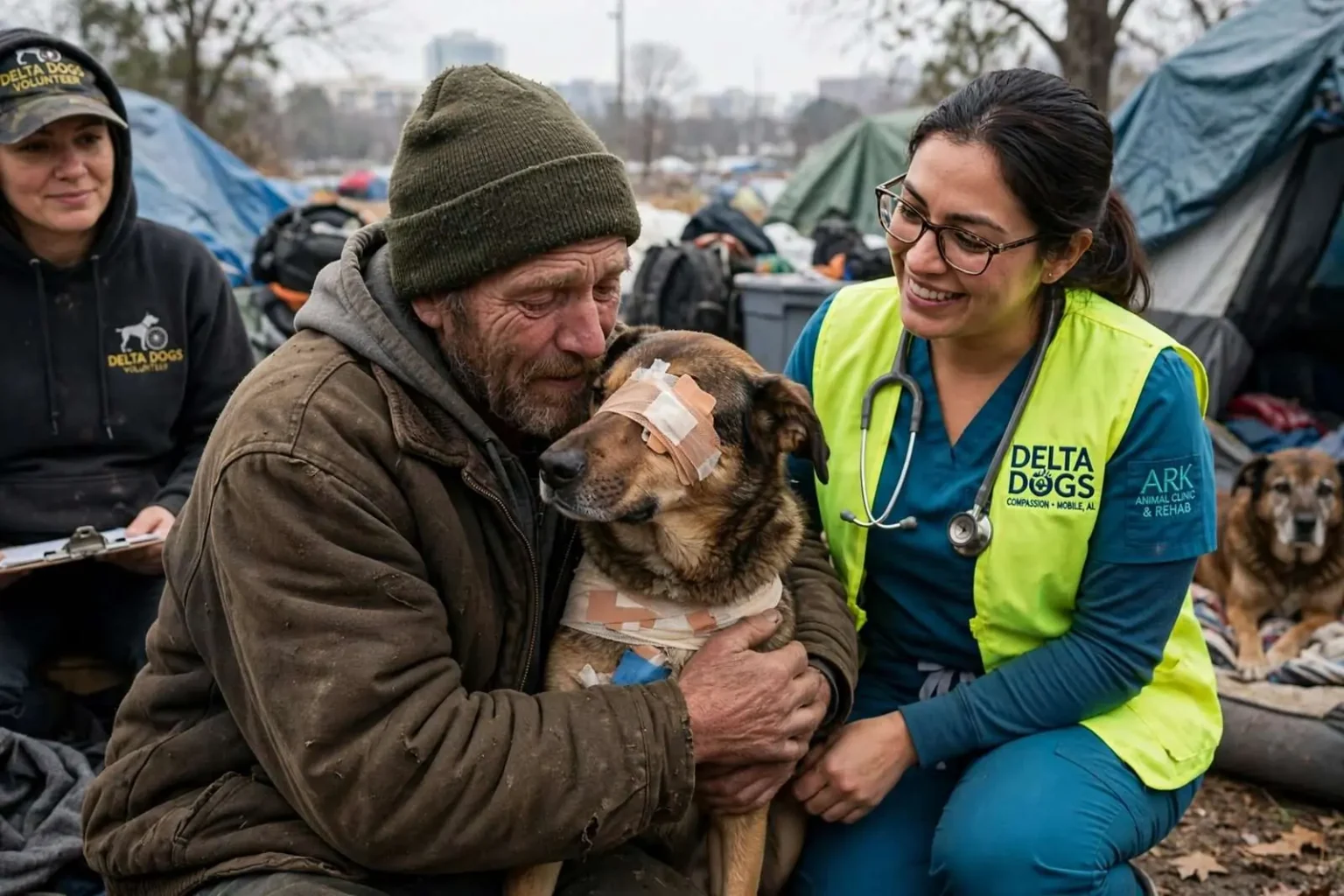
A new volunteer effort in Mobile is showing that compassion for animals often goes hand in hand with compassion for people. Delta Dogs, a service organization launched as a partner project of the Delta Bike Project and Ark Animal Clinic and Rehabilitation Center, made headlines in mid-January after helping reunite a homeless Mobile man with his badly injured dog.
James Gardner, 51, has lived outdoors in a Mobile encampment for roughly 16 years, sharing his tent with his mixed-breed dog, Seven, and the dog’s mother. Seven was given to Gardner by his late wife, Margaret, who died in 2013, and the dog has since become one of the few constants in Gardner’s life.
For people living on the street, a pet is rarely a simple matter of companionship. A dog provides protection at night, warmth on cold nights, and a routine that gives shape to days that otherwise have none. Outreach workers in Mobile and in cities across the country have long observed that homeless individuals with pets will often decline shelter beds rather than give up their animals, because most shelters cannot accommodate them. That trade-off — housing versus the animal — is one of the hardest choices service providers ask anyone to make, and it is precisely the gap Delta Dogs was created to help close.
Earlier this year, an accident left Seven with severe injuries to his chest and eye during a stretch of bitterly cold weather, with overnight temperatures dropping into the teens. Delta Dogs volunteers learned of Seven’s condition and arranged for immediate treatment. Veterinarian Dr. Jennifer Eiland and her staff at Ark Animal Clinic in west Mobile performed emergency surgery on the dog and oversaw several days of recovery.
The cold snap that framed the injury was the kind that endangers animals and people alike along the Gulf Coast, where homes and streets alike are built for a warm climate. For a dog living in a tent, exposure to temperatures in the teens is a medical emergency in itself, and the chest and eye injuries Seven suffered would likely have proved fatal without surgery. The speed with which volunteers moved — learning of the condition, arranging treatment, and getting the dog to a clinic — made the difference.
A reunion instead of an intake line
Once Seven was well enough to travel, Eiland and other Delta Dogs volunteers personally returned him to Gardner rather than routing him through a shelter or rescue intake process. The reunion, described by those present as emotional, brought Gardner’s small found family back together — Seven, his mother, and a second dog belonging to a fellow encampment resident.
The decision to return the dog directly was a deliberate one. Standard animal-welfare practice would have taken Seven into a rescue system — intake, evaluation, foster placement, adoption screening — a process designed to find a new home for an animal, not to preserve the home he already had. Delta Dogs’ founders argued that the home Seven had, in a tent with a man who loved him, was worth protecting, and that the correct outcome was a repaired dog and a repaired family rather than a rehoming.
Gardner, who does occasional work as a plumber, said he was moved that a group of strangers would go to such lengths for an animal belonging to someone living outside the traditional social safety net. His words captured the organizing idea behind the project: that the bond between a homeless person and a pet is real and worth honoring, and that a community’s treatment of its most vulnerable residents includes how it treats the animals they depend on.
According to Delta Dogs co-founder Jennifer Greene, the organization put out a call for donations on social media to help cover Seven’s veterinary costs and received an outpouring of community support, raising several hundred dollars in less than a day. Greene said the response reflected a broader community interest in supporting Mobile’s homeless population and the animals that often serve as their closest companions.
The speed of the fundraising mattered practically as well as symbolically. Emergency veterinary care of the kind Seven required runs into hundreds of dollars before treatment even begins, and neither Gardner nor the young organization had that kind of money on hand. The social media appeal turned the cost of one dog’s surgery into a shared community expense, spread across dozens of small donations, and demonstrated that the project could raise money quickly enough to say yes to the next emergency.
From bikes to veterinary care
Delta Dogs grew out of the Delta Bike Project, a Mobile nonprofit that has focused on providing bicycles and mechanical support to residents in need, and represented an expansion of that mission into veterinary care and pet support services for homeless and low-income pet owners in the Mobile area.
The connection between the two efforts is less unlikely than it might sound. The bike project has always worked at the intersection of transportation and poverty, supplying a practical tool — reliable mobility — to people who cannot afford one, along with the repair knowledge to keep it working. Pet support for homeless owners addresses a parallel need: the animal is often the most important relationship in a person’s life on the street, and helping keep that relationship intact removes one of the biggest barriers that keeps people from accepting services, treatment and shelter.
Volunteers describe the model as deliberately low-barrier. There are no forms to fill out at an office across town, no requirement that a pet owner prove income or housing status before an animal in obvious distress gets help. Someone learns of an injured or sick animal, tells a Delta Dogs volunteer, and the network activates — a clinic appointment, a ride, a fundraising appeal if the costs are beyond what the project can absorb. That immediacy is what saved Seven’s case from becoming a euthanasia referral, and it is the quality organizers most want to preserve as the effort grows.
Ark Animal Clinic and Rehabilitation Center, the project’s other institutional partner, supplies the veterinary capacity that volunteers alone cannot. Its west Mobile location gives the effort a working home for examinations, surgery and recovery, and Dr. Eiland’s willingness to perform emergency work for a patient who could not pay upfront is the piece of the model that makes the rest possible. A volunteer group can find the dog, raise the money and drive the reunions, but the medicine has to come from somewhere.
Partnerships of this kind are becoming a template in other cities, where animal welfare groups and homeless outreach organizations have begun working together rather than in parallel. The logic is straightforward: a person who trusts an organization enough to let it treat their dog is a person who may later accept a meal, a medical appointment or a housing referral. Animal care becomes the point of first contact — the moment trust is established — rather than a problem outreach workers simply work around.
Organizers said they hoped the visibility from Seven’s story would help sustain the young program as it looked to assist more animals whose owners face housing instability.
Attention is a real currency for a project like this. Media coverage of a single reunion translates into volunteers, donations and names of other animals in need — the raw material a young charity needs to grow. Organizers have emphasized that Seven’s case is not unique; in encampments across Mobile there are dogs needing vaccinations, flea treatment, heartworm prevention and spay or neuter surgery that their owners cannot obtain on their own. Each of those is a smaller version of the same gap Delta Dogs exists to fill.
The broader context matters too. Mobile’s homeless population includes a significant number of people living in unsheltered encampments rather than in shelters, and among them pets are common. Traditional outreach — meals, blankets, shelter referrals — reaches many but balks at the animal question. By answering that question directly, Delta Dogs has positioned itself as a bridge between animal welfare and human services, two fields that usually operate on separate tracks.
For Gardner, the outcome was simpler than any organizational mission statement. With Seven back at his side and recovering well, he said his first plan was to take his dog for a familiar walk through downtown Mobile, grateful that a community of strangers had stepped in when his family needed it most.
The walk through downtown will look, from the outside, like any other man walking his dog on a January afternoon. But it is also the measure of what the project accomplished: an injured dog back in the tent where he is loved, his mother still nearby, and an owner who no longer has to face the streets alone.