Mobile Launches New Business Portal, Advertises Judge Openings and Sets Storage Tank Hearing
Mobile rolled out a redesigned Urban Development website, posted openings for municipal judges and scheduled a public hearing on oil storage tanks.
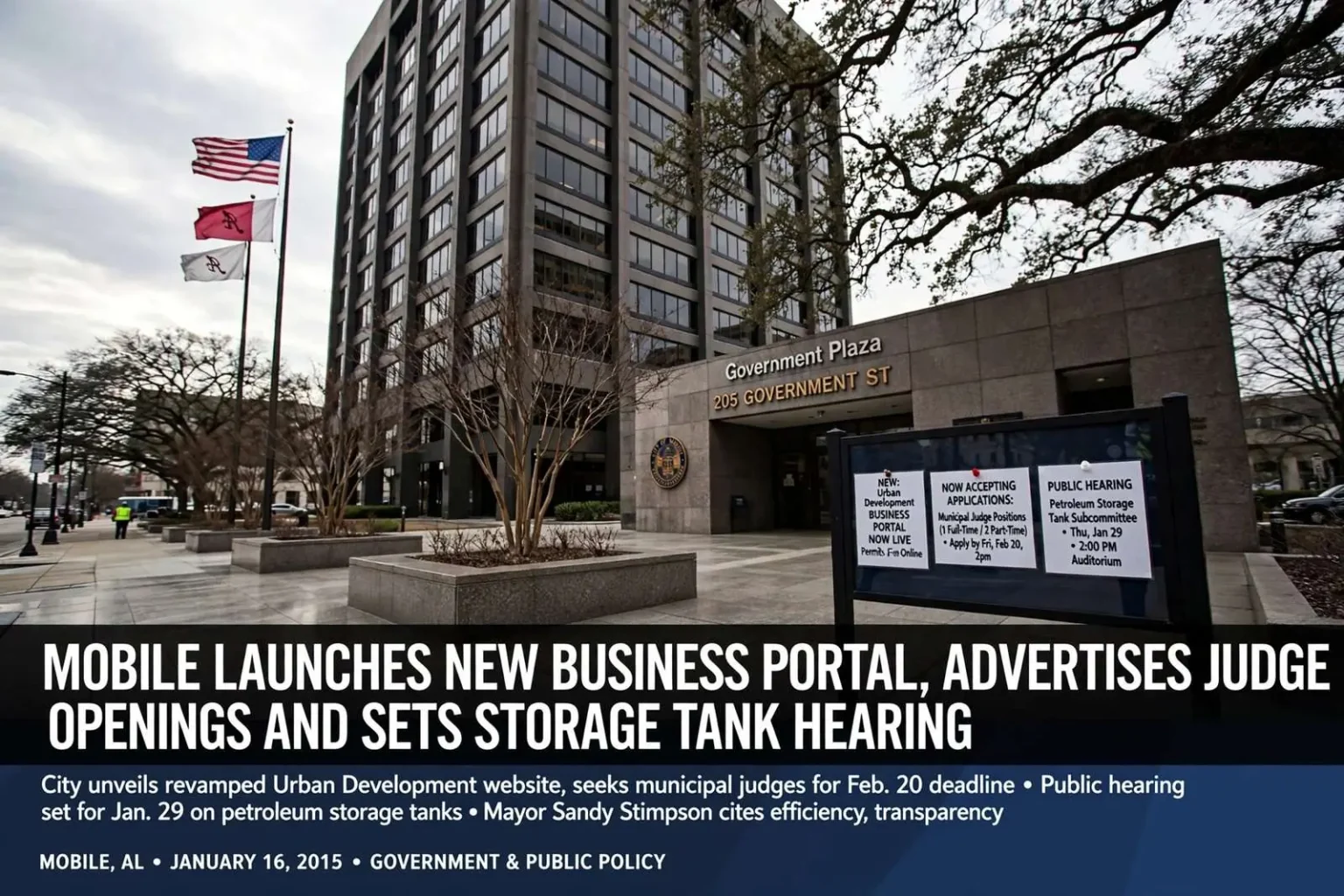
Mobile city government moved on several fronts in mid-January 2015, launching a redesigned website for its Urban Development department, advertising openings for municipal judge positions and setting a public hearing on a contentious above-ground petroleum storage tank issue. Together, the moves touched on three things residents deal with most directly in city government: how easily businesses can navigate permitting, who hears cases in municipal court and how the city regulates industrial development in its neighborhoods.
The city’s Urban Development department unveiled its new website on Jan. 16, designed to give businesses a more user-friendly way to access permitting information. Mayor Sandy Stimpson said in a prepared statement that the site represented an important first impression for companies looking to set up shop in Mobile and was part of a broader effort to streamline the permitting process for new businesses.
A new front door for permitting
The redesigned site offers downloadable applications, codes and forms for the public, along with updated contact information for staff who handle code enforcement, permitting, planning and property maintenance. For a department whose work touches nearly every construction project and property transaction in the city, the website functions as a front door, and city officials hoped that moving routine questions and paperwork online would cut down on trips to city offices and phone calls to staff.
City officials said the new site was built at no additional cost to Mobile taxpayers, a point they emphasized given the administration’s focus on fiscal discipline. Using existing staff and resources to modernize the department’s public face fit the broader pattern of Stimpson’s first term, which included a wide-ranging review of city operations aimed at finding efficiencies across departments.
The emphasis on permitting reflected a recurring theme in Mobile’s economic development pitch. Cities across the region compete for manufacturers, restaurants and retail projects, and developers routinely rank the speed and predictability of permitting among the factors they weigh when choosing a site. A business that can download the right form, find the right staff contact and understand the applicable codes without hiring an expediter has one fewer reason to build elsewhere.
Urban Development’s responsibilities span the life cycle of a property in Mobile, from the first zoning question through construction inspections, code enforcement complaints and property maintenance cases. Each of those steps generates paperwork that had previously required a visit or a call, and each is now documented and downloadable on the new site.
Openings on the municipal bench
Separately, the city announced it was accepting applications for one full-time and two part-time municipal judge positions. Interested candidates were required to submit resumes to the city clerk’s office by early afternoon on Feb. 20 to be considered for the openings, giving the city several weeks to build a pool of qualified applicants for its municipal court system.
Mobile’s municipal court handles the high-volume work of city justice: traffic cases, misdemeanor ordinance violations, code enforcement citations and other matters that arise under city law. Judges on that bench decide thousands of cases a year, and the court’s operations directly affect how residents experience city government, whether they are contesting a traffic citation or answering a property maintenance charge.
Municipal judgeships in Alabama are appointed positions, typically filled by the city council on the mayor’s recommendation, and they require candidates to be licensed attorneys with the qualifications to preside over court proceedings. Part-time positions allow the city to distribute a heavy caseload among several judges while keeping costs manageable, and vacancies like these draw applicants from across the local bar, including prosecutors, private practitioners and lawyers with experience in municipal matters.
The February deadline gave the city clerk’s office time to compile applications before the council’s selection process, which ordinarily includes review of the candidates’ qualifications and, in many appointment cycles, interviews. Whoever took the benches would join a court whose docket reflects the daily frictions of a city of roughly 200,000 people — and whose decisions on code and property cases intersect directly with the Urban Development department’s enforcement work.
The storage tank debate
Mobile’s Planning Commission also set a date for a long-anticipated public hearing on above-ground petroleum storage tanks, a topic that had drawn sustained community interest and debate. The subcommittee studying the issue scheduled a 2 p.m. meeting on Jan. 29 in the Government Plaza auditorium to hear public comments, giving residents and industry representatives alike a formal opportunity to weigh in.
Anyone wishing to address the subcommittee had to sign up with staff stationed at the auditorium entrance, and each speaker was limited to five minutes. Officials said the meeting would run no later than 5 p.m., and if not everyone on the sign-up list got a chance to speak, a second meeting would be scheduled to hear the remainder of the comments.
Above-ground petroleum storage tanks had become one of the most visible land-use disputes in the city, pitting fuel companies and terminal operators against neighborhoods concerned about safety, aesthetics and property values. Mobile’s history as a port and pipeline hub means large tank facilities have long been part of the landscape, but proposals to expand or add tanks near residential areas had generated organized opposition and, eventually, a push for clearer local rules governing where such facilities could operate and what standards they had to meet.
The subcommittee’s work sat at the intersection of several layers of regulation. Above-ground storage tanks are subject to state and federal environmental rules covering spill prevention, secondary containment and fire safety, but cities retain authority over zoning and land use — the power to decide whether a tank farm belongs next to a subdivision. Crafting local standards meant finding language that protected neighborhoods without overreaching into territory already regulated by state agencies.
Public hearings of this kind follow a familiar rhythm in Mobile’s planning process. The commission and its subcommittees gather testimony from residents, industry representatives and technical experts, then take the record back into deliberations before drafting recommendations. The five-minute limit keeps the docket moving through what planners expected to be a lengthy speaker list, and the promise of a second session signaled that officials anticipated enough interest to outlast a single afternoon.
What the three moves added up to
For all their procedural surface, the January announcements pointed in a common direction: a city government trying to make its processes more legible. A website that explains permitting, a transparent call for judicial applicants and a scheduled, structured public hearing each represented the same idea — that the rules should be published, the openings advertised and the deliberations open to the public.
Residents and businesses watching the city’s website work, the municipal court appointments and the storage tank subcommittee would see the results in different ways: faster answers on a building permit, new judges on the bench later in the year and, eventually, a recommendation on tank regulations that would shape what gets built where. Each process, begun in the same mid-January stretch, was scheduled to play out over the months that followed.
Behind the permitting push
The January 2015 timing placed the website launch in the middle of a period when the Stimpson administration was systematically reviewing how city departments operated. Early in a mayoral term, administrations often audit long-standing practices — how permits move between desks, how long inspections take, how complaints are logged — and technology upgrades tend to follow those reviews. The Urban Development site fit that pattern, turning the findings of internal process work into something the public could actually use.
For small business owners in particular, the difference between a confusing permit process and a clear one is measured in opening dates. A restaurant waiting on approvals cannot hire staff or order equipment until it knows the timeline, and each week of uncertainty adds cost. City officials framed the website as a way of shortening that fog, letting an entrepreneur in midtown or a contractor in west Mobile see the requirements before submitting anything.
The department’s four public-facing divisions each serve a distinct slice of the city’s daily business. Permitting and planning handle the prospective work — what can be built and where. Code enforcement and property maintenance handle the existing city, responding to complaints about overgrown lots, unsafe structures and violations of the city’s property standards. Publishing accurate contact information for each division was a small change, but one aimed at keeping inquiries from bouncing between offices.
What the tank hearing meant for neighborhoods
For the neighborhoods most affected by the storage tank question, the Jan. 29 hearing represented the first formal chance to put their concerns on the record in front of the body studying the issue. Residents who had attended years of community meetings on the topic were urged to sign up early, since the sign-up sheet at the auditorium entrance set the speaking order and the five-minute cap meant every slot counted.
City planning staff typically brief subcommittees on the existing regulatory landscape before taking testimony, giving speakers a common factual baseline. On the tank issue, that landscape included federal spill-prevention requirements, state environmental oversight and the city’s own zoning powers — the last of which was the focus of the subcommittee’s work. The question before Mobile was not whether tanks would exist in a port city, but under what terms new facilities could locate near homes, schools and businesses.
The outcome of such subcommittee work usually arrives as a written recommendation to the full Planning Commission, which can then forward proposed standards to the city council for adoption. Between the January hearing and any final vote would come months of drafting, legal review and further public input — a timeline that tested the patience of residents who had followed the issue for years, but one that also allowed the resulting rules to withstand legal challenge.
Connecting the three items
The same week that produced the website, the judicial postings and the hearing notice illustrates how city government actually works: several offices, acting on separate calendars, each taking a step that residents eventually experience as one thing — how easy it is to deal with the city. The applications downloaded from the Urban Development site end up as the cases municipal judges hear; the enforcement cases those judges decide trace back to the property standards the Planning Commission helps shape; and the Planning Commission’s land-use rules determine what gets permitted in the first place.
Residents interested in following any of the three threads had clear avenues to do so: the new website for permitting information, the city clerk’s office for the judicial appointments and the Planning Commission’s docket for the storage tank subcommittee’s next steps. Each was a public process by design, and each, city officials noted, began with the same mid-January announcements.