Cyclists and Pedestrians Rally for Safer Streets in Downtown Mobile
Cyclists and walkers gathered on newly paved St. Louis Street in downtown Mobile to push for safer, more bike- and pedestrian-friendly streets.
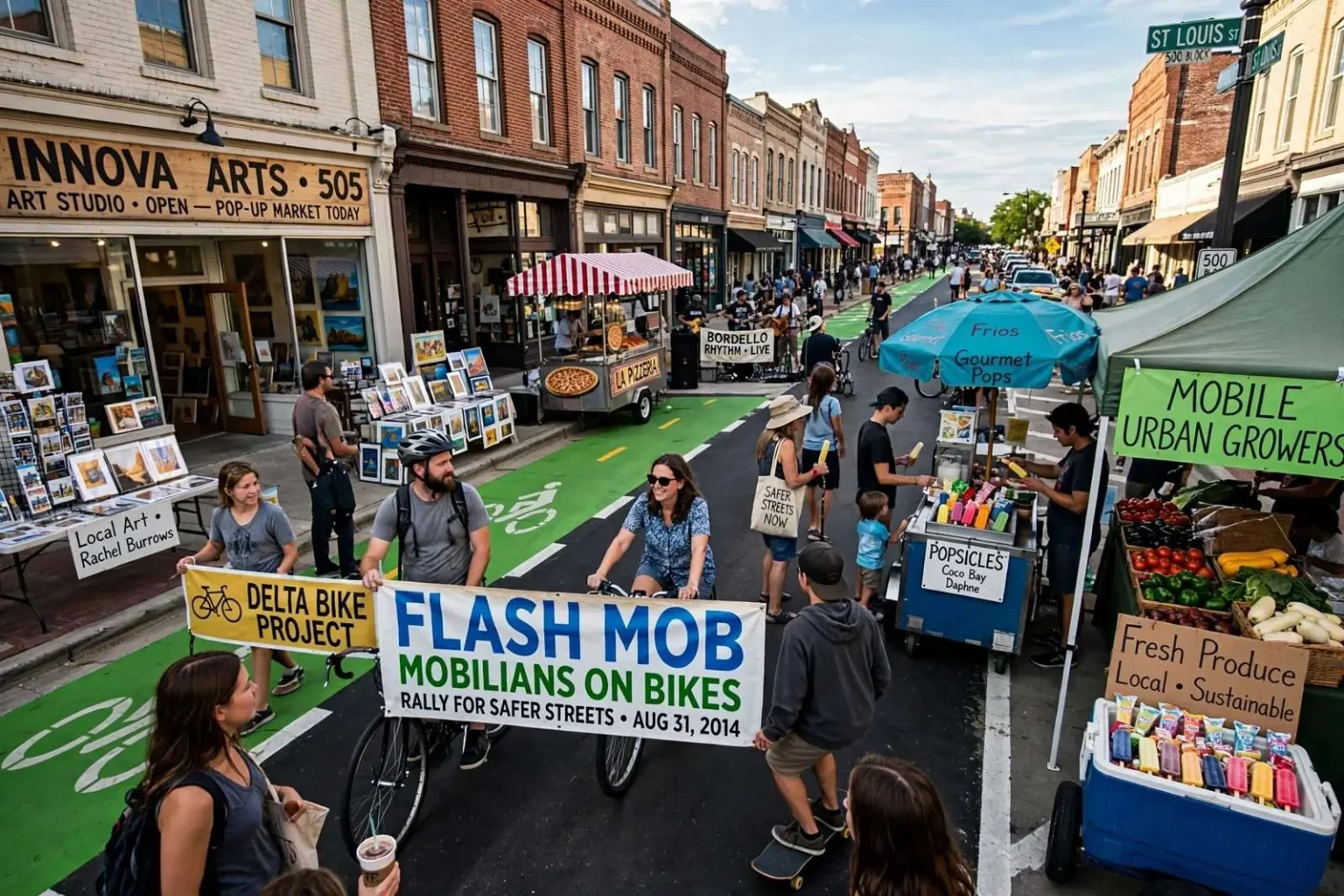
MOBILE — Downtown Mobile’s freshly repaved St. Louis Street became a gathering point on the afternoon of Aug. 31, 2014, as cyclists, walkers and skateboarders converged for a community event billed as a “Flash MOB” – a nod to Mobilians on Bikes, the advocacy group that organized the outing alongside the Delta Bike Project.
Rather than a spontaneous song-and-dance flash mob, this gathering was aimed at showing city leaders that residents care about safer, more walkable streets. Participants were asked to ride, walk or roll to a stretch of St. Louis Street in the heart of downtown at 3 p.m., where freshly striped bike lanes had already drawn attention.
The event turned a simple block of new pavement into a demonstration of what the groups argue downtown streets could be. The repaving project had given the city a clean slate on St. Louis Street, and the experimental bike lanes painted on both sides of the block offered a small-scale preview of the changes advocates hope to see spread across the downtown grid.
Jeff DeQuattro, who leads the Delta Bike Project, said the experimental lanes on both sides of that block had already proven popular with riders. He argued that Mobile has an opportunity to rethink its streets so that people on foot or on two wheels can get around safely, regardless of age or ability.
A Wish List for Safer Downtown Streets
Among the changes DeQuattro said he would like to see: additional bike lanes throughout downtown, safer marked crossings, wider sidewalks, better street lighting at night, “road diets” that narrow vehicle lanes to slow traffic, and more shaded, green spaces along city streets.
He singled out Broad Street, Water Street and Government Street as corridors that could benefit from improved crossings to better connect downtown for people not traveling by car. Each of those thoroughfares carries heavy traffic through the heart of the city, and each presents the same challenge for pedestrians: wide pavement, fast vehicles and long gaps between safe places to cross.
Other features on his wish list included curb bump-outs at intersections to slow turning traffic, physically protected bike lanes separated from vehicle travel, and sidewalks wide enough to accommodate wheelchairs and other mobility devices. The list reads as a primer on modern street design, drawing on approaches that cities across the country have adopted to reduce crashes and make walking and cycling practical choices rather than risky ones.
Protected bike lanes — separated from moving cars by curbs, planters or parked vehicles — have become the standard recommendation of cycling advocates nationwide, on the theory that paint alone rarely persuades anyone but the most confident riders to share a lane with traffic. Road diets, which convert a four-lane street into two travel lanes plus a center turn lane, have similarly been shown in study after study to reduce crashes while often improving traffic flow at the volumes downtown Mobile streets carry.
The accessibility goals in the advocates’ list extend beyond cyclists. Wider sidewalks that accommodate wheelchairs and other mobility devices, shaded green space that makes summer walking tolerable on the Gulf Coast, and lighting that makes nighttime travel safe are all measures that benefit seniors, families with strollers and visitors on foot as much as they benefit riders — part of the argument that street redesign is a quality-of-life investment for the entire city rather than a subsidy to a single user group.
A Block Party With a Purpose
The gathering doubled as something of a block party. Local artist Devlin Wilson used the occasion to open the doors of his new studio, Innova Arts, at 505 St. Louis St., while artist Rachel Burrows and others sold work at a pop-up market set up along the street. Mobile Urban Growers brought a farm stand offering fresh produce to browsers.
Food and drink vendors including Coco Bay Daphne, Frios Gourmet Pops and La Pizzeria set up for the crowd, and the band Bordello Rhythm provided live music through the afternoon. The mix of art, food and music gave the event the feel of a street festival, and the vendors’ presence made the practical argument as well: when people are comfortable lingering on a street, businesses and artists follow.
The Delta Bike Project, the nonprofit bicycle organization DeQuattro leads, has become a hub for Mobile’s cycling community, offering repair space, tools and education aimed at getting more residents on bicycles. Its partnership with Mobilians on Bikes — a group formed to advocate for better conditions for everyday cyclists in the city — reflects the two-pronged approach of the local bike movement: build the community of riders first, then press for the infrastructure to keep them safe.
Organizers said they hoped the turnout would send a signal to city hall that residents are paying attention to how downtown streets are designed, and that Mobile’s growing bike and pedestrian community wants a seat at the table as future improvements are planned. The timing was deliberate: with St. Louis Street freshly repaved and the experimental lanes already in place, the demonstration arrived while decisions about downtown’s street design were actively being made.
Downtown Mobile presents a particular opportunity for walkability advocates. The city’s historic core — laid out in a compact grid within sight of the Mobile River — was built at a scale made for walking, and revitalization efforts over the past two decades have brought residents, restaurants, galleries and entertainment venues back into the district. The gap, advocates argue, is in the connections: wide, fast corridors between the attractions that make crossing downtown on foot or by bicycle unnecessarily risky.
The 2014 event also reflected a broader national movement. Cities across the country spent the early 2010s adopting complete streets policies, testing protected bike lanes and re-examining streets engineered around automobile throughput, and the Mobile gathering inserted the Port City into that conversation. The argument advanced by Mobilians on Bikes and the Delta Bike Project was that Mobile’s historic street grid and mild climate make it a natural city for walking and cycling — provided the streets are designed to protect the people who use them.
For the participants who pedaled, walked and rolled onto St. Louis Street on the last afternoon of August, the afternoon offered a first glimpse of what those changes would look like. The freshly striped lanes on a single repaved block were small, but they were real — and the crowd that gathered around them, sample popsicles in hand with live music playing, made the case that Mobile’s streets could serve everyone who travels them, whatever they ride.
The demonstration also highlighted the economic argument that has driven street redesigns in cities across the country. Pop-up markets, farm stands and gallery openings like those on St. Louis Street that afternoon depend on foot traffic, and studies of complete streets projects elsewhere have consistently found that walkable, bikeable commercial districts support higher sales for small businesses. Advocates in Mobile framed the block party as evidence: a street redesigned even slightly for people attracted artists, vendors and a crowd, all of them spending the afternoon — and their money — downtown.
Safety data behind the advocates’ wish list is well established. Marked crossings, curb bump-outs and narrower travel lanes have all been shown to reduce vehicle speeds and pedestrian injuries, and better nighttime lighting addresses one of the most significant risk factors for serious crashes. Those interventions matter most along corridors like Broad Street, Water Street and Government Street, where the volume of traffic and the number of destinations combine to create the highest stakes for people on foot.
St. Louis Street itself gave the demonstration its setting and its symbolism. The street sits a few blocks from Bienville Square in the heart of the downtown grid, lined with historic commercial buildings and a growing roster of studios and businesses, and its fresh repaving made it the most visible canvas in the district for a conversation about what city streets are for. The experimental bike lanes — two stripes of paint on a single block — became the event’s centerpiece precisely because they showed how quickly a street can begin serving new users once the decision is made.
Mobilians on Bikes and the Delta Bike Project have continued to press the case that riders across Mobile — commuters, students and recreation cyclists alike — deserve infrastructure that matches the city’s ambitions. The Aug. 31 gathering was the movement’s most visible public moment to date: a block party, an art opening and a demonstration rolled into one, held on the one block in downtown Mobile where safer street design had just stopped being theoretical.
The afternoon closed with the same message it opened with: safer streets are a choice a city makes, block by block, and the people who ride, walk and roll downtown are ready to help make it.