Gulf Shores, Orange Beach on Pace for Another Record Tourism Summer
Strong Labor Day bookings and rising tax collections point to a fourth straight record tourism summer for Alabama's Gulf Coast.
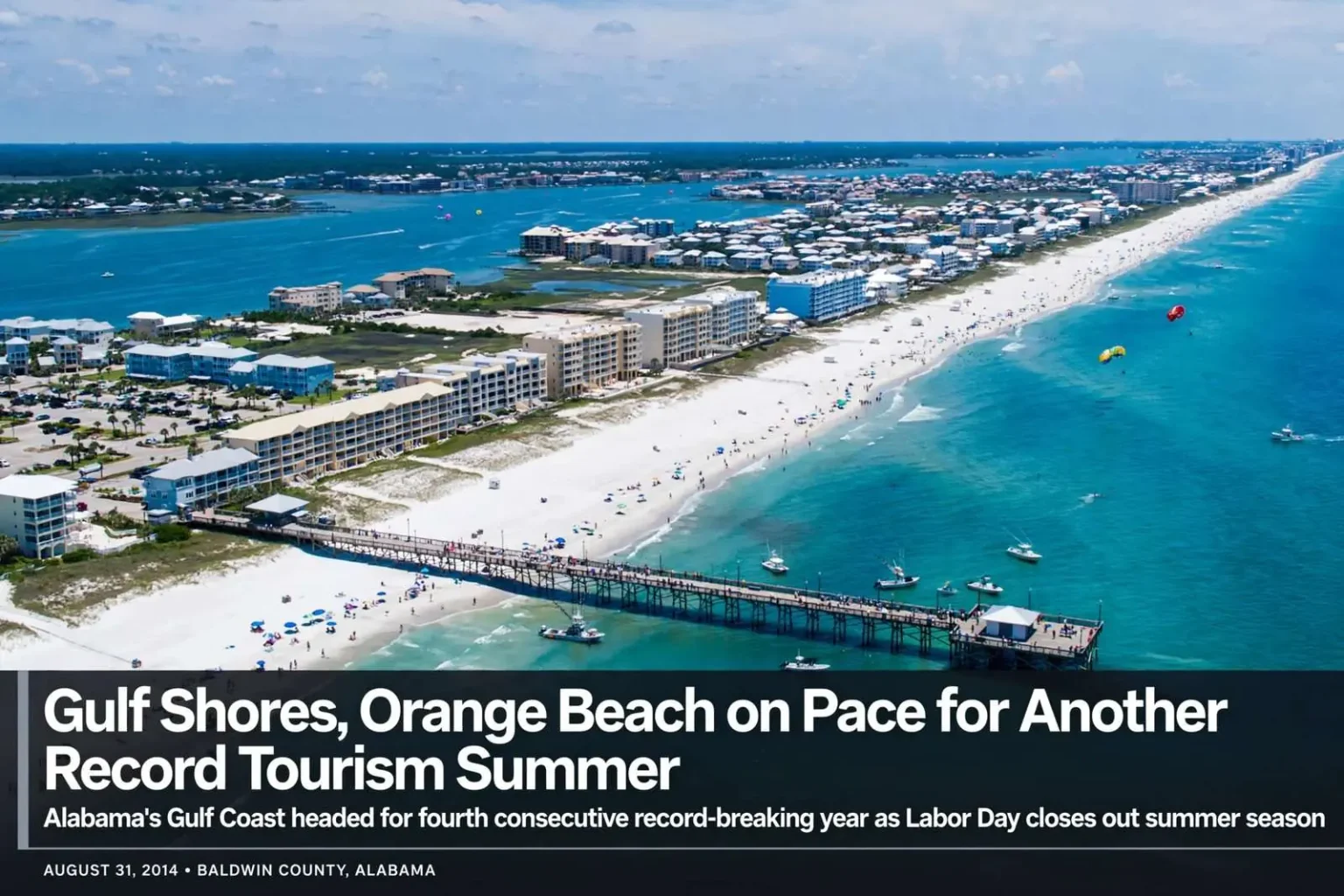
As Labor Day weekend closes out the summer season, tourism figures out of Gulf Shores and Orange Beach suggest Alabama’s Gulf Coast could be headed for its fourth consecutive record-breaking year. Sales and lodging tax collections through much of the summer are running well ahead of last year’s pace in both beach communities, even as officials caution that it is too early to declare a formal record.
The president of the local tourism authority, which markets both cities collectively, said June and July already produced record-setting tax collections, with August figures still being finalized. His office often uses early summer performance as a barometer for how the full year will shake out, and this year’s numbers have been consistently strong. If the pattern holds through the fall, 2014 would extend a remarkable run of growth for the Baldwin County beach communities, which have rebounded strongly in the years since the Deepwater Horizon oil spill disrupted the 2010 season.
In Orange Beach, sales tax collections climbed more than 11 percent through late August compared to the same stretch in 2013, adding more than $600,000 in additional revenue. Lodging tax collections in the city rose nearly 10 percent over the same period, translating into an additional $647,948 collected. Both increases point to a summer in which visitors not only filled the city’s condos and beach houses but spent freely on restaurants, shops, and entertainment along the Perdido Pass corridor and throughout the city.
Gulf Shores posted more modest but still positive sales tax growth, up 5 percent through the end of July compared to the prior year. Lodging tax collections in Gulf Shores, however, slipped by roughly 5 percent, a dip tourism officials attribute largely to a March court ruling that stripped the city of jurisdiction over a 19-mile stretch of annexed land on the Fort Morgan peninsula. That land, dotted with condominiums and rental homes, reverted to Baldwin County’s control, cutting off the city’s ability to collect lodging tax revenue there.
The Fort Morgan ruling’s impact
Tourism officials argue that without the court ruling, Gulf Shores’ lodging tax collections likely would have shown growth rather than a decline. The Fort Morgan peninsula has long been a significant part of the city’s vacation rental inventory, and the loss of jurisdiction over the annexed territory removed a sizable slice of taxable lodging activity from the city’s ledgers. The ruling does not mean fewer visitors came to the area — it means that a portion of the lodging revenue that would once have flowed to Gulf Shores now accrues to the county instead.
The March decision settled a long-running dispute over the annexation, and its budgetary consequences will shape city planning for years. Gulf Shores officials have had to account for the missing revenue as they finalize spending plans, while Baldwin County gains tax collections in an unincorporated area where it previously received little. For vacation rental operators on the peninsula, day-to-day business continues much as before, but the governmental picture has shifted.
Month-by-month data shows the pattern clearly. Orange Beach sales tax revenue rose in May, June, and July compared to 2013, with May showing the strongest year-over-year jump. Gulf Shores saw a similar spring surge, though June sales tax collections were not as strong as the months on either side of it. Even so, the overall trajectory for both cities through the heart of the summer was decisively upward, and the Labor Day holiday provided one last burst of visitors to close the books on the season.
The strength of the summer reflects a broader pattern along the Alabama Gulf Coast. The white-sand beaches of Gulf Shores and Orange Beach draw families from across the Southeast, particularly from Atlanta, Nashville, Birmingham, New Orleans, and Memphis, all within a day’s drive. The two cities have invested heavily in their tourism product over the past decade, from the Gulf State Park fishing pier and beach renourishment projects to a steady buildout of restaurants, attractions, and vacation accommodations.
Why the numbers matter
Tourism is the economic engine of south Baldwin County. Sales and lodging taxes collected from visitors fund a substantial share of local government operations in both cities, reducing the burden on permanent residents. Lodging tax revenue in particular supports beach maintenance, public safety, and marketing efforts that keep the communities competitive against destinations in Florida and Mississippi. When collections rise, the effects ripple through the entire regional economy, supporting jobs in hospitality, construction, retail, and real estate.
A fourth consecutive record year would also underscore the resilience of the Gulf Coast tourism economy. The industry has weathered the oil spill, hurricanes, and the national economic downturn in recent years, and the steady climb in collections suggests visitor confidence in the destination is at a high point. Rental property owners have reported strong booking patterns, and the shoulder seasons in spring and fall have grown longer as the area’s reputation extends beyond the traditional summer months.
Officials caution against declaring victory before all the numbers are in. August figures are still being compiled, and September through December collections can swing with weather events and the broader economy. But with June and July already in the record books and August tracking strong, the tourism authority’s leadership has reason for optimism as it begins planning next year’s marketing campaigns.
The two cities market themselves jointly in many respects, sharing a visitor bureau that promotes the 32 miles of Alabama coastline as a single destination. That cooperation has paid off in an era when destinations compete for attention in crowded regional markets. Whether measured in occupied condos, restaurant receipts, or the taxes those activities generate, the summer of 2014 has been one of the strongest on record for the Alabama beaches, and both communities enter the fall season with momentum on their side.
What it means for local residents
For year-round residents of Gulf Shores and Orange Beach, the tourism boom carries both benefits and strains. Strong collections help keep local property taxes among the more modest in the region and fund amenities that residents themselves enjoy, including parks, public beaches, and improved roads. At the same time, the seasonal influx of visitors brings heavier traffic along Highway 182, the Foley Beach Express, and the state routes that funnel travelers onto the island, and it makes summer living in the beach towns markedly busier than the off-season.
Local business owners say the strength of the summer has been broad-based, extending beyond the traditional beachfront sectors. Marinas, fishing charters, and adventure sports operators reported steady demand, while the cities’ growing calendars of festivals and concerts helped fill rooms in the shoulder weeks between peak family vacation periods. Events staged in the spring and fall increasingly serve as an extension of the high season, and city officials have leaned into that strategy as a way to smooth out the economic calendar.
The lodging tax picture in Gulf Shores bears watching as the budget year progresses. City leaders will need to absorb the loss of the Fort Morgan revenue in their long-term planning, whether through adjustments to spending, modest increases elsewhere, or continued growth in collections from the rest of the city. Baldwin County, meanwhile, will now direct the taxes collected on the peninsula, and county officials have indicated the revenue will support services in the unincorporated area.
Looking ahead, the tourism authority’s focus turns to the fall season, when the crowds thin but the weather remains mild and the fishing, golf, and festival calendars keep visitors coming. If the summer’s pace is any indication, the Alabama Gulf Coast will close 2014 with its fourth straight record year — a milestone that once seemed distant during the difficult seasons that followed the oil spill and that now reflects the steady rise of one of the region’s most important industries. Officials say final figures for the year should be available in the months ahead, and both cities will be watching closely as the books close on another strong season at the beaches.
Regional competition remains a constant backdrop. Florida panhandle communities to the east continue to invest in their own attractions, and Mississippi’s Gulf Coast casinos draw a different but overlapping visitor base. The tourism authority’s marketing strategy emphasizes what sets the Alabama beaches apart — the easy drive-in access, the family-friendly scale of the towns, and the concentration of publicly accessible beach — and the record collections suggest the message is landing with travelers who have a choice of destinations each summer.
City officials in both communities have also pointed to infrastructure as the next frontier. Continued growth places demands on roads, drainage, parking, and public safety staffing, and both cities have studied ways to manage peak-season congestion without diminishing the visitor experience. How well Gulf Shores and Orange Beach balance those pressures may determine whether the current record run extends to a fifth year and beyond.