
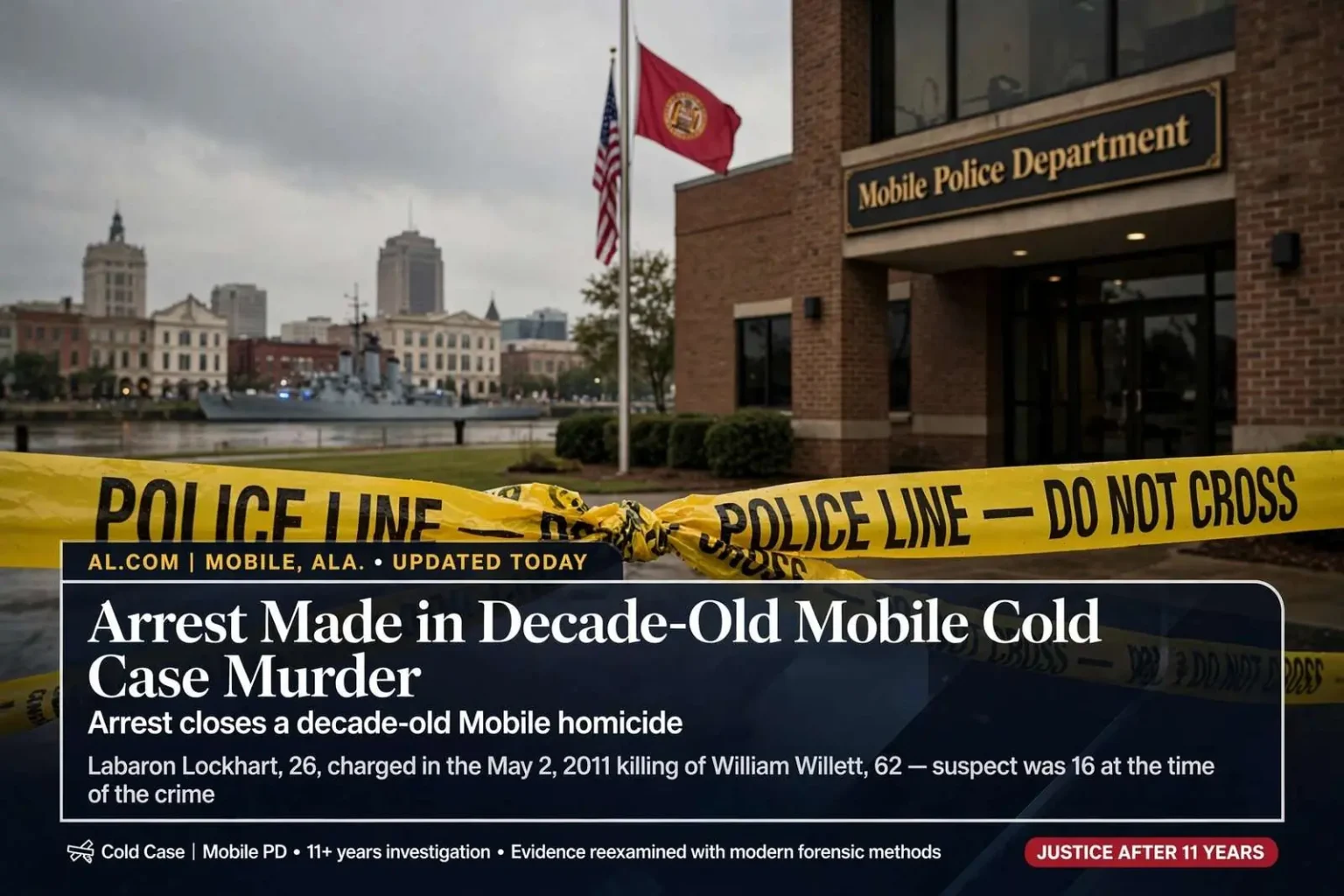
Arrest closes a decade-old Mobile homicide
MOBILE, Ala. — Police have made an arrest in a cold case homicide that went unsolved for more than a decade. Labaron Lockhart, now 26, has been accused of killing William Willett on May 2, 2011, according to the Mobile Police Department. Lockhart would have been 16 at the time of the murder, authorities said, a detail that places the case among the difficult category of homicides in which the suspect was a juvenile when the killing occurred. Willett was 62 when he was killed, a 48-year difference in age between the victim and the teenager now accused in his death.
The arrest closes a chapter that stayed open for more than eleven years, a span in which the case passed from the original investigators to the detectives who carry the city’s unsolved homicides. Cold case arrests like this one typically follow years of quiet work — re-interviewing witnesses, revisiting physical evidence as forensic methods improve and waiting for the break that finally gives prosecutors a case they can take to court. Police have not said what finally moved the Willett investigation forward.
What police have disclosed
Details on what evidence led police to Lockhart were not immediately made public by the department. Withholds of that kind are routine in homicide prosecutions, particularly in cold cases, where investigators must protect witness statements, forensic findings and the strategy of the upcoming prosecution from anything that could compromise the case. What the department has confirmed is the essential outline: an arrest, a named suspect, a charge connected to the May 2, 2011 killing of William Willett and a suspect who was a minor when the crime occurred.
Cold case detectives have long worked to revisit unsolved homicides across the city with the help of evolving forensic techniques and new witness testimony. The unit’s work reflects a broader reality of homicide investigation: a case that stalls in its first months does not necessarily end there. DNA methods have advanced dramatically since 2011, databases have grown, and witnesses who kept silent years ago sometimes come forward when circumstances change. Detectives in Mobile and across the country have used each of those developments to revive cases that once seemed closed for good.
The suspect’s history with the courts
According to Mobile Metro Jail records, Lockhart has cycled through the jail system on multiple occasions since the 2011 murder for various drug-related and other offenses. That record means he has been in and out of the local justice system repeatedly during the same years the Willett case sat unsolved — a pattern not uncommon in cold case arrests, where the person ultimately charged was well known to law enforcement for other reasons long before the homicide charge arrived.
Authorities have not clarified whether those prior arrests were connected in any way to the still-then-unsolved homicide investigation. The question matters for how the case developed: sometimes a suspect surfaces through evidence tied directly to the crime, and sometimes a fresh charge gives investigators leverage to revisit old conversations. Police have not said which path applied here, and the department’s disclosure stops at the jail records themselves.
The long arc of the case
For William Willett’s family, the arrest arrives more than a decade after the May morning in 2011 when his life ended in Mobile. Families of homicide victims frequently describe the cold case years as a suspended state — the case neither solved nor closed, with periodic contact from investigators but no answer to the central question of who was responsible. An arrest reopens that passage, this time moving toward a courtroom, where the evidence gathered over eleven years will be tested in public.
The case also joins the wider ledger of Mobile’s unsolved homicides, a list the police department’s cold case unit works continuously. Each arrest on an old case serves a purpose beyond the individual prosecution: it signals to witnesses in other stalled investigations that time does not extinguish a case, that evidence can be resubmitted and reinterpreted as science improves, and that detectives remain willing to act on what they find years after a crime. Anyone with information about the original 2011 killing of William Willett is asked to contact the Mobile Police Department or leave an anonymous tip with CrimeStoppers of the Gulf Coast.
How cold cases move again
The mechanics of a cold case arrest are worth understanding, because the Willett case followed a path familiar to detectives across the country. A homicide that cannot be closed in its first year is placed in the unsolved file, where it remains assigned to a cold case squad rather than abandoned. Those detectives periodically re-review the file, looking for three kinds of openings: new forensic analysis that older methods could not perform, witnesses whose circumstances or loyalties have changed since the original investigation, and connections between the victim or the crime scene and other cases that have since been solved.
Forensic science has been the most powerful of those openings. Since 2011, DNA interpretation has advanced to where samples once too small or too mixed to yield results can now be analyzed, and genealogical techniques have allowed investigators to identify suspects through relatives who appear in public DNA databases. Evidence preserved from old scenes — stored for exactly this reason — can be reexamined years later with tools that did not exist when the crime occurred. Whether any of those methods produced the break in the Willett case has not been disclosed.
Prosecuting an old case
An arrest in a decade-old homicide opens a second, distinct challenge: building a prosecution from aged materials. Memories fade, witnesses move or die, and the defense will probe every gap the years have opened. Prosecutors who take cold cases to trial lean on the physical and documentary evidence that survives — lab results, records, statements captured in writing — and on the testimony of the original investigators who can walk a jury through the file. The age of the case shapes every strategic decision from charging through trial.
The juvenile question adds another layer. Because Lockhart would have been 16 at the time of the killing, the case sits at the intersection of homicide law and the rules governing juvenile offenders charged as adults, a territory that Alabama courts have addressed in significant rulings over the years. Sentencing frameworks for offenders who were minors at the time of their crimes are narrower than for adults, and those constraints will shape the prosecution’s approach as the case proceeds.
CrimeStoppers and community tips
The department’s request for information about the original 2011 killing continues even after an arrest, because investigations often broaden once a suspect is charged. Anyone with information about the murder of William Willett is asked to contact the Mobile Police Department or leave an anonymous tip with CrimeStoppers of the Gulf Coast, the regional tip line that has operated for decades across the central Gulf Coast. Anonymous tips flow to investigators without revealing the caller’s identity, and CrimeStoppers programs pay rewards for tips that lead to arrests in qualifying cases.
Tip lines have become an essential part of how Gulf Coast homicide cases get solved. CrimeStoppers of the Gulf Coast takes tips by phone and online around the clock, strips identifying information before passing anything to investigators and allows reward payments to be collected without revealing who provided the lead. That structure encourages people who would never walk into a precinct to share what they know, and detectives in Mobile have repeatedly credited anonymous tips with breaking cases that had sat dormant for years.
That channel matters in cases like this one. Homicides are most often solved through people — someone who saw something, heard something or heard about it afterward — and the eleven-year gap between the crime and the arrest suggests that information eventually reached investigators from somewhere outside the original evidence. Every additional piece of information now serves the prosecution, and police have made clear that the request for the public’s help did not end with the arrest.
A pattern across the city
Mobile’s experience with cold case arrests mirrors that of cities across the region and the country. Unsolved homicides accumulate in every major city, and the passage of time hardens the challenge even as new tools soften it. Departments that maintain dedicated cold case units — as Mobile does — consistently produce arrests in cases that are five, ten and twenty years old, and each one demonstrates the same principle: an unsolved case is a case still open, still assigned and still capable of producing an answer.
For the Willett family, the years between May 2011 and this arrest were long ones, and the road ahead runs through the courts rather than around them. The arrest of Labaron Lockhart, 26, for the killing of 62-year-old William Willett brings a decade-old case to the threshold of a resolution it has never had. What the evidence shows, and what a jury makes of it, will be the next chapter in a Mobile homicide file that sat open for more than eleven years.
