Mobile County Commissioner Resigned Amid 2008 Seat Dispute
Mobile County Commissioner Merceria Ludgood resigned in August 2008 after court and attorney-general actions affected the District 1 seat she had won in a special election.
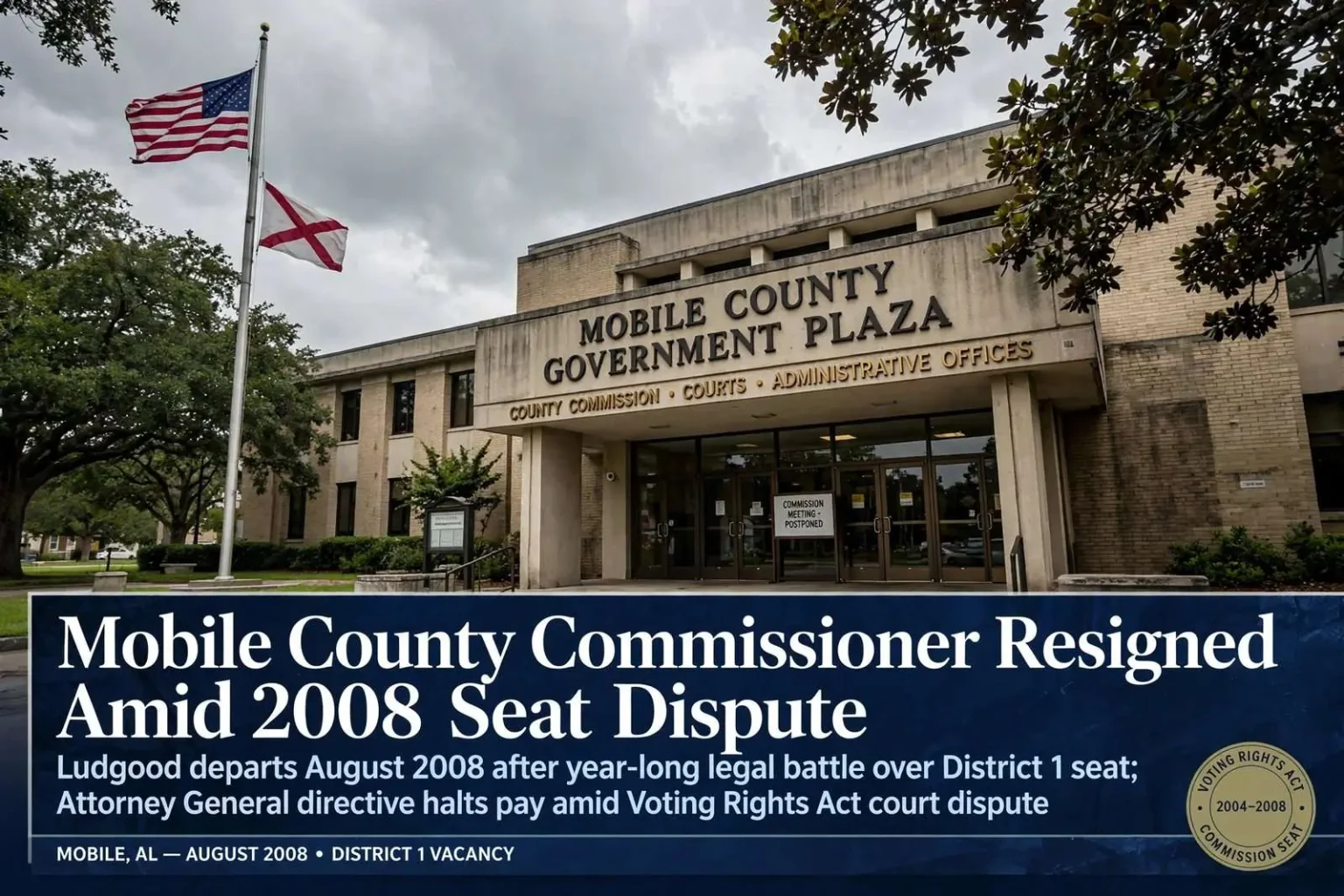
Mobile County Commissioner Merceria Ludgood resigned in August 2008 amid a prolonged legal dispute over the District 1 commission seat. The resignation capped more than a year of courtroom wrangling over who legitimately held the post — a fight that reached from a Mobile courtroom to the Alabama Attorney General’s office and turned one county commission seat into the most closely watched political story on the Gulf Coast.
Ludgood had won a 2007 special election after a judicial panel removed Juan Chastang from office. The panel had concluded that Gov. Bob Riley’s appointment of Chastang violated the Voting Rights Act, but later court action favored Riley’s position, leaving the question of the seat’s rightful occupant hanging over the county government through months of appeals and procedural rulings.
The dispute was never a minor spat. District 1 encompasses much of the City of Mobile and a substantial share of the county’s population, and its commissioner casts one of three votes on a body that controls county roads, planning, health department funding and the region’s largest local budget. Every month the seat’s ownership stayed unresolved was a month of uncertainty for a government that had to keep functioning.
The Legal Tangle Over District 1
The roots of the conflict reached back to 2004, when Commissioner Sam Jones ran for mayor of Mobile and left the District 1 seat vacant. Riley appointed Chastang to fill the post, a routine exercise of the governor’s authority that soon proved anything but routine. Challenges to the appointment moved through the courts for years, centering on the Voting Rights Act’s requirement that certain changes to voting law and procedure in jurisdictions like Mobile County receive federal preclearance.
A three-judge panel ultimately sided with the challengers, concluding that the appointment process as carried out violated the Voting Rights Act, and ordered a new special election to let the district’s voters settle the matter themselves. That special election, held in 2007, was won by Ludgood, a longtime public servant in Mobile County government who took office with the blessing of the courts at the time.
But the legal question did not end at the ballot box. Later court action favored Riley’s position, breathing new life into the argument that Chastang — and not the special election winner — was the seat’s lawful holder. Attorneys for each side pressed their interpretations while the commission met week to week, and by the summer of 2008 the competing claims had produced two threads of authority over the same office: an election result on one side and a court ruling on the other.
Resignation Followed Legal Action
After Attorney General Troy King instructed county officials to stop paying Ludgood, she turned in her county vehicle and credit card and left the office. The instruction cut off the practical machinery of the job — salary, expenses and official resources — and left Ludgood holding a title that a state legal opinion no longer recognized, even as the underlying litigation continued.
Her response to the pressure was measured. She said she was not claiming a legal right to remain in the position, but did not want the departure characterized as being forced from office. The distinction mattered to Ludgood, whose public career in Mobile County spanned decades and whose reputation rested on service rather than self-interest; resigning under protest preserved her standing to seek the seat again.
King’s intervention also placed county government itself in an awkward position. Commissioners and county personnel had to decide whose signature counted on official documents, whose name belonged on the commission dais and how to handle agenda items that touched District 1, all while the courts had not issued a final word on the seat.
A Vacancy Expected to Be Temporary
The report said the vacancy was expected to be temporary, with Chastang seeking to return and Ludgood planning another run for the seat in November. In other words, neither camp treated the August departure as the end of the story — it was one turn in a saga both sides believed would be settled by the voters before the year was out.
That expectation shaped the political calculations on both sides. Chastang positioned himself as the rightful appointee seeking restoration of an office he had held for years, while Ludgood prepared to take her case back to District 1 voters, running on the special-election mandate she had already won once. County residents watched a legal argument slowly convert itself into a campaign.
For the commission’s day-to-day work, the temporary nature of the vacancy eased the disruption. The remaining two commissioners could transact the county’s routine business, and district services — road maintenance requests, constituent casework, community grants — continued through the county’s professional staff while the seat’s representation waited on the courts and the calendar.
The Voting Rights Act Stakes
What made the Mobile County dispute notable far beyond the Gulf Coast was the federal law at its center. Section 5 of the Voting Rights Act requires covered jurisdictions — including Mobile County — to obtain federal approval, or preclearance, before making changes that affect voting. The judicial panel’s conclusion that Riley’s appointment process violated the Act placed Mobile County’s dispute inside one of the most consequential legal frameworks in American election law.
Civil rights advocates and election law scholars tracked the case because its outcome touched on how appointments to local offices interact with federal voting protections. For Mobile County residents, the stakes were more concrete: the question of whether their District 1 commissioner should be chosen by the governor’s pen or by the voters of the district itself.
The episode also demonstrated how long such questions can remain unsettled. From the 2004 vacancy through the 2007 special election to the August 2008 resignation, the District 1 dispute spanned four years, multiple courts, an attorney general’s ruling and a special election — all for a single seat on a three-member county commission.
Ludgood’s Career and Standing
Merceria Ludgood brought deep experience to the office she held under contested circumstances. A Mobile native with a career in county administration and public service, she had spent years in Mobile County government before seeking the commission seat, and her special-election victory in 2007 reflected both her professional standing and the district’s appetite for a proven public servant.
Her handling of the August 2008 exit reinforced that image. By turning in the county vehicle and credit card promptly after the attorney general’s directive and declining to claim a legal right to remain, she kept the dispute focused on the courts rather than on her own conduct. Her insistence that she not be characterized as forced from office, and her immediate plans to run again in November, made clear that she viewed the episode as a pause in her service rather than an end to it.
What the August 2008 Record Shows
This account documents the legal and political circumstances reported in August 2008. It does not describe subsequent election results or the current composition of the Mobile County Commission. Readers seeking the outcome of the November contest or the later history of the District 1 seat should consult records from the elections that followed, which settled the question this story leaves open.
What the August 2008 record does establish is a portrait of county government under unusual strain: a commissioner resigning under an attorney general’s payment directive she disputed in spirit but honored in practice, a governor’s appointee seeking restoration through the courts, and a judicial panel’s Voting Rights Act ruling colliding with later court action favoring the governor’s position. The convergence of those forces left the seat vacant, the litigation alive and the electorate waiting.
The story also illustrates the machinery of Alabama county government at work during a crisis. A three-member commission cannot simply pause when one seat is contested; roads still get inspected, budgets still get administered and constituent services continue. Mobile County’s ability to keep functioning through the District 1 dispute — with two commissioners and a professional staff carrying the load — was the quiet background to a loudly contested political and legal fight.
For District 1 residents, the summer of 2008 was a lesson in the intersection of local politics and federal election law: a county seat worth fighting over, fought over through every available avenue — the ballot, the courtroom and the attorney general’s office — while the people the district represented watched the process unfold and prepared to have the final word in November.
By any measure, the District 1 dispute of 2004 through 2008 ranks among the most consequential controversies in modern Mobile County government, and the August 2008 resignation of Merceria Ludgood stands at its center — the moment when a year of litigation caught up with the office itself and pushed the decision back to where the judicial panel first said it belonged: with the voters of District 1.