Money Gap Yawns in Mobile County’s District 1 Commission Race
Democratic nominee Merceria Ludgood held a nearly 100-to-one fundraising lead over Republican Juan Chastang heading into the Oct. 9 special election to restore the Mobile County Commission to full strength.
If fundraising foretells anything, the Mobile County Commission was about to seat only its second woman ever, and its first in nearly two decades.
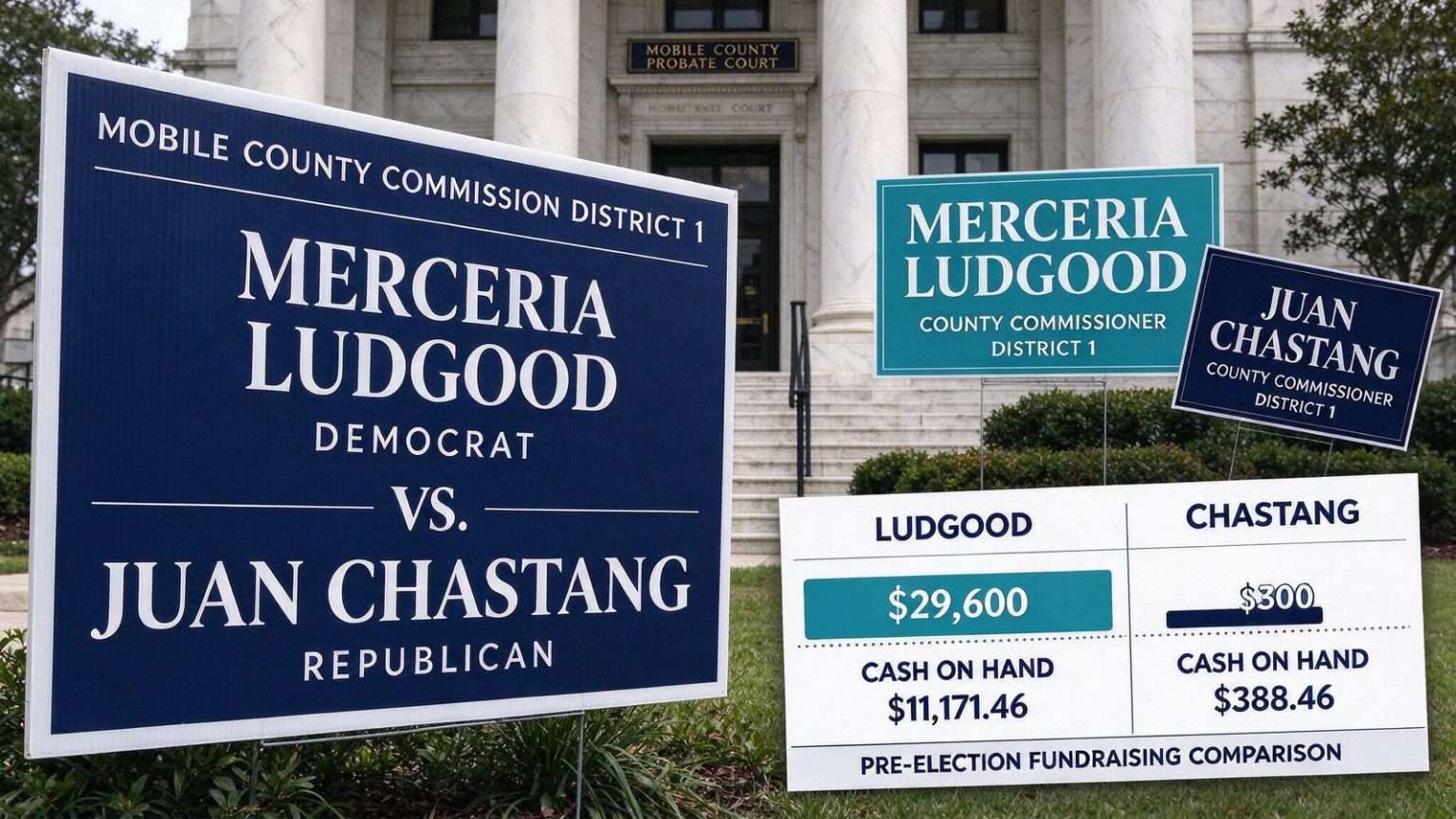
Democratic nominee Merceria Ludgood reported a commanding lead in contributions over Republican nominee Juan Chastang — $29,600 to $300, a margin of nearly 100 to one — in the five-to-10-day pre-election financial disclosures filed with Mobile County Probate Court.
Voters were to go to the polls Tuesday, Oct. 9, to elect a District 1 commissioner and restore the three-member commission to full strength.
The disclosure documents themselves follow an old Alabama ritual. In the final stretch before any county or state election, candidates file their five-to-10-day reports with the probate judge’s office, and anyone who wants to read them can walk into the courthouse and do so. In a race like this one, the filings functioned as the real campaign narrative — more revealing than any speech about which interests had invested in which candidate, and by how much.
An Oct. 9 election date put the contest in an unusual slot, weeks after the regular primary season had ended and in the middle of the county’s budget year. Special ballots like this one draw modest turnout, which magnifies the value of exactly the advantages Ludgood’s report showed: paid canvassers, committee endorsements and a donor network that could keep her name in front of voters through the final stretch.
The disparity in the ledgers was hard to overstate. In a local race, $29,600 is real money — enough for radio, direct mail and a paid canvassing operation across a district that spans much of the city of Mobile and its surrounding communities. Three hundred dollars is not a campaign; it is a filing fee’s worth of activity. Whatever else the Oct. 9 election would decide, the money made clear which candidate had the backing of the district’s political and civic establishment.
Two Candidates, Neither a Newcomer
Chastang was the most recent District 1 commissioner, but he was not running as an incumbent. Gov. Bob Riley had tapped him to fill the vacancy created when Sam Jones was elected mayor of Mobile. Chastang was ultimately ousted when federal authorities declared the appointment invalid — a consequence of the federal oversight that has long governed how vacancies in this majority-Black district may be filled, under a consent decree rooted in the Voting Rights Act.
That history set the rules of the race. The consent decree, born of decades of voting-rights litigation over how Mobile County filled commission vacancies, required that the seat’s fate belong to the voters rather than to a gubernatorial appointment. Chastang’s tenure, however brief, had been the appointment the federal courts rejected — which meant his run this fall was, in effect, his first chance to win the office outright at the ballot box.
Ludgood was no novice either. A longtime assistant county attorney, she was not retained earlier that year when her contract came up for renewal before the two-member commission then in office — Commissioners Stephen Nodine and Mike Dean, both Republicans. She knew the county’s business from the inside, and the circumstances of her departure gave her candidacy an edge.
The irony was not lost on observers: the commission’s action had, in effect, set free the person best equipped to run against the district’s nominees. Ludgood’s years in the county attorney’s office meant she could walk into any department, any budget hearing or any road project dispute and speak the government’s language fluently — an advantage no amount of spending could buy her opponent.
The Ledgers
Chastang opened the reporting period with $448.46 on hand. He raised $200 in cash contributions — a single donation, from Cecil Tanner — plus $100 in non-itemized contributions. He spent $360 and entered the final days of the campaign with $388.46.
Ludgood opened with just over $3,000. She raised $29,600 in itemized and non-itemized cash contributions, spent $21,437.64, and had $11,171.46 remaining as Election Day approached.
Her donor list read like a map of Mobile’s Democratic and civic networks. Alabama Citizens for the Environment PAC gave $6,150 and ACE PAC another $3,000. TRD PAC contributed $5,000. The Mobile County Democratic Executive Committee gave $1,000, as did James E. Nevels, Goodwyn Mills and Cawood PAC, Clarence M. Ball Jr., and Mr. and Mrs. R.L. Smith Jr.
Health care interests connected to Ball — Ball Healthcare Services, Ball Healthcare Inc., Twin Oaks Nursing Home and Hi-Tech Medical Services — gave $500 apiece.
Other contributors included state Rep. James Buskey’s campaign fund, Aladems County PAC, Citizens for Better Roads PAC and the Eastern Shore’s political networks, along with individual donors including Tom Delchamps, Roland C. McRae, Margie L. Lee, Doris J. Ladd, John Cain, Reggie Copeland Jr. and former state legislator Mary Zoghby.
Among the campaign’s expenses was $2,050 to former state Rep. William Clark for canvassing.
Read together, the contributors told a story: labor and environmental PACs, the county party, the city’s Democratic legislative establishment, health care interests, and a who’s-who of Black Mobile’s civic leadership — the network that had sustained the district’s politics for a generation. The paid canvassing operation, run through a veteran of the Legislature, meant the money would not just buy advertisements but actually turn out voters door by door, the traditional currency of a Mobile district race.
The PAC names on the report also mapped the policy terrain of the office itself. A roads-focused PAC invests in a county commissioner because commissioners divide paving contracts and set road priorities. An environmental PAC invests because commission votes touch drainage, zoning and development across the county. Health care operators invest because the commission funds the health department and shapes the regulatory climate for care facilities. In Mobile County, those are not incidental interests — they are the daily business of the office, and the donors’ presence on the report reflected that.
Chastang’s report told the opposite story: no committees, no party apparatus, no paid staff — a campaign running on its candidate’s name recognition from his months in the seat and whatever personal effort $388.46 could fund.
What a Win Would Mean
Ludgood, if elected, would become only the second woman ever to serve on the Mobile County Commission. Oliveth Archer served from 1985 to 1989.
Archer’s single term had come and gone a generation earlier, but it established the precedent that a woman could hold countywide executive power in Mobile — chairing meetings, controlling agenda items and casting the votes that moved the county’s money. Ludgood’s candidacy arrived in a different era for women in Alabama public life, with women already leading in city halls and legislative delegations across the state, yet the county commission — with its roads, budgets and courthouse traditions — had remained untouched by that shift since Archer left office.
That gap — nearly two decades between the county’s first female commissioner and its second — said something about the office itself. The commission has historically been a club of a very particular kind: three seats, decided district by district, filled by men whose names stuck to buildings, roads and courthouse traditions. A woman taking a seat would change the composition of county government in a way no single election to the Legislature could.
The commission’s work is unglamorous and consequential: county roads, the budget, the sheriff’s funding, appointments to authorities and boards that shape development across a county of more than 400,000 people.
With only two commissioners seated, every decision had required both of them to agree — an arrangement that concentrated power and slowed the county’s business.
That two-member interlude deserves a moment of attention, because it shows what the third seat is actually for. With Nodine and Dean — both Republicans, both from districts outside District 1 — holding the only votes, a single disagreement could stall the county’s business entirely, and the county’s fastest-growing constituencies had no commissioner of their own at the table. Restoring the third seat meant restoring representation for a district that is home to a large share of the county’s population, and returning the commission to the three-vote arithmetic that forces coalition-building rather than unanimity.
For District 1’s voters, the Oct. 9 election was therefore about more than one office. It was about who would sit at the table when the county divided its road money, negotiated with the city over services, appointed members to the port and industrial development authorities, and set the tax-supported budget that funds the sheriff’s deputies who patrol the district’s neighborhoods. Fundraising totals do not decide those questions. But they previewed, with unusual clarity, which candidate would arrive at the table with a network behind her — and the ledgers said it would be Ludgood.
Ludgood won the election and went on to serve on the commission for many years, becoming one of the most influential figures in Mobile County government.