Historical report, published from archived local news coverage.
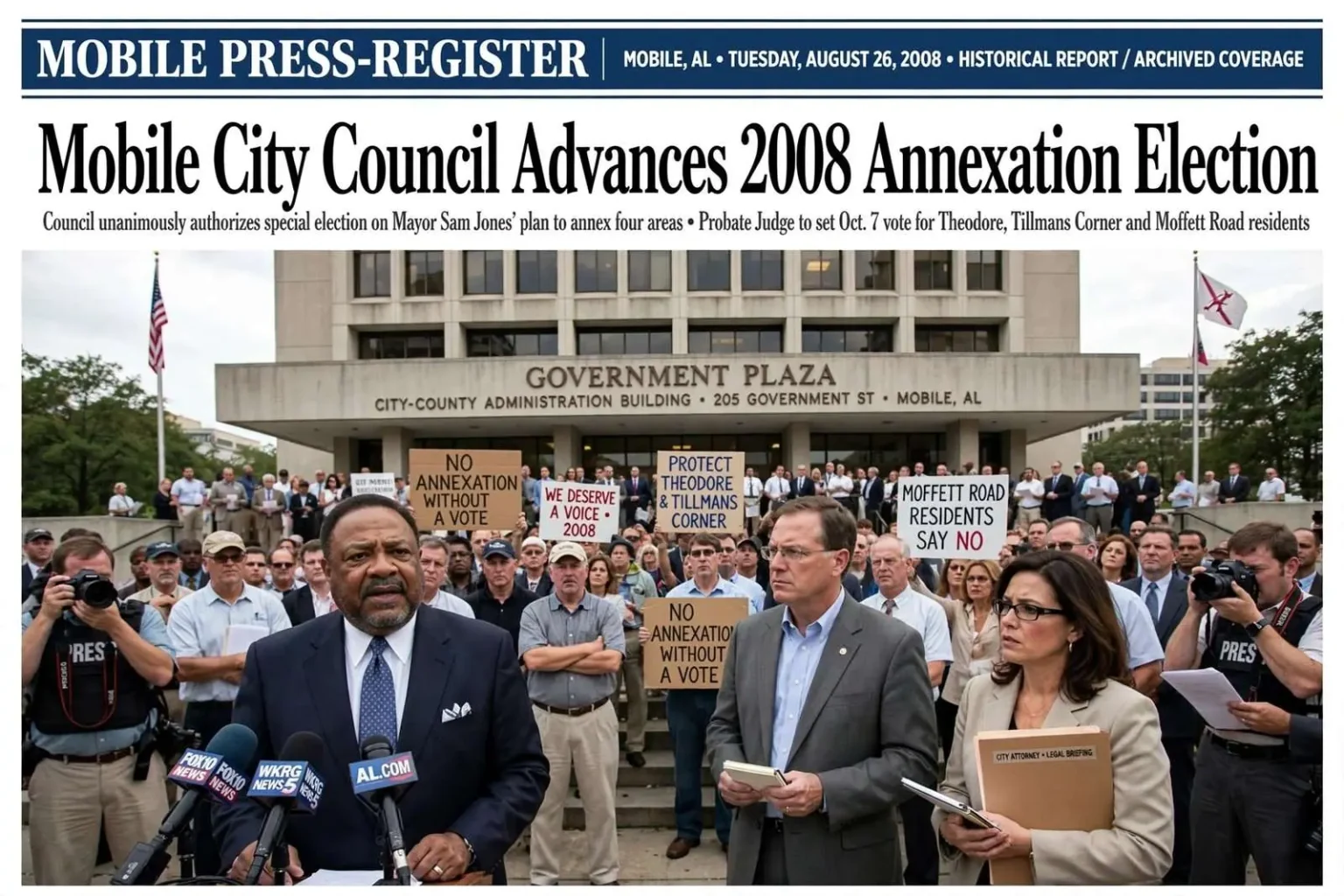
On Aug. 26, 2008, the Mobile City Council unanimously authorized a special election on Mayor Sam Jones’ proposed annexation plan, setting in motion one of the more consequential debates of the era over Mobile’s growth and its boundaries. The proposal sought to add four areas to the city, including portions of Theodore, Tillmans Corner and Moffett Road — communities in unincorporated Mobile County where residents had long lived outside city limits while depending on the region’s economy and infrastructure.
The council’s action did not itself annex anything; it authorized a vote. Probate Judge Don Davis was to set the election date, and only residents within the proposed annexation lines would be eligible to cast ballots — a legal structure that became one of the plan’s central controversies. The authorization followed weeks of public argument over whether the city should expand, who should decide, and what residents in the affected areas would actually gain or lose by joining Mobile.
A packed house at Government Plaza
Public interest in the plan ran high. More than 300 people attended a meeting at Government Plaza to express their views on the proposal, packing the downtown chamber in numbers that made the stakes visible to every council member in the room. Speakers included residents of the affected communities, city officials, and critics of the plan, and the tone of the session reflected a genuine division rather than a formality.
The proposal drew criticism from several local elected officials, whose objections added institutional weight to the opposition. Some argued that the city was pursuing expansion without the consent of everyone its decision would affect — including businesses located inside the proposed lines and residents whose communities would be reshaped by the boundary change without receiving a vote. Others questioned the timing and the city’s motives, framing the annexation as a revenue question dressed as a services question.
City officials defended the plan on legal and practical grounds. City attorney Larry Wettermark said the proposal was based on Alabama law, which governs how municipalities expand and who participates in annexation elections. Mayor Sam Jones, who had proposed the expansion, framed it as a matter of fairness and opportunity: the city would give people who wanted to join Mobile the chance to vote, and those who did not wish to be part of the expansion could say so at the polls — at least, the polls within the proposed lines.
The annexation debate in context
The 2008 dispute was the latest chapter in a decades-long tension in Mobile County between the city and its unincorporated outskirts. Communities like Theodore and Tillmans Corner in the southern part of the county, and the areas along Moffett Road to the northwest, sat in a gray zone: close enough to Mobile to share its economy, its traffic, and many of its services, but outside its tax base and its municipal government.
For the city, annexation meant population, tax revenue, and a stronger claim on state and federal funding formulas that reward municipal size. For residents of the affected areas, the calculation was more mixed. Annexation promised access to city police and fire protection, city courts, and municipal services, along with city property taxes added to county ones. Critics in 2008 questioned whether the promised services would offset the new tax burden, and whether the city’s inclusion of commercial corridors suggested that revenue, not representation, was driving the map.
The eligibility question sharpened everything. Under the Alabama law the city relied on, only residents living within the proposed annexation lines could vote on the measure — meaning Mobilians outside the lines, and county officials whose budgets and jurisdictions would be affected, would have no ballot. Critics argued that businesses and other affected residents would not all have a voice, a complaint that echoed through the Government Plaza meeting and beyond.
The mayor’s case and the legal framework
Mayor Sam Jones, Mobile’s first African-American mayor, had made growth a theme of his administration, and the annexation plan represented his most ambitious move in that direction. His position at the time was straightforward: people who wanted to join Mobile deserved the chance to vote on it, and the city deserved the chance to make its case. The council’s unanimous authorization of the special election suggested that, whatever reservations individual members held about the plan itself, the consensus held that a vote was the proper next step.
The legal architecture behind that vote was rooted in state law. Alabama’s annexation statutes lay out the procedures by which municipalities expand — petition-driven, election-driven, and legislative routes among them — and the rules for who votes in each. City attorney Larry Wettermark’s assurances that the proposal was based on Alabama law were aimed directly at critics who questioned the process; the administration’s argument was that the city was following the framework the Legislature had provided, not inventing its own rules.
With the council’s authorization in place, attention shifted to Probate Judge Don Davis, whose office was responsible for setting the election date. The judge’s role underscored the procedural nature of the moment: nothing had been annexed, and nothing would be unless the voters inside the lines approved. The election’s outcome would depend on turnout within the four proposed areas — a practical problem for the mayor’s team, since opposition to annexation among the affected residents ran visibly strong.
What the four areas meant
The geography of the proposal explained much of the politics. Portions of Theodore and Tillmans Corner sit along the southern corridor of the county, where U.S. 90, U.S. 43, and I-10 carry heavy commercial traffic and where decades of suburban growth had blurred the line between Mobile and its unincorporated neighbors. The Moffett Road area to the northwest anchored a similar pattern along U.S. 45, another growth corridor radiating from the city. Annexing portions of these communities would have drawn Mobile’s boundaries deep into the county’s populated edges, extending city services — and city taxes — into neighborhoods that had defined themselves by their independence from City Hall.
Business interests featured prominently in the debate because the proposed lines, critics said, appeared to follow commercial corridors as closely as residential ones. Sales and property tax from businesses along those routes would flow to the city if annexation passed, strengthening Mobile’s balance sheet while leaving some affected business owners without a vote on the change. That asymmetry — taxation by map rather than by consent — became the plan’s most persistent criticism among its opponents.
County officials raised parallel concerns. Sheriff’s patrols, fire districts, and county services stretched across the affected areas, and shifting them into the city would redraw responsibilities and budgets at the county level. The elected officials who criticized the plan spoke from those vantage points, arguing that the city’s proposal treated unincorporated Mobile County as a resource to be drawn down rather than a set of communities to be consulted.
A debate frozen in place
This account describes the debate and the council’s action as they stood in August 2008 — a historical record of a moment, not a report on the proposal’s later outcome. What the archived coverage preserves is the shape of the argument: a mayor offering a vote to those who wanted in, a council unanimously agreeing to hold one, a city attorney anchoring the process in state law, and hundreds of residents packing Government Plaza to argue that the plan reached too far and asked too few.
The issues on the table that summer — growth versus identity, revenue versus representation, who votes and who merely pays — have never really left Mobile County. Every subsequent discussion of annexation, incorporation, and municipal boundaries in the region echoes the questions raised in 2008, when four areas of the county came closer to the city than they had ever been, and the community turned out in force to say exactly how it felt about the distance.
How annexation fights play out in Alabama
The intensity of the 2008 debate made more sense against the backdrop of Alabama municipal law. Unlike some states that require countywide or regional approval for boundary changes, Alabama’s framework generally lets annexations proceed through mechanisms confined to the affected territory — which is precisely why opponents in Mobile focused their anger on the map and the electorate rather than on abstract policy. When the decision can be made by a narrow slice of the public, every detail of where the lines run and who falls inside them becomes the whole fight.
That structure also explains the administration’s confidence. City attorney Larry Wettermark’s insistence that the proposal rested on Alabama law was not a side comment but the core of the defense: if the lines were drawn according to statute and the election conducted under statute, the city’s position was legally sound even if it remained politically contested. The gap between legal validity and public legitimacy — a recurring theme in annexation battles across the state — was exactly the space in which the Government Plaza critics operated.
Neighboring communities watched the Mobile fight closely for their own reasons. In unincorporated Mobile County, the alternative to annexation has always been incorporation — forming a new municipality to keep the area’s tax base and its identity out of the city’s hands. The 2008 proposal, by threatening to absorb portions of Theodore and Tillmans Corner, gave residents of those communities a concrete reason to organize, and the decades-long history of incorporation efforts in south Mobile County traces back through episodes exactly like this one.
The city’s growth imperative
For Mobile’s leadership, the case for expansion was ultimately about arithmetic. Cities lose population to their suburbs in census counts when residents move just outside the line, and federal and state formulas distribute money by counted population. Every annexed household and business strengthened Mobile’s position in those formulas, and the administration of Mayor Sam Jones viewed the four proposed areas as growth that was already functionally part of the city — people who worked in Mobile, shopped in Mobile, and drove Mobile’s roads — being counted as if it belonged to no one.
The counterargument was that “functionally part of the city” did not mean “wanting to be part of it.” Residents of Theodore, Tillmans Corner, and the Moffett Road corridor had organized their lives around county services and unincorporated status for generations; many had moved there precisely because it was outside the city. Annexation, from their standpoint, was not an invitation but an alteration — one that arrived with a tax bill and, for some, no ballot at all.
The council’s unanimous vote to authorize the election did not settle that tension; it deferred it to the campaign that would follow. Whatever the eventual result of the proposal, the August 2008 session captured both sides at full strength: a city government unified behind its right to ask the question, and a public crowded into the chamber to argue that the question itself had been asked of the wrong people.
Why the 2008 fight still matters
Annexation debates compress every major question of local government into one map: who pays taxes, who receives services, whose votes count, and how a city defines itself as it grows. Mobile’s 2008 proposal put all of those questions on the table at once, in front of a crowd of 300 at Government Plaza and an audience of county residents watching to see how far City Hall would reach.
The archived record of that moment — the unanimous vote on Aug. 26, the criticism from local elected officials, Wettermark’s reliance on state law, Jones’ promise of a vote for those who wanted in, and Judge Don Davis’ pending task of setting the date — preserves the terms of a debate that has never fully closed. Every subsequent proposal to move Mobile’s boundaries, and every effort by unincorporated communities to incorporate in response, has been conducted in the shadow of the same questions residents raised that summer.