Historical report, published from archived local news coverage.
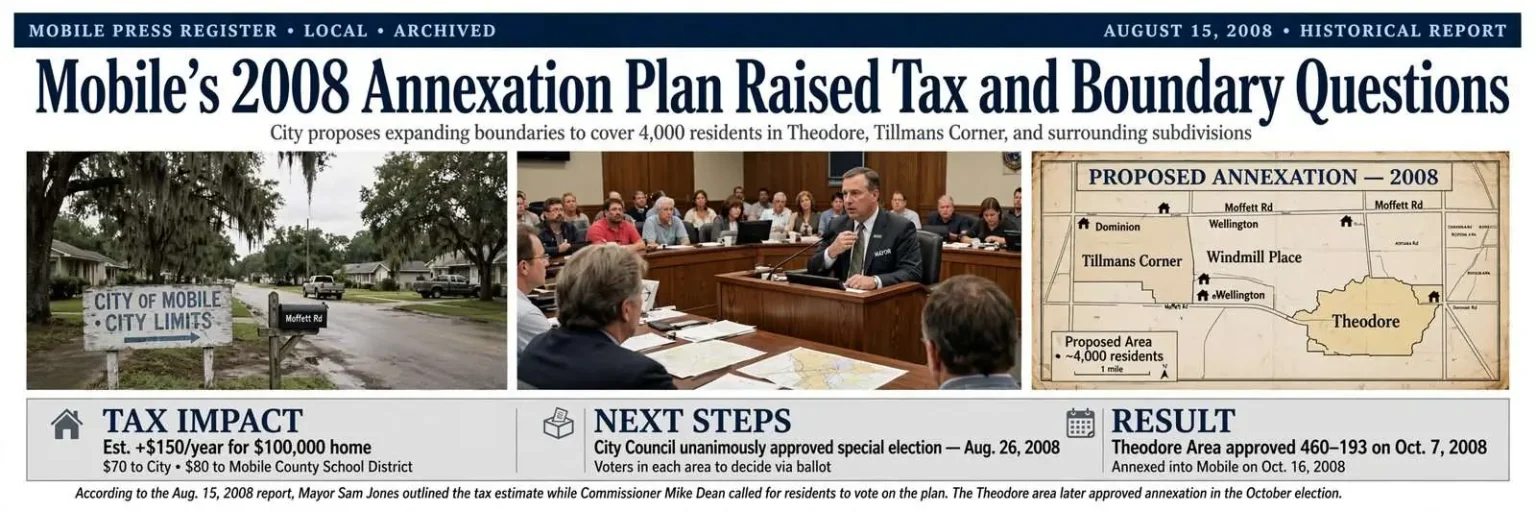
An archived local news report from Aug. 15, 2008, described Mobile’s proposed annexation plan and the debate it prompted among residents and local officials. City leaders said more than 4,000 residents were included in a plan covering parts of Theodore and Tillmans Corner, Moffett Road, and the Windmill Place, Dominion and Wellington subdivisions — pockets of unincorporated Mobile County that would cross the city line if the proposal moved forward.
The proposal touched one of the most durable tensions in Mobile County politics: the relationship between the city of Mobile and the sprawling unincorporated communities around it. Theodore and Tillmans Corner, south of the city, and the Moffett Road corridor to the northwest, have for decades existed in a gray zone — county addresses, county services, but economies and daily life deeply tied to Mobile. Annexation proposals periodically seek to formalize that relationship, and each one reopens the same arguments over taxes, representation and identity.
Who Was Included — and Who Cared
The map’s details mattered enormously to the people inside it. More than 4,000 residents stood to become Mobile citizens, with the areas named in the report spanning both southern suburbs and western corridors. Residents of named subdivisions such as Windmill Place, Dominion and Wellington faced a concrete question: did the services and identity of cityhood outweigh the tax bill that came with it?
The archived report captured both answers. One resident whose property sat along the city line told the station she preferred being in the city, reflecting the view of those who expected better services, clearer code enforcement or simply the civic standing of a Mobile address. Another homeowner and business owner opposed the anticipated tax increases, voicing the equally common calculation of property owners who felt they already paid for what they needed through county fees and private arrangements.
That split — neighbor against neighbor along the proposed boundary — is the defining feature of virtually every annexation fight in Alabama. Property owners with larger parcels or commercial holdings tend to see the property-tax math most starkly; residents on smaller lots often weigh garbage collection, street lighting, police response and fire protection more heavily. Neither side in the 2008 debate was unusual; both represented positions Mobile County voters have taken for decades whenever the city’s map has crept outward.
The Tax Math on the Table
The report said Mayor Sam Jones described an estimated annual increase of $150 in property taxes for a $100,000 home, with $70 going to the city and $80 to the Mobile County School District. Jones said the revenue would support city services. The numbers gave residents a concrete basis for decision-making: on a typical modest home, the cost of joining the city would run roughly the price of a family dinner out each month, with more than half of the increase directed to schools rather than city hall.
That breakdown illustrated how annexation taxation actually works in Mobile County. A newly annexed property typically picks up the city’s millage while the school district’s share — already levied countywide — continues or adjusts according to the district’s structure, meaning the city itself collects only part of the visible increase. The mayor’s framing emphasized what the city’s portion bought: police and fire response integrated into the municipal system, city street maintenance, sanitation and the other services that come with a Mobile address.
Opponents read the same numbers differently. A business owner’s opposition, as reported, reflected the way commercial property multiplies assessed value — and therefore tax increases — compared with a residence. For a business holding property assessed at commercial rates, even a modest millage shift can amount to a substantial annual expense, and owners argue they receive services they were already sourcing privately or through county arrangements.
Political Fault Lines
Mobile County Commissioner Mike Dean criticized the proposed map and called for residents to decide whether to join the city. The commissioner’s intervention placed county government squarely in the debate and echoed a long-running principle in annexation disputes: that people should not be absorbed into a city without a vote of their own. County commissioners, whose districts include the unincorporated territory the city sought to absorb, have historically been protective of those constituents — both out of representation and out of institutional interest, since annexation removes property and population from the county’s base.
The Election Question
The prospect of a special election carried its own significance. Alabama annexation elections historically hinge on turnout: the affected residents often vote at low rates, while the city’s existing electorate is not always entitled to weigh in on the expansion depending on the legal route used. A special election over annexation in 2008 would have required the council to balance timing, cost and the political appetite for a campaign that would have put tax increases and city identity on every mailbox in the affected areas.
The council’s expected consideration of an election date also reflected the mayor’s posture. Rather than pursuing a purely legislative or petition-based absorption, the process under discussion appeared to lean toward giving residents the vote Commissioner Dean demanded — the more defensible path politically, though one that gives opponents a forum to organize.
How This Debate Fits Mobile County’s History
The 2008 proposal belongs to a long sequence. Mobile has expanded through annexations repeatedly across its history, absorbing developed county territory in waves — westward along Airport Boulevard, south along the bay, northwest along Moffett Road. Each wave produced the same arguments heard in this report: services versus taxes, county identity versus city identity, and the commissioner-versus-mayor institutional friction that surfaces whenever the city eyes unincorporated neighborhoods.
Theodore and Tillmans Corner themselves have periodically debated incorporating as cities of their own — a movement that gains strength precisely when annexation proposals appear, since residents who prefer neither option see their own cityhood as the alternative. The interplay between Mobile’s expansion ambitions and the southern communities’ incorporation talk has shaped Mobile County politics for generations, and the August 2008 report sits inside that larger story.
Commissioner Dean’s demand — that residents decide — echoed positions taken by county officials across multiple decades of annexation debates, and the mayor’s emphasis on modest tax math echoed city officials across the same decades. In that sense the report documented not a new fight but a recurring one, fought this time over 4,000 residents and three named subdivisions.
The Unanswered Question
This historical account does not address the proposal’s eventual outcome. The archived report ends where daily coverage ends: with a council expected to consider an election date, a mayor’s tax estimate on the record, a commissioner’s objection on the record, and residents on both sides of the line quoted in their own words.
What remains documented is the snapshot itself — an August 2008 moment when more than 4,000 residents of Theodore, Tillmans Corner, the Moffett Road corridor and the Windmill Place, Dominion and Wellington subdivisions were weighing a $150-a-year question about who their city would be. The tax figures, the split among neighbors, the commissioner’s call for a resident vote and the council’s pending decision together form the historical record of how the debate stood on that date, preserved here from the archived local news coverage in which it first appeared.
Reading the Numbers Like a Local
It is worth pausing on how the $150 estimate was received in context. Mobile County property owners had lived through reassessment debates and millage fights of their own, and a 0.15-percent-of-value framing — $150 on a $100,000 home — is the kind of number both sides in an annexation fight can use. Supporters could say the cost of city police and fire integration amounted to about $12.50 a month; opponents could say the increase lands forever, compounds with future city rate decisions, and arrives without a guarantee of service improvements at the individual address.
The split between the city’s $70 and the district’s $80 also illustrates why school districts track annexation so closely. City growth changes the district’s tax geography without changing its obligations, and school funding arguments have shaped countywide tax referendums in Mobile County for decades. A mayor explaining annexation in 2008 knew the school share had to be stated plainly — because voters would ask.
And the presence of a business owner among the opponents foreshadowed the commercial question that runs through every Alabama annexation: cities want commercial corridors because they generate sales tax, while those corridor owners face the largest property-tax consequences of crossing the line. That tension — between a city’s fiscal interest in a corridor and an owner’s cost calculus — recurs in Mobile County annexation debates to this day, and the August 2008 report recorded it in its plainest form: one neighbor in, one neighbor out, on the same map.