Residential street in Mobile, AlabamaA Mobile-area residential street.

Historical report, published from archived local news coverage.

Days before Mobile’s Oct. 7, 2008, annexation referendum, an archived local news report described criticism of the city’s promotion of the proposal in one of the targeted areas.

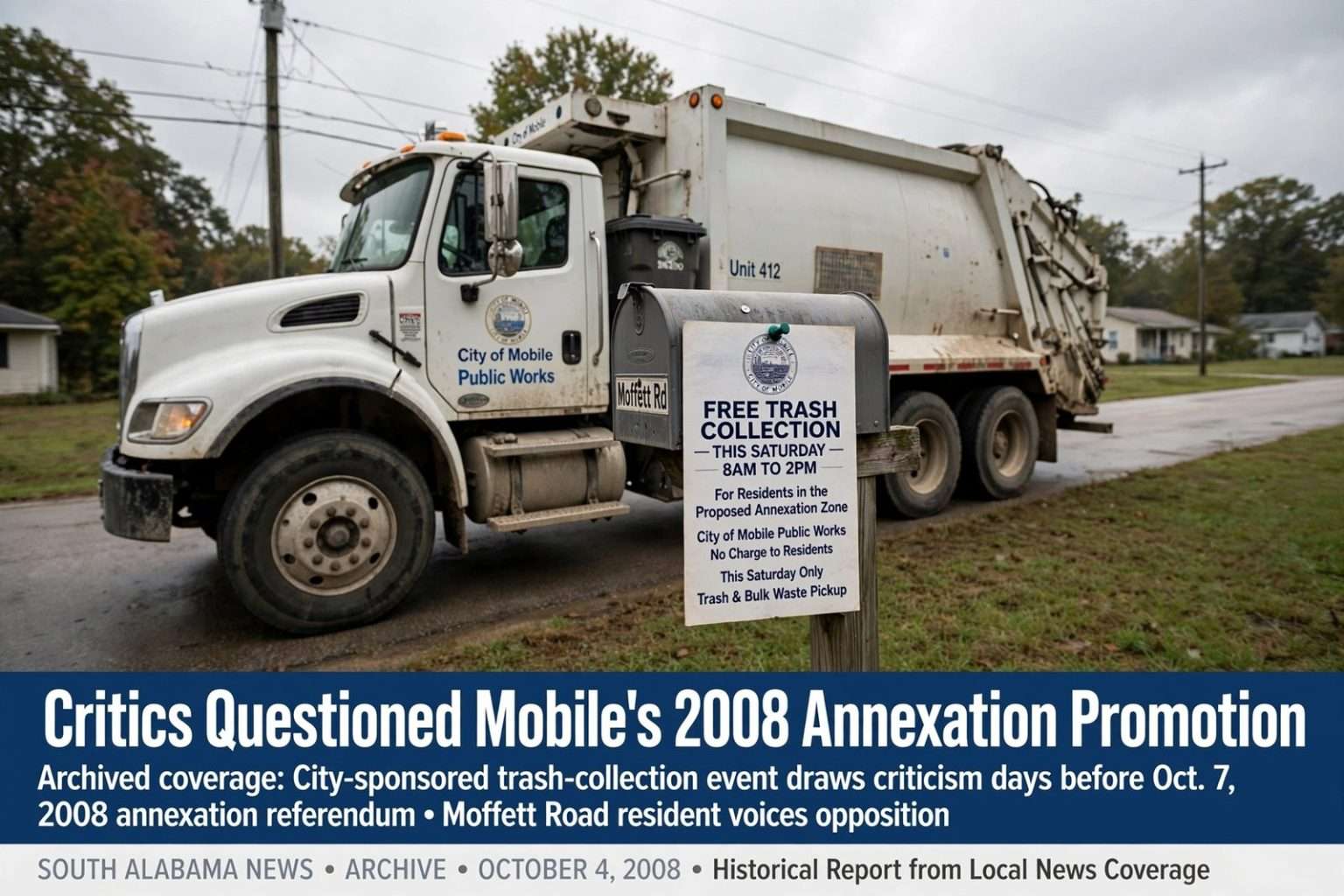
The report said postcards promoted a free Saturday trash-collection event for residents in a proposed annexation zone. Critics questioned the use of city tax dollars and city workers for the event, arguing that it was intended to influence the vote.

The fight over the mailboxes

The dispute centered on a familiar instrument of modern annexation campaigns: the demonstration of municipal services. Postcards mailed into the proposed annexation area advertised a free Saturday trash-collection event, with city crews and city equipment doing the hauling — a vivid, hands-on exhibit of what life inside the city limits could look like for households that had been hauling their own trash for years.

To supporters, the event was exactly what a service demonstration should be: a taste of the goods on offer before an election asked residents to accept them permanently. To critics, the same event looked like campaigning conducted with public resources — city tax dollars paying workers and trucks whose labor was aimed, in substance, at winning votes. The report captured that tension as it played out in the days before the referendum, with both sides agreeing on what the event was meant to accomplish and disagreeing on whether that aim was legitimate.

Among the residents quoted in the coverage was Bobbie Graham, a Moffett Road resident, who said she planned to vote against annexation.

The city’s answer

The mayor’s office declined an on-camera interview but maintained that the effort was legal.

Spokesperson Barbara Drummond said trash collection was a service not provided to residents of the proposed annexed area and that the event was meant to help educate them about the service.

The education framing is the standard municipal defense in these disputes. Cities argue — and have prevailed on the argument before — that informing residents of unincorporated areas about the services available to them is a legitimate public function, particularly when a referendum will decide whether those services, and the taxes that fund them, will extend to those very residents. The critics’ counterargument is equally standard: that the line between education and electioneering disappears when the public demonstration lands in mailboxes on the eve of the vote.

An earlier dispute in Theodore

The report also noted prior criticism over city crews working at private property associated with a Theodore event encouraging residents to vote.

See also  Kim Family Releases Third Video of Alleged Hazing at Davidson High School as Final Juvenile Appears in Court

The Theodore episode followed the same pattern in a different setting. Rather than a collection event, the criticism involved city crews performing work at private property connected to a community gathering organized to encourage residents to vote on annexation — the same charge, that city resources were being deployed in the service of the city’s own referendum campaign, leveled in a different part of the proposed annexation area.

Theodore sits south of Mobile’s city limits along U.S. 90, one of the densest unincorporated communities in Mobile County, and its neighborhoods have appeared in the city’s annexation ambitions repeatedly over the decades. The Moffett Road corridor, where the trash-collection postcards were directed, runs northwest of the city toward the Washington County line — the other traditional frontier of Mobile’s growth. Together, the two areas sketch the map of the 2008 effort: the city seeking to annex populated, commercially active unincorporated zones on both of its main growth axes.

Why annexation fights get heated

Annexation referendums are, by their nature, referendums on taxes and services at once. Residents inside a proposed annexation zone are weighing city property tax and municipal fees against garbage collection, street lighting, closer policing and fire protection — and the arithmetic differs household by household. Cities pursue annexation because population and commercial property inside the limits expand the tax base and the census count that shapes federal funding; residents resist when they calculate that they would be paying more for services they currently do without or receive another way.

In 2008, Mobile’s city government was led by Mayor Sam Jones, the city’s first Black mayor, whose administration was pursuing growth policies for a city that had watched decades of population and retail flow outward into unincorporated Mobile County. Every major Southern city of Mobile’s vintage has fought the same battle against its own suburbs, and annexation campaigns — some successful, some not — have been the recurring instrument of that fight across the region.

The rules that govern the promotion

Alabama law leaves annexation to the voters in the affected area, with property-owner petitions and public referendums as the primary paths into a municipality. What the law does not do is script how a city may advocate for its own proposal, which is why the disputes surface again and again: the line between a city informing residents and a city campaigning at public expense is enforced, when it is enforced at all, by ethics opinions, local controversy and the political process rather than by a bright-line statute.

See also  A Crowded Field Shapes Up Against Mobile County Commissioner Mike Dean

That ambiguity is what made the 2008 trash-collection event worth covering as a news story. Both the city’s defense — this is a service those residents do not have, and they should know about it — and the critics’ objection — that “knowing about it” arrived by mail days before an election — could be, and were, sincerely held. Similar fights over service demonstrations, mailers and city-staffed events have accompanied annexation votes across Alabama for decades.

What the record shows and what it does not

These were claims and responses reported at the time, not findings by South Alabama News. The account does not address the referendum’s later result.

That distinction matters in a historical reconstruction. The archived coverage establishes what was alleged, what was defended and who was quoted — but it does not adjudicate whether the service events crossed any line, and it does not record how the vote came out. Readers evaluating the episode today are looking at the shape of a local controversy as it stood in the final days of September 2008: a city promoting services by demonstrating them, residents of the affected zones pushing back, and a referendum scheduled for Oct. 7 that would settle the underlying question at the ballot box.

The broader pattern, though, is durable. Mobile’s growth policy has run through annexation for most of the city’s history, and every campaign has produced some version of the same argument about public resources and public persuasion. The 2008 episode is a snapshot of that recurring fight — postcards, trash trucks and all — preserved exactly as the local coverage of its day framed it.

Moffett Road and the annexation map

The Moffett Road corridor targeted by the postcard campaign is the U.S. 45 artery running northwest from Mobile’s city limits toward Semmes and the Washington County line — a stretch of commercial strips, older subdivisions and rural acreage that has oscillated in and out of the city’s annexation debates for half a century. Residents there historically received fire protection and other services through special districts and county provision rather than city government, which is precisely the service gap the trash-collection event was designed to dramatize.

Annexation maps in Mobile County tend to follow commercial pressure. The corridors where the city has most often sought to extend its limits are the same ones where retail development, population growth and infrastructure investment were flowing outward, and the Moffett Road and Theodore areas both fit that description in 2008. For the city, bringing those zones inside the limits captured sales tax and property tax already being generated there; for many of the residents, the trade-off was accepting city taxes for services they had organized their lives around living without.

See also  The University of Mobile Will Open a New Missions Hub on Campus in Time for the Fall Semester

The woman who said no

The quotation from Bobbie Graham — a Moffett Road resident telling a local station she planned to vote against annexation — represents the other side of the ledger that never gets a press conference. Annexation referendums are decided by thousands of individual household calculations like hers: what the trash service is worth, what the taxes would add up to, and whether the postal promise of a free Saturday haul told her anything reliable about the next decade.

Opposition voices like Graham’s are the reason service demonstrations are deployed at all. A city that felt confident of winning on the merits would not need to fill mailboxes with postcards before the vote; the promotional apparatus itself testifies to how contested these referendums are, even in areas where the city’s services might genuinely lower a household’s costs.

A recurring Mobile story

The 2008 episode sits in a long line of Mobile annexation controversies reaching back generations, from the great mid-century expansions that pushed the city west to I-65 and beyond to smaller campaigns that failed at the ballot box. Each one has produced its own version of the same dispute over resources and persuasion, and each has left the city’s boundaries — and its tax base — shaped by the outcome.

What the archived coverage of the October 2008 referendum preserves is the texture of that fight at street level: city trucks, mailed postcards, a spokesperson defending the effort as education, and a Moffett Road resident announcing her vote. The referendum’s result belongs to another set of records; the argument itself is what the news coverage of the day captured, and what this reconstruction passes along.