Aircraft-related facilities in Mobile, AlabamaMobile's aerospace sector.

Historical report, published from archived local news coverage.

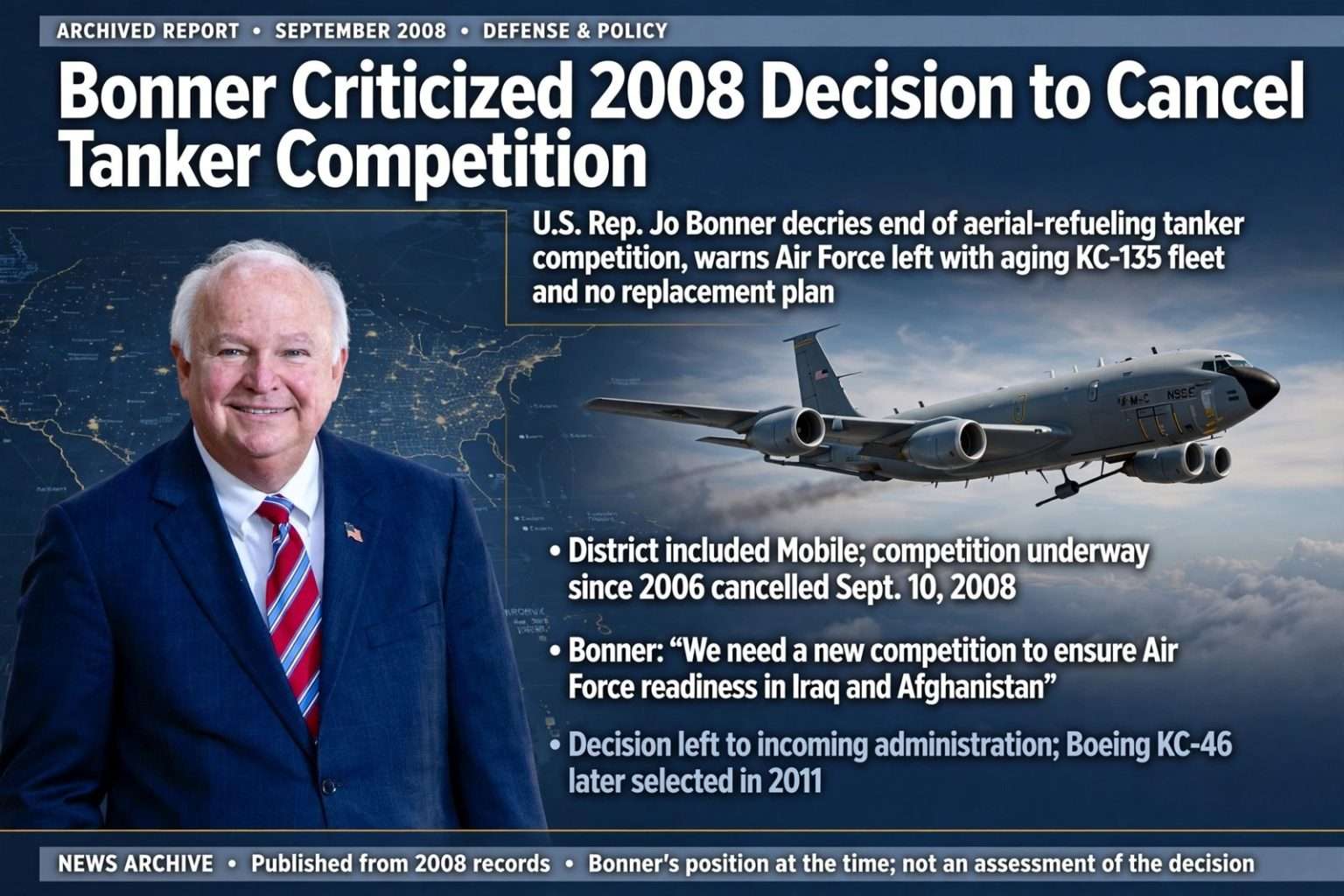
U.S. Rep. Jo Bonner sharply criticized the Defense Department’s decision to cancel the aerial-refueling tanker competition in September 2008, according to an archived local news report, calling the move a blow to the Air Force and to the Gulf Coast’s hopes for the massive contract.

Bonner, whose district included Mobile at the time, said the decision left the Air Force with an aging KC-135 fleet and no immediate replacement plan. The KC-135 Stratotanker, the workhorse of the Air Force’s refueling operations, had been in service since the 1950s, and Bonner argued that postponing its replacement indefinitely put both the military’s readiness and its airmen at risk.

The congressman objected to ending work that had been underway since 2006, when the Air Force began the competition to field a new tanker. He argued that a procurement of this scale should be carried across presidential administrations by career military professionals rather than left to the shifting political winds of a transition period — a pointed concern in the fall of 2008, as a new administration prepared to take office.

Bonner also cited the Air Force’s ongoing operational use of tankers in Iraq and Afghanistan, where aerial refueling was essential to nearly every combat and transport mission flown. Every day without a replacement program, he argued, was another day added to the burden carried by an increasingly old fleet. He urged officials to move forward with a new competition rather than let the requirement languish.

This report records Bonner’s position at the time; it is not an assessment of the decision or of the procurement’s later outcome.

The tanker competition’s turbulent history

The cancellation capped one of the most contentious procurement sagas in modern Air Force history. The effort to replace the KC-135 had begun after a separate leasing arrangement with Boeing collapsed in scandal years earlier, and the 2006 competition — known as KC-X — pitted Boeing against a team of Northrop Grumman and the European aerospace company EADS, which had proposed building the aircraft in Mobile.

When the Air Force selected the Northrop Grumman-EADS entry in early 2008, Mobile celebrated the prospect of a major aircraft assembly operation at Brookley, the former Air Force base at the city’s airport. But Boeing protested the award to the Government Accountability Office, which sustained key elements of the protest, and the Pentagon moved to restart the competition — a process that was still unresolved when the Defense Department canceled the solicitation entirely in September 2008, just weeks before the presidential election.

See also  Clarke County Trash Collection Rates Set to Drop as Waste Management Wins New Contract

The cancellation stunned Gulf Coast officials who had spent years pursuing the contract. Bonner was among the most vocal, and his remarks reflected the frustration of a delegation that had seen Mobile positioned to win the work, lose the award on protest, and then watch the entire competition shelved. For Mobile, the tanker was not an abstract defense program — it was the promise of thousands of jobs and a return to the city’s aviation roots at Brookley, where aircraft had been built during World War II.

Bonner’s argument that career military professionals should carry the procurement across administrations spoke to a deeper concern about how defense acquisitions had become politicized. The tanker competition had already survived one reversal, and advocates feared that a change of administration could bury the requirement for good. The KC-135 fleet, meanwhile, kept flying — and kept aging — with no successor in development.

The congressman’s point about operational tempo was grounded in the demands of the moment. Aerial refueling tankers underpinned the American air campaign in the Middle East, extending the range of fighters, keeping cargo aircraft moving and enabling surveillance flights to remain on station for hours. Any interruption in tanker availability would ripple through the entire Air Force mission structure, a reality that made the aging fleet’s condition a daily operational concern rather than a distant planning problem.

What the KC-135 meant to the Air Force

The KC-135 first entered service in the late 1950s, and by 2008 many of the tankers in the fleet were older than the crews flying them. Decades of structural fatigue, corrosion and parts obsolescence had made maintaining the fleet increasingly expensive, and the Air Force had pursued re-engining and modernization programs to keep the aircraft viable. Still, military planners across two administrations had identified tanker replacement as one of the service’s most urgent modernization needs.

The fleet’s endurance was a testament to its original design, but it also illustrated the risk Bonner described: an Air Force flying missions in two wars on aircraft designed when Dwight Eisenhower was president, with no contract signed to replace them. Every year of delay added maintenance costs and operational risk, and advocates argued that the bill would only grow the longer the replacement was postponed.

See also  Alma Bryant Setter Parris Collier Powers Hurricanes Into Volleyball Postseason

Bonner’s criticism also placed him among a bipartisan group of lawmakers who accused the Pentagon of process failure. Members of Congress from Alabama and Washington state — the two regions competing for the tanker work — had pressed the Defense Department for months over the handling of the competition, and the September cancellation intensified those objections. Hearings, letters and floor speeches followed, all pressing the same question: how would the Air Force get its tankers?

For the Mobile area, the stakes were economic as much as military. The Northrop Grumman-EADS proposal had promised an assembly plant that would anchor an aerospace corridor along the Gulf Coast, building on the region’s shipbuilding and defense footprint. Local and state officials had invested heavily in the pursuit, and Bonner’s advocacy in Washington was part of that sustained effort. The cancellation of the competition put those plans in limbo, leaving the city waiting for the process to begin again.

The congressman’s insistence that officials move forward reflected the consensus among tanker advocates that the requirement would not go away. Whatever the fate of a particular solicitation, the KC-135 fleet would eventually have to be replaced, and every year of delay meant the transition — when it finally came — would be harder, faster and more expensive.

The road after the cancellation

This account preserves Bonner’s September 2008 response as it was reported at the time. The fuller story of what followed — the eventual restart of the competition, the Pentagon’s later decisions and the outcome for the companies and communities involved — belongs to later reporting and is not assessed here.

What the 2008 episode made plain, and what Bonner’s criticism captured, was the cost of a stalled procurement. An aging fleet kept flying, a competition that had consumed years of work was thrown out, and the communities and companies that had invested in the outcome were left to start over. For the Gulf Coast’s congressional delegation, the cancellation was the low point of a saga they had fought through for years, and Bonner’s words at the time reflected both anger at the process and a determination to keep the tanker replacement effort alive.

The episode also became a case study in defense acquisition that policymakers have cited ever since: the danger of protests and reversals derailing critical programs, the difficulty of carrying major procurements across political transitions, and the operational price paid by a military that waits for a replacement while its workhorse aircraft ages past its design life. In September 2008, all of those threads converged on a single decision, and Mobile’s congressman made his objections a matter of public record.

See also  St. Paul's Senior Linebacker Will Abrams Takes the Reins of the Saints' Defense

Bonner’s role in the tanker fight went beyond public statements. As the representative for southwest Alabama, he pressed the Air Force and the Defense Department in letters and hearings, worked with the state’s senators to keep Mobile’s bid viable, and reminded Pentagon officials of the requirement they were walking away from. Archived coverage from the period shows a delegation treating the tanker as a defining issue for the region’s economic future, not merely one contract among many.

The September 2008 decision also landed at a moment of broader anxiety for the defense industrial base, with two wars consuming resources and a presidential transition looming. Advocates for the tanker warned that the combination — an abandoned competition, an election on the horizon and budget pressure ahead — was exactly the environment in which critical programs die quietly. Bonner’s argument for carrying the procurement through with career professionals was aimed squarely at that risk.

The congressman’s citation of ongoing tanker operations gave the debate its urgency. Aerial refueling was so embedded in Air Force operations that its absence was almost unthinkable: bombers and fighters crossing oceans, cargo fleets moving supplies, and surveillance aircraft holding station all depended on tankers meeting them in the air. The KC-135’s age was not an abstraction measured in procurement documents — it was measured in maintenance hours, grounded aircraft and the strain on crews keeping a 50-year-old fleet combat ready.

His final point — the urging that officials move forward — was the simplest and the most consequential. Whatever the faults of the process, the requirement remained, and the only path that made sense to tanker advocates was to begin again without delay. The archived report preserved that position: criticism of the cancellation, defense of the work already done, and a call to restart the effort for the sake of the fleet, the mission and the airmen who depended on both.