Mobile Joined Planned I-65 Clean-Fuels Corridor in 2008
In 2008, Mobile gas stations joined a planned alternative-fuel corridor along Interstate 65, intended to give flexible-fuel and diesel drivers regular access to E85 and biodiesel pumps.
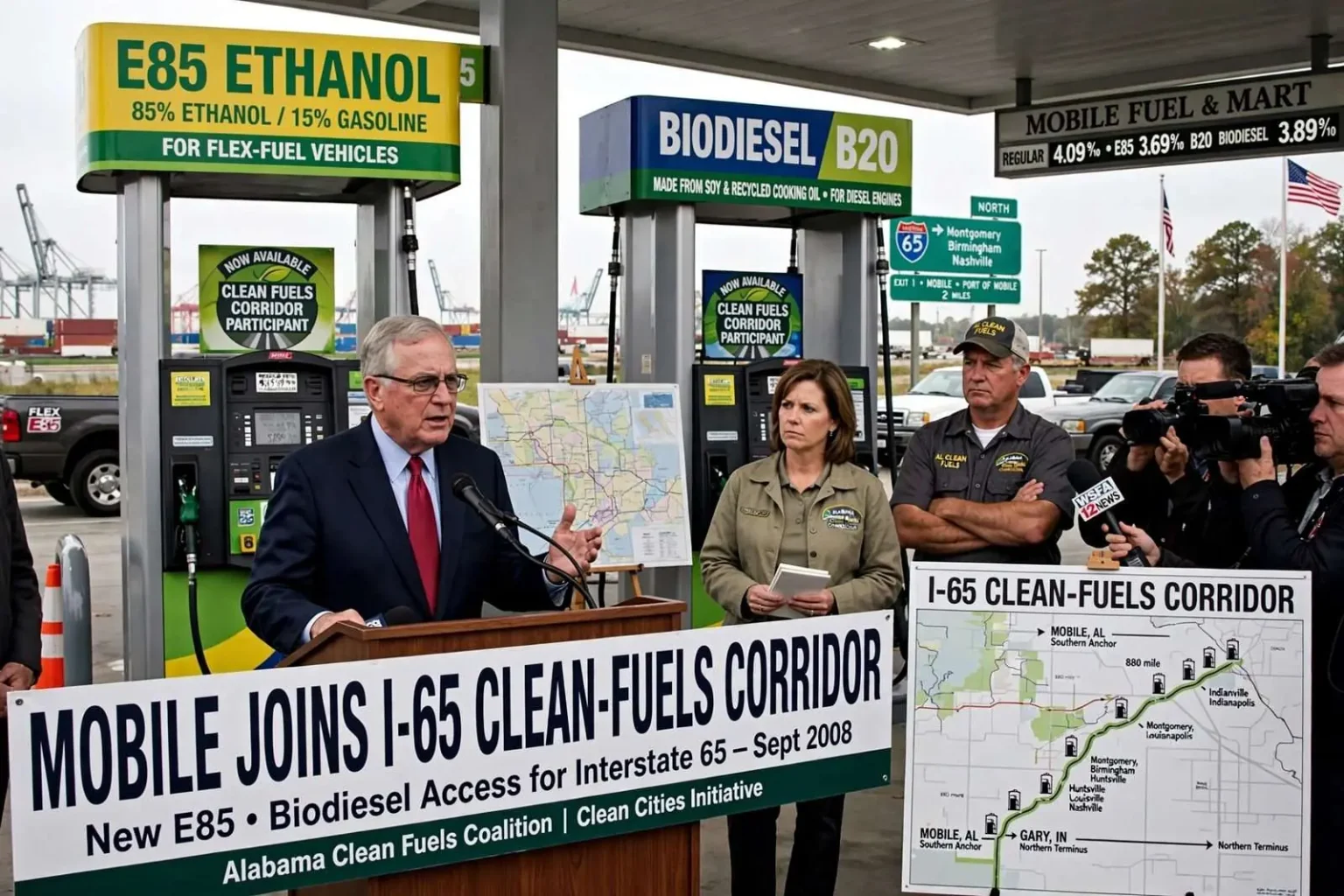
Mobile gas stations joined a planned alternative-fuel corridor along Interstate 65 in 2008, a project intended to expand access to E85 ethanol and biodiesel for drivers traveling one of the Southeast’s busiest north-south routes. The idea was straightforward: string together participating stations at intervals along the interstate so that drivers of flexible-fuel vehicles and diesel vehicles could count on finding a pump wherever they stopped.
Alabama Clean Fuels Coalition representatives said that, once completed, the corridor from Mobile to Gary, Indiana would allow flexible-fuel and diesel vehicle owners to travel without being more than a quarter tank away from an E85 or biodiesel pump. That quarter-tank promise was the organizing principle of the whole effort — a standard borrowed from the way interstate travelers already think about gasoline, applied to fuels that at the time were notoriously scarce outside the Midwest’s corn belt.
The Corridor Concept
Interstate 65 runs more than 880 miles from Mobile’s port district through Montgomery, Birmingham, Huntsville, Nashville, Louisville and Indianapolis before terminating at Gary on the shores of Lake Michigan. It is the primary freight artery linking the Gulf Coast to the Midwest, which made it a natural candidate for the national Clean Cities initiative’s corridor program. The federal push encouraged states along shared interstates to recruit station owners, verify fuel quality and list locations so that a driver could plan an entire trip on alternative fuel without detouring off the highway.
For Mobile, participation placed the city at the southern anchor of the route. The city’s port and its role as the western gateway to the beaches of Baldwin County meant heavy through-traffic, and corridor organizers wanted E85 and biodiesel available where long-haul and regional drivers actually refuel. Stations that joined committed to stocking the fuels and keeping them available, in exchange for inclusion in the corridor’s official mapping and the marketing that came with it.
E85 and Biodiesel Explained
E85 is a blend of 85 percent ethanol and 15 percent gasoline, usable only in flexible-fuel vehicles designed to run on any blend from plain gasoline up to E85. Automakers had been producing flex-fuel versions of popular trucks and sedans for years, often without owners even knowing their vehicle qualified, so the chief obstacle to E85 adoption was not the vehicle fleet but pump availability. Alabama in 2008 counted only a handful of E85 stations statewide, most of them clustered around Huntsville and Birmingham; the corridor promised to change that map from the bottom up.
Biodiesel, the corridor’s other fuel, runs in any diesel engine and requires no conversion at all. Made from soybean oil, recycled cooking grease and animal fats, biodiesel blends — commonly B5 or B20 — were already finding use in municipal fleets and farm equipment across Alabama. The state’s agricultural sector had a direct stake: every gallon of ethanol or biodiesel pumped in-state creates demand for Alabama-grown corn and soybeans, which is why farm organizations backed the corridor alongside environmental and energy-security advocates.
Statewide Promotion
Gov. Bob Riley visited Mobile to promote the fuel effort and described reducing dependence on Middle Eastern oil as a national priority. Riley, who served two terms from 2003 to 2011, made alternative energy a recurring theme of his administration, and the corridor announcement fit the state’s broader pitch that Alabama could turn its farmland, ports and interstate infrastructure into an asset in the emerging biofuels economy. Drivers interviewed for the report also pointed to the appeal of domestic alternatives, reflecting a moment when fuel prices had spiked above four dollars a gallon nationally and energy security polled as a top-tier concern.
The governor’s visit underscored the political arithmetic behind the project. E85’s appeal crossed party lines in 2008 — farm-state Republicans liked the crop demand, environmental advocates liked the renewable content, and security-minded voters liked the idea of fuel that did not arrive by tanker from the Persian Gulf. A corridor that made those fuels practical for interstate travel was, for its supporters, infrastructure in the same sense as the interstate itself.
What the Plan Promised — and What It Did Not
This account records a 2008 plan and promotional effort for alternative-fuel access. It does not describe the corridor’s final buildout, current fuel availability or present-day policy, and that limitation matters for readers trying to trace the project’s legacy. Corridor programs of that era depended on voluntary station participation, grant funding and market conditions for fuels whose price advantage over gasoline shifted with the corn and crude markets. Some corridors materialized nearly as mapped; others thinned out as station owners weighed the costs of tanks, dispensers and fuel supply contracts against thin E85 demand.
Mobile’s Role at the Anchor
Mobile’s participation gave the corridor its Gulf Coast terminus, and the city’s geography explains why organizers wanted it that way. I-65 begins in Mobile amid some of the busiest freight infrastructure on the Gulf Coast — the State Docks, the growing aerospace corridor to the north, and the highways that funnel beach traffic through the city in summer. A corridor without its southern anchor stocked would leave northbound flex-fuel drivers starting their trip on gasoline and southbound ones ending it on a search. Local stations that joined made the quarter-tank promise achievable from mile zero.
The effort also connected Mobile to a national network of Clean Cities coalitions, the Department of Energy-backed partnerships that coordinate alternative-fuel deployment regionally. Alabama’s coalition worked with counterparts in Tennessee, Kentucky and Indiana to recruit stations state by state, share signage standards and aggregate the stations into publicly searchable maps. For a driver in 2008, that mapping was the difference between owning a flex-fuel truck and actually using it as one.
The Broader Energy Moment
The corridor push arrived at the peak of a national wave of biofuels optimism. The 2007 federal energy law had mandated large increases in renewable fuel volumes, ethanol production capacity was expanding across the Southeast, and states were competing for biorefinery projects the way they would later compete for automotive plants. Alabama’s pitch emphasized its own advantages: timber biomass, row crops, rail and port access, and the interstate grid to move finished fuel. The I-65 corridor was the consumer-facing piece of that strategy — the part a driver could touch at the pump.
Gasoline prices in 2008 gave the project its urgency. After a summer in which regular crossed four dollars a gallon, drivers were unusually receptive to alternatives of any kind, and E85 typically priced below gasoline even though it delivers somewhat lower fuel economy in most vehicles. The drivers interviewed along the Gulf Coast reflected that calculus, framing domestic fuels less as an environmental statement than as a hedge against oil markets half a world away.
How Drivers Used It
The practical value of the corridor depended on vehicle choice, and that is where the flexible-fuel fleet mattered. Automakers had sold millions of E85-capable vehicles nationwide, many of them work trucks owned by fleet operators — utilities, municipalities, contractors — who refueled on predictable routes and could plan around corridor stations. Long-haul diesel operators had an easier entry: biodiesel blends work in existing engines, so a trucking company running I-65 could adopt the fuel without buying anything new. The corridor’s design served both audiences at once, which is why E85 and biodiesel were promoted as a pair rather than as competing options.
For ordinary Mobile-area drivers, the corridor’s most lasting contribution may have been simply making the option visible. A flex-fuel badge on a truck many owners had never thought about became a reason to try a pump on Government Street or along the I-65 frontage roads, and every trial filled in the demand data that station owners used when deciding whether to keep the fuel stocked. Alternative-fuel infrastructure has always grown that way — station by station, driver by driver — and the 2008 corridor was an attempt to speed the process along the route where interstate travel would prove the concept fastest.
The Announcement in Retrospect
Read from the present, the 2008 corridor announcement captures a specific moment when biofuels stood at the center of American energy policy and Gulf Coast cities were being recruited as the supply chain’s southern gateway. The governor’s message in Mobile — energy independence as a national priority, delivered at the mouth of I-65 — tied the city’s interstate to a project stretching eight hundred miles to Lake Michigan. Whatever the corridor’s eventual buildout, the quarter-tank promise it pursued shaped how Alabama and its neighbors mapped alternative fuels for years afterward, and Mobile’s stations were where that map began.
The coalition’s work extended beyond signage and maps. Corridor organizers promoted flexible-fuel awareness campaigns urging owners to check their owner’s manuals or fuel-door labels for the E85 designation, since surveys had consistently shown that a large share of flex-fuel vehicle owners did not know their trucks qualified. Converting an unaware owner into an E85 customer costs nothing but information, which made public education the cheapest infrastructure investment available to the project.