Alabama Leaders Proposed Study of Florence-to-Mobile Freeway in 2008
A 2008 report covered a proposed state commission to study financing and building a freeway from Florence to Mobile.
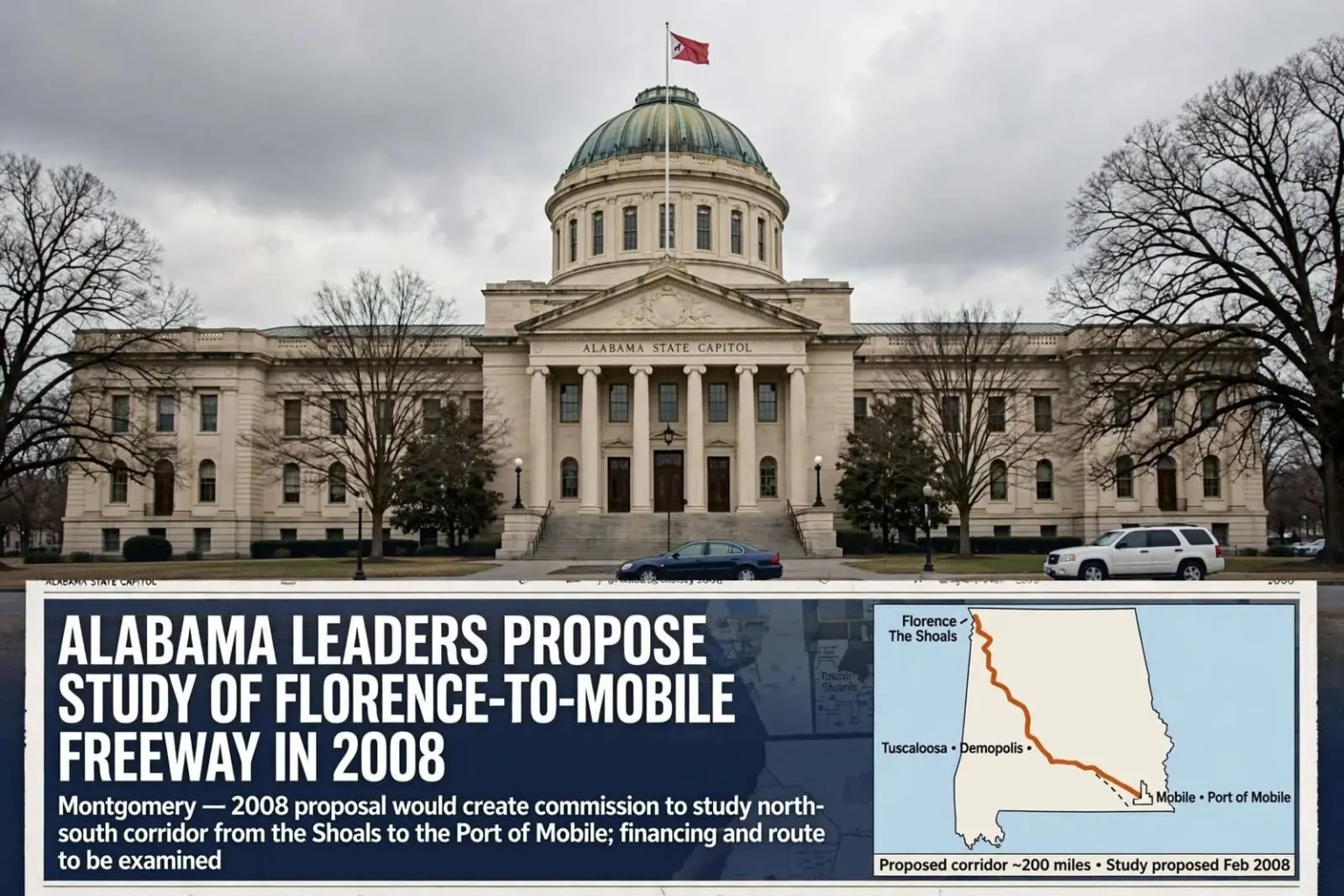
MONTGOMERY, Ala. — Alabama leaders proposed creating a commission in 2008 to study how a freeway could be financed and built from the Florence area to Mobile, a plan that would have created a formal body to examine one of the state’s longest-discussed transportation ambitions, according to a report carried by a local station. The proposal aimed to move the idea from talk to study by giving it an official sponsor within state government.
Lt. Gov. Jim Folsom Jr. said the need for a route along the west side of the state had been discussed for decades. Folsom, a Cullman native whose public career included terms as governor and long service in state offices, had longstanding ties to north Alabama’s development concerns, and his endorsement of the study reflected the frustration of west-Alabama communities that had watched four-lane highways and interstate corridors develop elsewhere in the state while the Tennessee River valley’s western stretch remained without a direct north-south route.
Under the proposal, the commission would have explored public and private financing options and reported to the Legislature the following February. The reporting deadline put the study on an unusually tight timeline, designed to give lawmakers a concrete document to consider during the next legislative session rather than an open-ended inquiry. Public-private financing was an increasingly popular framework for major infrastructure projects at the time, as state transportation budgets strained against rising construction costs and traditional fuel-tax revenues struggled to keep pace.
The Legislature would have needed to vote to create the commission, meaning the proposal’s fate rested with lawmakers rather than with the executive branch. That structure reflected the reality of major infrastructure planning in Alabama: new corridors require legislative authorization, and any future freeway’s financing would ultimately need legislative approval as well, whether through traditional appropriations, tolling authority, or partnership arrangements with private developers.
The case for a west Alabama corridor
The idea of a improved north-south route connecting the Shoals region — Florence, Sheffield, Tuscumbia and Muscle Shoals — with Tuscaloosa and ultimately Mobile had circulated for decades before the 2008 proposal. West Alabama’s existing highway network funnels traffic onto winding two-lane roads or routes that swing east toward Birmingham before turning south, adding hours to trips between the state’s northern tier and the Gulf. Communities along the proposed corridor, from the river towns of the Tennessee Valley through the Black Belt and the piney woods around Demopolis, had long argued that a modern route would unlock economic development, improve access to medical care, and connect the state’s port to its industrial north.
Supporters pointed to the corridor’s potential to serve the Port of Mobile, whose container terminal was poised for major expansion during those years. A direct truck route between the Shoals and the port would, in theory, move freight more efficiently and open industrial sites along the way to manufacturers seeking highway access. The route also traced through some of the state’s most economically distressed counties, giving the proposal an equity argument alongside its transportation rationale: west Alabama had, by many measures, the least developed highway infrastructure in the state.
Opposition and skepticism centered on cost. A freeway spanning roughly 200 miles of varied terrain — river crossings, rural stretches and the wetlands near the coast — was projected to cost billions of dollars, an enormous sum for a state that has historically ranked among the lowest in per-mile transportation spending. Questions also persisted about whether traffic volumes along the corridor would justify the expense, and whether a toll-supported model could service the debt such a project would require.
How the 2008 proposal fit the era
The 2008 commission proposal arrived during a period when states across the country were experimenting with new ways to fund major highways. Public-private partnerships, in which private concessionaires finance and operate toll roads in exchange for revenue, were being tried from Texas to the Carolinas, and transportation officials were actively debating how such models might work in Alabama. A commission with a legislative mandate to study those options would have given the state a formal vehicle for that evaluation — something advocates argued was long overdue for a corridor with decades of discussion behind it.
The timing also intersected with Alabama’s other major infrastructure preoccupation of the era. The state was, in those years, investing heavily in improving U.S. Highway 43 and other existing routes through west Alabama, widening sections to four lanes where funding allowed. Incremental improvement of existing highways represented the realistic alternative to a new freeway, and debates over the corridor often turned on which approach offered better value: a piecemeal upgrade of the roads that already existed, or the long, expensive pursuit of an entirely new facility.
Legislative interest in the corridor has waxed and waned in the years since, with successive leaders revisiting pieces of the vision. The Port of Mobile’s expansion, the growth of industries along the Tennessee River, and persistent development gaps between west Alabama and the rest of the state have kept the underlying logic of the route alive in transportation planning conversations, even as financing questions have remained unresolved.
What the proposal would have required
Had the Legislature created the commission, its members would have faced a demanding assignment: assemble financing models, evaluate route alternatives, weigh environmental and community impacts, and deliver recommendations in a matter of months. Commissions of that type in other states have typically taken years to produce route studies of comparable scope, and the February reporting deadline reflected the sponsors’ desire to force a concrete result rather than an indefinite study.
The commission’s findings would have carried no guarantee of construction. Even a favorable report would have left the state facing the fundamental challenges that had stalled the corridor for decades — a multi-billion-dollar price tag, a financing mechanism acceptable to lawmakers, and the years of environmental review and land acquisition that any new freeway requires. Supporters of the 2008 proposal argued, however, that a formal study was the necessary first step, converting a recurring political conversation into a document that future Legislatures could act on.
This is a historical summary of a 2008 infrastructure proposal, not a current transportation plan. The proposal described here was considered during the 2008 legislative period, and its provisions reflected the financing ideas and transportation priorities of that era. Readers seeking current information about Alabama’s highway planning, the status of north-south corridor proposals, or Alabama Department of Transportation projects should consult current ALDOT publications and official sources, since the situation described here reflects only what was proposed and reported in 2008.
The geographic logic of the corridor deserves a closer look, because it explains why the idea has survived so many legislative sessions. The Florence area sits in Alabama’s northwest corner, anchored by the four cities of the Shoals and the Tennessee River industries that employ thousands in manufacturing, logistics and healthcare. Mobile, at the state’s southern tip, is the Gulf’s rising container port, connected to the interior by interstates that run east through Birmingham and Montgomery. Between them lies a stretch of west Alabama served principally by U.S. Highway 43, a road that threads through communities such as Demopolis, Linden, Grove Hill and Jackson on its way to the coast — vital to the towns it connects, but never built to carry the freight volumes a modern corridor demands.
For the counties along that stretch, the freeway conversation has always been about more than drive times. Rural west Alabama has lost population and industry for decades as manufacturing declined, and civic leaders there have argued that transportation access is the single most decisive factor in whether new investment reaches them. Hospital closures, school consolidations and the movement of young people to Birmingham, Huntsville and the coast have amplified the argument that a connected corridor could reverse the region’s trajectory — or at least slow its decline.
Traffic planners, for their part, have weighed the corridor against competing needs across the state. Alabama’s transportation funding has long been stretched between urban congestion relief, bridge replacement backlogs, and rural road maintenance, and every major new corridor competes with those demands for the same dollars. That arithmetic — needs that always exceed revenue — is the backdrop against which the 2008 commission proposal was made, and it remains the central challenge for any future version of the Florence-to-Mobile idea.
The 2008 episode is also a case study in how infrastructure ideas persist in state politics. Proposals to study the corridor have surfaced repeatedly across different administrations and legislative sessions, each version adapted to the financing tools and political realities of its moment. What the 2008 proposal contributed was a specific, actionable structure: a legislatively created commission, a defined study scope covering public and private financing, and a reporting deadline that would have placed the results before lawmakers at the start of a session — a concrete framework for a conversation that had, until then, mostly been conducted in generalities.