Foley Woman Injured in Dog Attack in 2008
A 2008 WKRG report covered a Foley woman's injuries after she said two neighboring dogs attacked her outside her home.
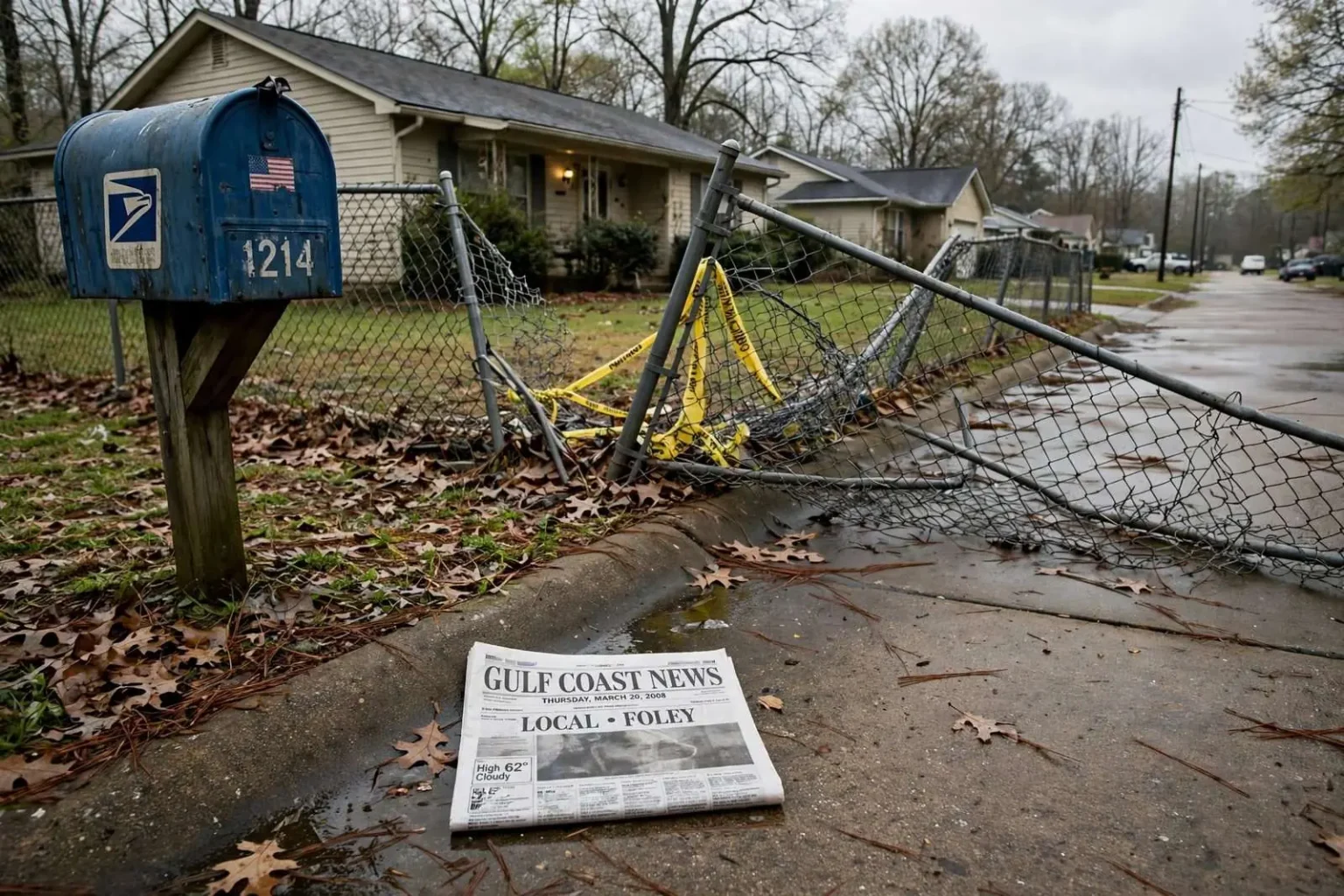
A Foley woman was injured in a dog attack in March 2008 after she went outside to retrieve her morning newspaper, according to a local station. Joannah Martin said two neighboring dogs attacked her and left her with 18 stitches. Her family sought to have the dogs euthanized, while their owner said the animals had not caused a problem before and claimed they had escaped a fenced area. This is a historical summary of a 2008 neighborhood animal-control dispute. Current conditions and any later outcome may differ.
An ordinary morning turned violent
What began as a routine errand — stepping out to the end of the driveway for the morning paper — became a painful ordeal for Joannah Martin in March 2008. Martin said two dogs from a neighboring property attacked her as she stood outside her Foley home, and the injuries she sustained required 18 stitches to close. The attack left her family shaken and pushed the dispute over the animals into the open, setting the Martin family against the dogs’ owner in a disagreement that played out through local reporting in the weeks that followed.
The details of the incident were stark in their simplicity. A woman on her own property, engaged in an everyday task, was set upon by two animals that did not belong to her. The severity of her wounds reflected the kind of damage dogs can inflict in a short time, and the fact that the attack happened in daylight in a residential neighborhood underscored how quickly such encounters can develop.
Foley and the challenge of animal control
Foley, like most Baldwin County municipalities of its size, relied on a combination of city animal control enforcement and county resources to handle complaints about loose or dangerous animals. Alabama state law places responsibility on owners to keep their dogs from running at large, and municipalities across the state adopt ordinances requiring leashes, fencing or confinement. When those measures fail, the consequences can be serious for neighbors who share streets, sidewalks and fence lines with unrestrained animals.
The March 2008 attack in Foley illustrated the gap that can exist between the rules and their enforcement. The dogs’ owner maintained that the animals had escaped a fenced area — an acknowledgment that confinement had failed, even as he defended the dogs’ history. For the injured woman and her family, the distinction mattered little; what mattered was that a failure of containment had left her with a significant injury.
Two sides of the dispute
After the attack, the Martin family pressed for the most serious remedy available: they sought to have the dogs euthanized. That outcome, in Alabama, generally requires action through municipal or district court, where a judge can declare a dog dangerous or vicious and order measures ranging from secure confinement and insurance requirements to destruction of the animal. The family’s position reflected both the severity of the injury and their fear that dogs capable of such an attack could strike again.
The owner saw the situation differently. He said the animals had not caused a problem before, and he maintained that the attack happened only because they had gotten out of a fenced area that ordinarily held them. From his perspective, the incident was an escape, not a pattern — a single failure rather than evidence of inherent danger. The disagreement between the two households captured the tension at the heart of nearly every serious dog-bite case: the same animals were a beloved pair on one side of the fence and a threat to public safety on the other.
How dangerous-dog cases proceed
When a serious dog attack occurs in Alabama, the typical path runs through local government. Animal control officers document the incident, quarantine the animals to check for rabies, and compile a record of the attack and any prior complaints. If the owner contests the outcome or the injured party pushes for stronger measures, the matter can reach a municipal or district court judge, who hears evidence about the animal’s history and the circumstances of the attack before deciding what restrictions or penalties to impose.
In the Foley case, the historical record does not state how the dispute was ultimately resolved. What is clear from the 2008 reporting is that both sides had dug in: the family wanted the dogs put down, and the owner wanted his animals returned to his care with, presumably, a better fence. Cases like this often ended in compromise — reinforced containment, restrictions on where the animals could go, and monitoring by animal control — rather than the destruction of the dogs, but each outcome depended on the facts as the court found them.
The wider problem of dog attacks
Dog attacks serious enough to require stitches are not rare, and the circumstances of the Foley incident were typical in several respects. Most victims are attacked by dogs they know, or by dogs belonging to neighbors, rather than by strays. Most attacks happen on or near the victim’s own property. And the trigger is often an ordinary moment — retrieving mail, walking to a car, stepping into a yard — rather than any provocation the victim was aware of.
Public health authorities have long urged owners to take containment seriously, noting that even friendly animals can behave unpredictably in unfamiliar circumstances. A dog that slips a fence is excited, stressed and operating outside its routine, which can bring out aggression that the owner has never seen at home. That reality informed both sides of the Foley dispute: the owner’s claim that the dogs had never caused a problem before did not, in the eyes of the injured family, contradict the reality of what had happened once the animals were loose.
What neighbors can do
The 2008 episode left Foley residents with practical lessons that remain relevant to any Gulf Coast neighborhood. Reporting loose dogs to animal control promptly creates the paper record that later becomes crucial if an attack occurs. Fencing should be checked and maintained, since dogs test weak points over time. And victims of an attack should seek medical care immediately, both for their own health and because documentation of the injuries — like the 18 stitches Martin received — becomes central evidence in any proceeding that follows.
For the families involved, the March 2008 attack was a rupture in ordinary neighborly life. Two households that had lived side by side found themselves on opposite sides of a dispute over whether two animals should live or die, with a woman’s injuries and a dog owner’s conscience hanging on the answer. The historical record preserves the dispute as it stood in 2008; how it ended is not part of the account that survives.
Baldwin County’s growth and neighborhood animals
The Foley attack also reflected the pressures of Baldwin County’s rapid growth in the 2000s. New subdivisions were spreading across former farmland, and in neighborhoods that had not existed a decade earlier, long-standing habits about keeping animals — letting them roam, relying on informal fencing, trusting neighbors to tolerate wandering pets — collided with the expectations of new residents. Dogs that once had fields to wander were suddenly sharing close quarters with families who expected every animal to be confined.
Municipalities across the county responded over the years with stricter leash ordinances and better-supported animal control operations, but enforcement has always depended on complaints and on the willingness of owners to comply. The 2008 Foley case was one instance of a tension that played out on thousands of Gulf Coast streets: between an owner’s attachment to his animals and a neighbor’s right to feel safe stepping into her own yard.
The human cost
Eighteen stitches is more than a statistic. A wound count like that reflects multiple bite injuries, emergency treatment, and a recovery measured in weeks, along with the possibility of scarring and the lingering fear that follows any animal attack. Victims of serious dog attacks commonly report lasting anxiety around dogs, even breeds they once trusted, and the psychological aftermath can outlast the physical healing by years.
For Joannah Martin, the morning paper run in March 2008 became the dividing line in her relationship with her neighborhood. The dogs’ owner, for his part, faced the possibility of losing animals he described as never having caused a problem, along with whatever legal and financial consequences followed the attack. The reporting from 2008 captured the dispute at its height, with the family demanding euthanasia and the owner defending his animals, and the record does not say where the balance was ultimately struck.
A case frozen in 2008
Nearly two decades later, the Foley dog attack survives as a historical account of one neighborhood’s worst morning. Its elements are ordinary and instructive at once: a containment failure, a serious injury, a family’s demand for the strongest remedy available, and an owner’s insistence that one bad day did not define his animals. The questions it raised — who bears responsibility when a fenced dog escapes, and what should happen to an animal after a severe attack — remain the questions communities ask whenever a similar incident occurs.