Foley House Fire Killed One and Injured Another in 2008
A 2008 WKRG report covered a fatal overnight Foley house fire that investigators believed began with a candle left burning in a kitchen.
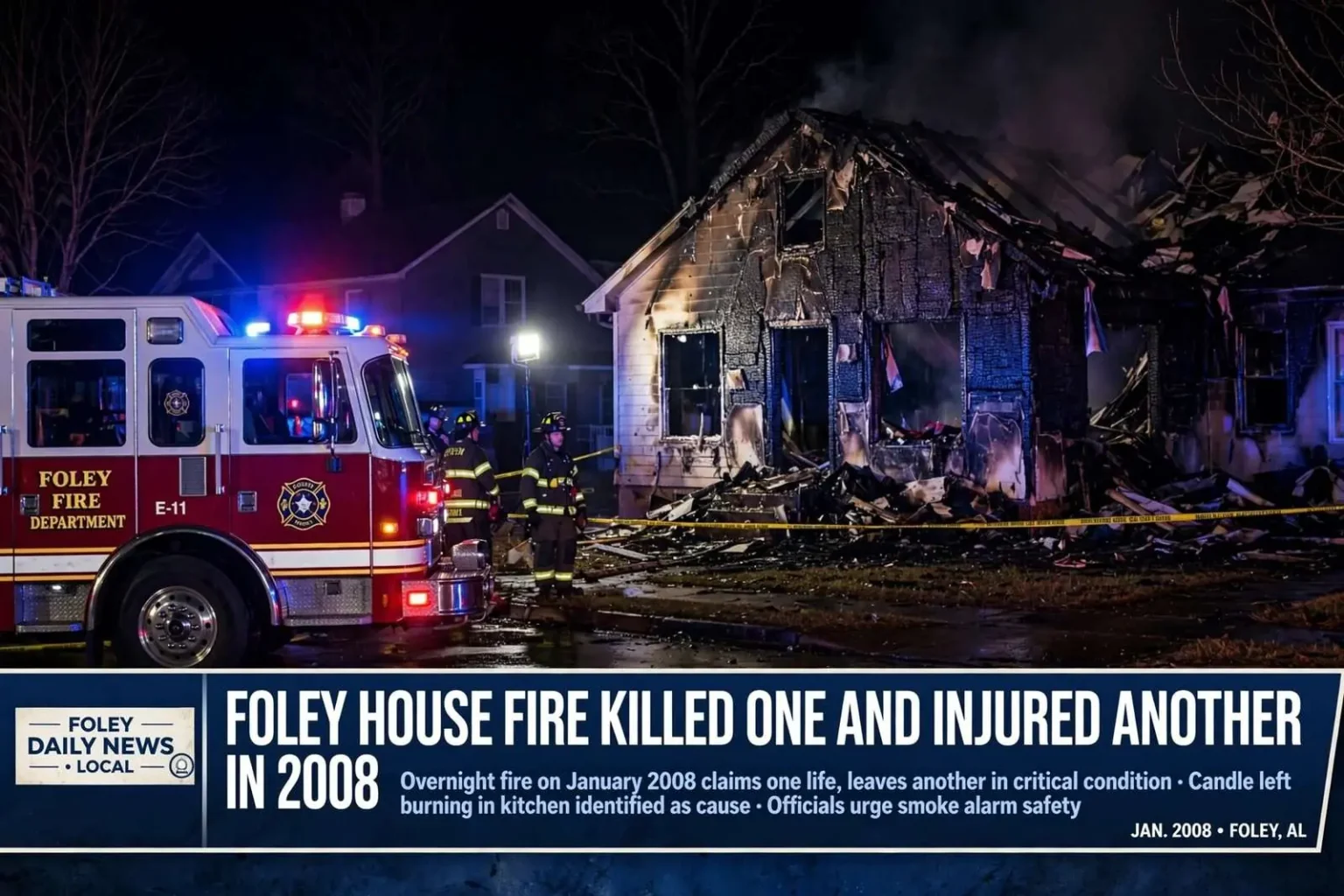
An overnight house fire in Foley killed one person and left another in critical condition in January 2008, according to a local station’s report. Foley Fire Chief Jamie Hinton said the back of the home was heavily involved when crews arrived, a detail that described both the intensity of the blaze and the difficulty firefighters faced in reaching its origin. John Sampson managed to escape the burning structure through a glass storm door, but Cynthia Brooks was found inside the home near the exit. Investigators concluded that a candle left burning in the kitchen started the fire, and they reported that the home had only one working smoke detector, located away from the flames.
The fatal fire underscored a risk that fire officials across Baldwin County and the rest of Alabama warn about every winter: the combination of open flames, sleeping households and insufficient smoke alarm coverage. January is consistently among the deadliest months nationally for residential fires, as cold weather brings candles, heaters and extended cooking into closer contact with daily life. What began in this case with a single candle in a kitchen claimed a life and nearly claimed another within minutes of ignition.
A night call in Foley
Foley, the rapidly growing Baldwin County city that serves as a retail and service hub for south Baldwin County, sits a short drive from the Gulf beaches and had been expanding steadily for years, adding subdivisions and commercial development around its historic downtown. Its fire department responds to a mix of structure fires, medical calls and motor vehicle accidents across the city and, through mutual aid arrangements, assists neighboring volunteer departments in the surrounding communities. Overnight structure fires are among the most dangerous calls such departments answer, both because of reduced visibility and because occupants are typically asleep when flames begin to spread.
When crews reached the home, Chief Hinton said, the back portion was heavily involved, meaning flames had already taken hold of a significant section of the structure. Firefighters arriving to a fire that has reached that stage are operating in a narrow window: they must simultaneously attack the blaze and search for anyone still inside. The conditions inside a burning house at night — zero visibility, superheated air, the disorientation of unfamiliar floor plans — make those searches treacherous even for trained crews with full protective equipment.
According to the report, Sampson’s escape came through a glass storm door, one of the few unobstructed paths out of the home once the fire took hold. Storm doors and other secondary exits sometimes become lifelines in house fires when primary routes are blocked by smoke and flame. Brooks, however, was found inside the home near the exit, a detail suggesting she had attempted to flee but did not make it out before the fire overtook the interior. She was pronounced dead, while Sampson’s injuries left him in critical condition, according to the station’s account of the incident.
The candle connection
Investigators’ conclusion that a candle left burning in the kitchen started the fire fit a well-documented pattern. Candles are a persistent cause of home fires nationwide, and fire safety agencies have long noted that the danger peaks in December and January, when candles accompany holiday decorations, power outages and cold-weather ambiance. A candle ignited near curtains, cabinets, paper or other combustibles can spread beyond control in seconds, and a flame left unattended — even briefly — removes the early-warning moment in which a small fire can be smothered or extinguished.
Kitchen fires carry particular risks because kitchens concentrate fuels: cabinets, wall coverings, stored groceries, towels and appliance cords. A candle burning near any of these can flash into a spreading fire before a household realizes the danger. Once fire extends beyond the room of origin, the survivable window inside the home shrinks dramatically, because smoke — the leading killer in residential fires — moves through the house faster than flames do, displacing breathable air and incapacitating sleeping or unaware occupants long before heat reaches them.
Fire officials use cases like this one to reinforce a short list of precautions that cost nothing to follow. Never leave a candle burning unattended or while sleeping, keep candles at least a foot away from anything that can burn, and prefer battery-powered flameless candles in bedrooms and living areas. Extinguish candles when leaving a room, keep matches and lighters away from children, and maintain working smoke alarms on every level of the home and inside sleeping areas.
Smoke detectors and the margin of survival
The detail that the home had only one working smoke detector, located away from the flames, became a central lesson of the case. Safety guidance from national fire organizations is explicit: every home should have working smoke alarms inside each bedroom, outside each separate sleeping area, and on every level of the home, including the basement. Alarms should be tested monthly, batteries replaced at least yearly, and the units themselves replaced on a ten-year cycle. In a home with adequate coverage, the alarm sounds within moments of combustion no matter where the fire starts, buying occupants the minutes that make the difference between escape and tragedy.
In this case, the single working detector’s distance from the kitchen — where investigators determined the fire began — meant it could not provide the earliest possible warning to people asleep in the home. Fire spreads through a structure at a pace that outruns human perception: within a couple of minutes of ignition, smoke can bank down to breathing level, and within a few more, temperatures in the fire room can reach levels that are instantly incapacitating. Every second of delayed detection consumes escape time that cannot be recovered.
Baldwin County’s rapid growth added a regional dimension to the problem. New subdivisions had multiplied across the county through the 1990s and 2000s, bringing thousands of newer homes to communities served by a blend of career and volunteer fire departments. Fire safety educators in the area, as elsewhere, worked with schools, churches and civic groups to distribute alarms and teach escape planning, knowing that in many rural and older homes the only alarm was a single unit in a hallway — exactly the configuration that failed to provide timely warning in the Foley fire.
Fatal fires as a recurring pattern
The Foley fire was not an isolated kind of tragedy. Across Alabama in the winter months, fatal house fires repeatedly traced to the same handful of causes: candles left burning, overloaded or malfunctioning heaters, fireplaces and chimneys without maintenance, and cooking left unattended. State fire officials have regularly recorded some of the highest per-capita fire death rates in the nation, a statistic tied to factors including rural response distances, older housing stock, poverty, and low rates of working smoke alarms. Each January, departments across the state brace for the season’s most dangerous stretch.
For local departments, a fatal fire brings a double burden: the investigation and the aftermath. Investigators must determine origin and cause, ruling out anything suspicious before an accidental cause like a candle can be definitively assigned, and their findings become part of the public record that shapes future safety campaigns. Survivors and neighbors, meanwhile, absorb the loss, and fire chiefs become spokesmen for the precautions that might have prevented it. Hinton’s account of the heavily involved rear of the home served that purpose: it gave the community a concrete picture of how fast a domestic accident becomes a fatal event.
The human toll in this case was compounded by its timing. An overnight fire in deep winter means a household caught in the deepest sleep of the night, with escape decisions made in darkness and smoke. The fact that one resident found a way out through a storm door while another was found near the exit illustrates how narrow the margins are — a difference of moments, of a doorway, of an alarm sounding minutes earlier, separates survival from fatality in these events.
What fire departments ask of residents
Fire safety officials draw a consistent set of lessons from fires like the one in Foley. A working smoke alarm near sleeping areas is the single most effective life-saving device in a home, and its cost is trivial compared with the stakes. Escape planning comes second: households that have agreed in advance on two ways out of every room, a meeting place outside, and a rule that once out, no one goes back in, consistently get out faster and more safely. Finally, the sources of ignition — candles, cooking, heaters — should never be left unattended, especially overnight, when detection and escape are hardest.
Officials also urge residents to close bedroom doors while sleeping, a practice shown to slow the spread of smoke and fire into sleeping areas and to buy additional minutes. They recommend that households with limited mobility or elderly members make special arrangements, since those residents need more time to escape and benefit most from early alarm coverage. And they ask homeowners to remember that even a fire extinguished quickly by arriving crews leaves a family displaced, so prevention remains the only fully effective remedy.
The community record
For Foley, the January 2008 fire entered the local record as one of the incidents that shaped the community’s approach to fire safety. The identification of a candle in the kitchen as the cause, and of a single misplaced smoke detector as the home’s only warning, gave firefighters a story they could tell at schools and civic meetings for years afterward — concrete, local, and impossible to dismiss as something that happens only somewhere else.
The case also illustrates the role of local news reporting in preserving the details of such events. The account of Sampson’s escape through a glass storm door, of Brooks being found near the exit, of Hinton’s description of the heavily involved rear of the home, and of the investigators’ candle-and-smoke-detector findings together form the documented history of the incident. Such records matter to a community long after the smoke clears: they inform safety campaigns, they settle questions for families, and they give later residents an accurate picture of the risks that come with coastal Alabama winters.
This article is a historical summary of a 2008 fatal-fire report from local news coverage. It reflects the facts as reported at the time, including the findings of investigators and statements attributed to Foley Fire Chief Jamie Hinton. It is retained as part of the local news record and does not describe current conditions, current personnel, or the subsequent outcomes for the individuals involved. Readers dealing with fire safety questions today should consult their local fire department and current national fire safety guidance for up-to-date recommendations.