Citronelle Police Chief John Norris Resigns, Cites Strained Relations With City Officials
Citronelle Police Chief John Norris resigned, citing deteriorating relationships with city officials in a farewell statement.
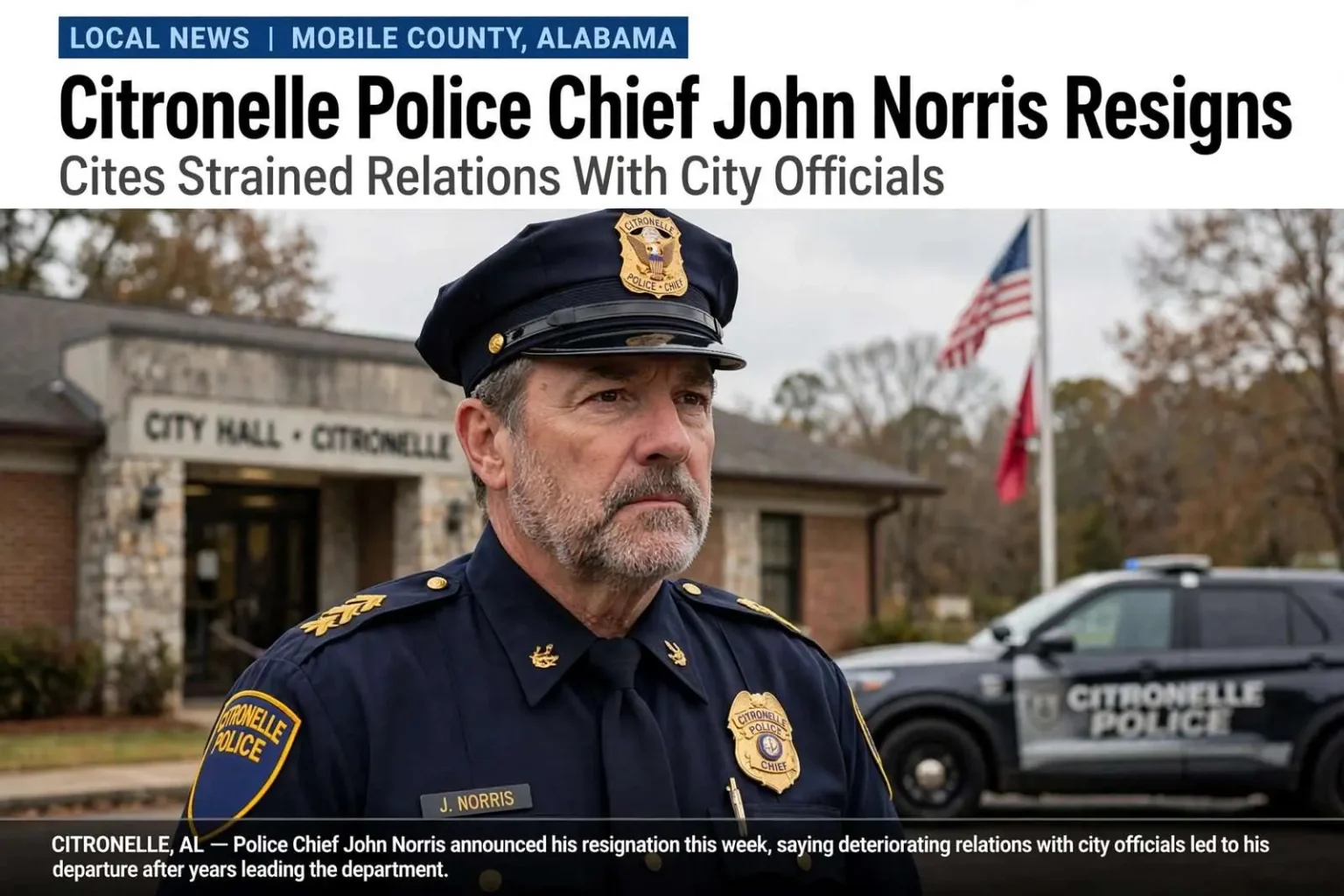
Citronelle Police Chief John Norris has resigned from the department he led, Mayor Jason Stringer confirmed. The mayor declined to give a reason for the departure, leaving residents of the north Mobile County city to learn the details from Norris himself, who addressed the decision in a public statement released after stepping down.
The resignation ends a tenure that Norris framed as a turning point for a small-city police department that he said had struggled with its standing before his arrival. His exit statement was notably pointed, pairing pride in the department’s progress with sharp criticism of the city officials he leaves behind, and it offered residents an unusually direct account of how the relationship between the chief’s office and city hall had broken down.
Norris explains his decision
In his statement, Norris called the resignation “not an easy decision but one that was inevitable, due to deteriorating relationships between myself and the city officials.” The wording made clear that the chief viewed the split as the product of a long-running rift rather than a single dispute, though neither he nor the mayor detailed the specific events that led to the break.
Norris defended his record in the same statement, saying that when he was hired he set out to run drug dealers and criminals out of Citronelle and to rebuild the department’s connection with residents. “I believe we accomplished that goal,” Norris wrote, in a summary of his mission that placed enforcement and community trust side by side as the two halves of the job.
He added that before his arrival the department “was not a respected police department and we changed that.” The claim underscored how central the department’s public reputation was to the way Norris measured his own tenure, and how much he believed had changed under his watch in a city where the police force is small enough that officers are regular presences in residents’ daily lives.
A parting shot at city leadership
Norris also took a parting shot at city leadership, writing that the only people who might not appreciate the department now are those who have been arrested or “the politicians who would rather focus on flower beds instead of supporting the police department.” The remark suggested that disagreements over priorities and resources inside city government had become, in the chief’s view, a defining feature of his final years on the job.
For a department the size of Citronelle’s, budget lines and city support are not abstractions. A municipal force in a city of Citronelle’s scale depends on the council and mayor for equipment, staffing levels, pay and the everyday resources that determine how aggressively it can pursue drug activity and other crime. Public friction between a chief and elected officials can therefore translate quickly into operational strain, and Norris’s statement implied that strain had reached the point where the job was no longer workable.
The chief closed his statement on a personal note, saying he looked forward to spending more time with his family and wishing the people of Citronelle well. Whatever his grievances with city officials, he directed no criticism at the community itself, describing his service to residents as the part of the job he set out to accomplish from his first day.
The city Norris leaves behind
Citronelle sits in the far northern reaches of Mobile County, near the Mississippi state line, a drive of roughly 45 minutes north of downtown Mobile. With a population of around 4,000 people, it functions as the commercial and service hub for a rural stretch of the county that includes communities such as Mount Vernon, Bucks and Calvert. That geography shapes the kind of policing the city requires: a small force responsible for a territory and roadway network far larger than its population might suggest, with state highways funneling traffic and, at times, drug activity through the city on the way to and from the coast.
Small departments in communities like Citronelle typically operate with a chief, a handful of full-time officers, and limited investigative capacity, which makes cooperation with the Mobile County Sheriff’s Office and other regional agencies a practical necessity for major cases. A chief who makes drug enforcement his signature issue, as Norris described doing, must sustain those partnerships while also managing the everyday calls — traffic, domestic disputes, property crime — that make up most of the department’s workload.
Norris’s reference to rebuilding the department’s connection with residents points to another reality of small-town policing: the department’s effectiveness depends heavily on the willingness of neighbors to report suspicious activity, cooperate with investigators and support the city’s investment in public safety. In a city the size of Citronelle, respect is not an abstract public-relations asset but the operational foundation of the department’s ability to make cases, and the chief said that foundation was absent when he arrived.
What happens next
The city launched a search for Norris’s replacement shortly after his departure became official. Until a successor is hired, the department’s command structure will be under strain familiar to any small city that loses its top law enforcement officer mid-year: interim supervision, pending cases and the task of reassuring officers that the department’s direction will not change with a new administration at city hall.
For the mayor and council, the hiring decision carries weight beyond routine personnel management. The next chief will inherit both the enforcement posture Norris says he built and the strained relationship with city officials that Norris says forced him out. Reconciling those two legacies — a department the chief calls transformed and a city hall he leaves openly criticized — will be the first test of whoever takes the job.
For residents, the practical questions are straightforward: whether patrols and drug enforcement continue at the pace Norris set, whether the officers he assembled stay through the transition, and whether the search produces a chief with the standing to work productively with the elected officials who will set the department’s budget. Those answers will unfold over the coming weeks as the city moves to fill the post, and as Citronelle’s next police chief takes over a department that, by its outgoing leader’s account, is a very different organization than the one he inherited.
How the news reached the public
The departure became public through the unusual route of both sides speaking separately. Mayor Stringer confirmed that the resignation had happened but offered no explanation, a stance that in municipal politics often signals an unresolved disagreement about how the separation should be characterized. Norris then filled the silence himself, releasing a statement that gave residents the version of events city hall declined to provide.
That dynamic — a terse official confirmation followed by a candid farewell letter from the departing chief — has become a familiar pattern in small Alabama municipalities, where personnel matters involving department heads rarely stay contained. Chiefs answer to mayors and councils on budget and policy, but they answer to residents on public safety, and a chief who believes his record speaks for itself has every incentive to address the public directly when the relationship with his employers ends badly.
Norris’s statement did both jobs at once. It presented his tenure as a completed mission — drug dealers and criminals pushed out, a department’s reputation rebuilt — and it framed his exit as the consequence of political friction rather than any failure of the department itself. The flower beds line, in particular, was the kind of pointed detail that residents of a small city could easily translate into specific local debates over how the city spends its limited funds.
The measure of a small-city chief
Whether Citronelle’s next chief builds on the gains Norris claims will depend on factors largely outside the police station: the city’s budget priorities, the council’s appetite for supporting enforcement spending, and the department’s ability to retain the officers now on its roster. Small municipal departments across south Alabama compete for a shallow pool of experienced officers against larger, better-paying agencies in Mobile and Baldwin counties, and a turbulent transition can accelerate departures that a stable one would prevent.
That is the practical stake in a change of leadership that might otherwise read as a personnel footnote. Citronelle is the primary police presence for a wide, rural corner of Mobile County, and the department’s capacity — its staffing, its partnerships with the sheriff’s office, its standing with residents who call in tips — determines how quickly the city responds to everything from wrecks on its highways to the drug activity Norris made his signature target.
The mayor’s office has said only that a search is underway. Until a successor is named, the statement Norris left behind will serve as the fullest public account of how his tenure ended, and it will shape the expectations residents carry into the next chief’s first months on the job.