Alabama Legalizes Medical Cannabis; Mobile-Baldwin Lawmakers Split on Final Vote
Gov. Kay Ivey has signed a bill legalizing medical cannabis in Alabama, with most of the Mobile and Baldwin county legislative delegation backing the measure and only three local Republicans voting no.
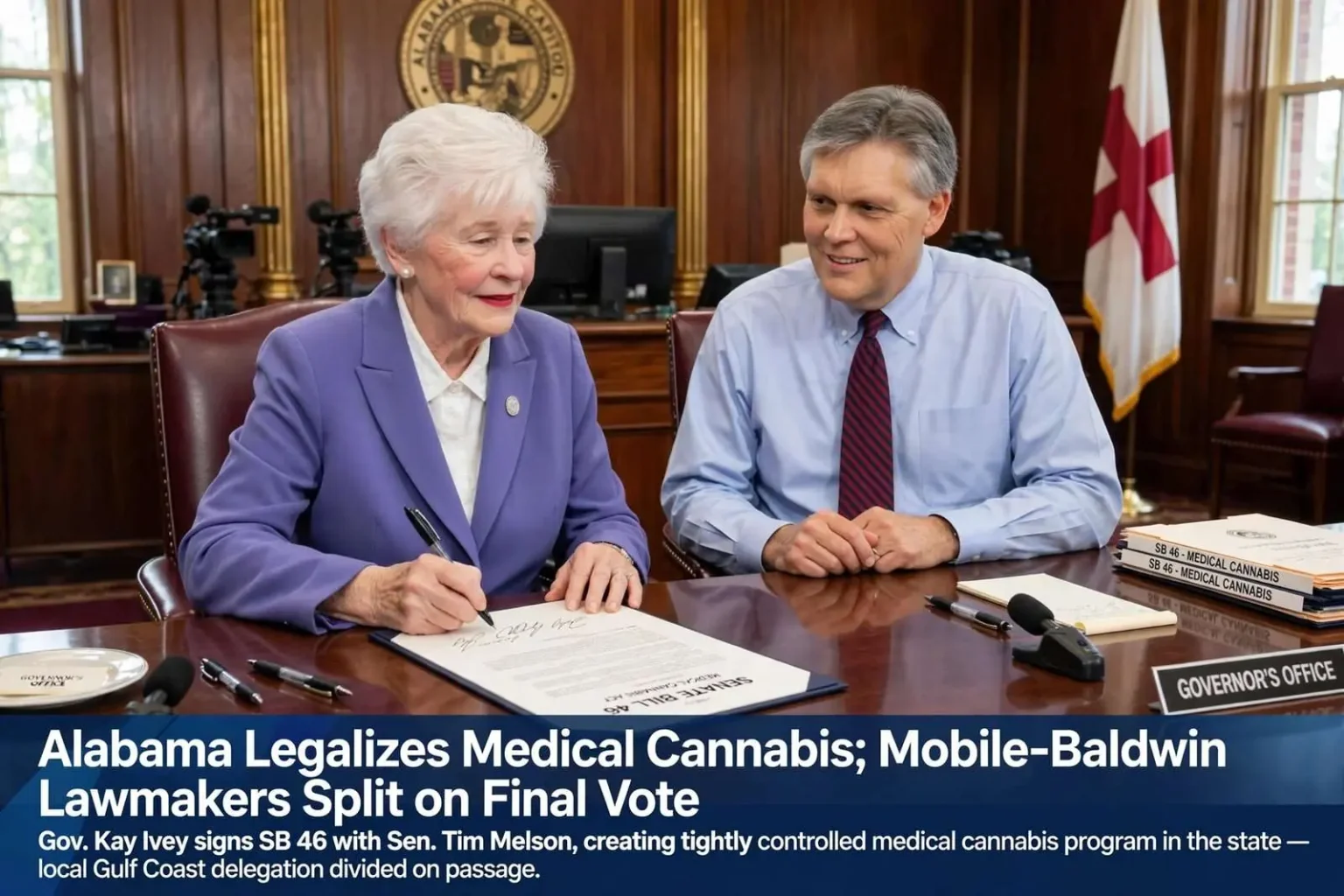
Alabama became the latest state to legalize cannabis for medical use this week after Gov. Kay Ivey signed Senate Bill 46 into law, capping years of debate at the State House over whether and how to allow patients access to the drug for treatment of specific illnesses. Ivey signed the measure alongside its sponsor, Republican state Sen. Tim Melson of Florence, a physician who has pushed similar legislation in previous sessions.
The signing placed Alabama alongside a growing majority of states that have authorized cannabis for medical purposes, while deliberately steering the program toward one of the most tightly controlled models in the country. From the product forms patients may buy to the state commission that will run the entire system, the law reflects a compromise between lawmakers who wanted patient access and those who feared recreating the expansive commercial markets seen elsewhere.
A Long Road Through the Legislature
The bill cleared the Senate with relatively little resistance but hit a rougher patch in the House of Representatives, where it stalled for a time before lawmakers attached a series of amendments and ultimately sent it to the governor’s desk.
The pattern was familiar to anyone who followed previous attempts. Melson, a retired anesthesiologist who represents the Shoals area, had carried versions of medical cannabis legislation in earlier sessions only to watch them die without reaching the governor. What changed this time was a combination of persistent advocacy from patients and families, growing public acceptance across party lines, and negotiation over amendments that addressed the concerns of skeptical members.
Legislative debate centered less on whether cannabis can help certain patients and more on guardrails. Opponents in the House pressed questions about diversion, youth access, impairment on the roads and the optics of the state endorsing a drug that remains illegal under federal law. Supporters countered that Alabama patients were already obtaining products from neighboring states or from unregulated sources, with no oversight and no benefit to the state.
What the New Law Creates
The new law creates a state commission tasked with regulating medical cannabis in Alabama, including licensing and oversight of growers, processors and dispensaries. Rather than folding the program into an existing agency, lawmakers built a dedicated commission, a structure intended to keep regulation concentrated in one body with explicit authority over the entire chain from cultivation to sale.
The commission will decide who receives licenses to grow, process, transport and dispense, a role that will inevitably attract intense interest from prospective businesses and their lobbyists. Lawmakers capped the number of licenses in several categories, a decision that will make each license valuable and the application process competitive. Commissioners are expected to face pressure from all sides as they write the rules that determine which companies enter the market and where dispensaries may operate.
Local governments in Mobile and Baldwin counties will have a say as well, since zoning decisions about where dispensaries, cultivation facilities and processing sites can locate will play out city by city and county by county, subject to the framework the commission adopts.
Who Can Qualify, and How
Physicians who complete additional training and pay a required fee will be authorized to recommend cannabis to patients suffering from a defined list of conditions, rather than prescribing it outright. The recommend-not-prescribe distinction is a direct consequence of federal law, which continues to classify cannabis as a Schedule I substance, barring doctors from writing prescriptions for it even where state law allows its use.
Qualifying conditions include depression, autism spectrum disorder, Crohn’s disease, epilepsy and other seizure disorders, panic disorder, Parkinson’s disease, nausea, pain or vomiting associated with cancer, and nausea or severe weight loss linked to HIV. The list was among the most contested elements of the bill, with lawmakers adding and removing conditions through multiple drafts as they weighed patient need against worries about scope creep.
Patients who qualify will need to obtain a recommendation from a certified physician and register with the state before they can purchase products, a process designed to create a documented, verifiable patient population rather than an open market.
No Smoking, No Raw Plant
The law does not permit smokable cannabis products or raw plant material. Instead, patients will be limited to forms such as pills, oils, creams, patches and other manufactured products, a restriction lawmakers included in part to distinguish Alabama’s program from more permissive recreational marketplaces in other states.
The ban on smokable flower became the signature compromise of the legislative fight. Supporters of the restriction argued that allowing raw plant material would blur the line between medical and recreational use, complicate testing and dosing, and give critics an easy visual of something resembling the pot shops of other states. Patient advocates countered that smoking delivers fast relief that pills and edibles do not, a point that matters for conditions involving sudden nausea or seizures.
The Legislature also banned vaping of medical cannabis and the production of edibles in the shape of commercially recognizable candy, further tightening the menu of products that licensed businesses can offer. What remains is a program built around pharmaceutical-style delivery: measured doses in manufactured forms, sold in licensed dispensaries by staff trained to explain them.
The Governor’s Case for a Careful Start
In a statement following the bill signing, Ivey said she was encouraged by the possibilities medical cannabis could offer patients living with chronic and difficult-to-treat illnesses, while stressing the need for a carefully managed rollout.
“As research evolves, Sen. Melson and I discussed how critical it is to continue finding ways to work on this to ensure we have a productive, safe and responsible operation in Alabama,” Ivey said. “Signing SB 46 is an important first step. I would like to again thank Sen. Tim Melson and Rep. Mike Ball for their hard work over the last few years and their willingness to address the legitimate concerns.”
The reference to Ball, a Republican House member from Madison County who shepherded the bill through the lower chamber, acknowledged that the legislation’s survival depended on the pairing of a physician-sponsor in the Senate and a negotiator in the House who could hold together a fragile coalition. Ivey’s emphasis on research evolving reflected her framing of the bill as an experiment the state would monitor rather than a policy settled for good.
How the Local Delegation Voted
The vote broke down along mostly party and regional lines rather than a strict partisan divide. Among members of the Mobile and Baldwin county legislative delegation, only three Republican lawmakers, Matt Simpson, Shane Stringer and Harry Shiver, voted against the bill, while the remainder of the local delegation supported its passage.
The split illustrated how medical cannabis cut across the usual alignment of Alabama politics. Legislative delegations along the Gulf Coast include members from urban Mobile, suburban Baldwin County and more rural districts, and the final vote mapping showed that proximity to constituents’ requests, religious constituencies and law enforcement perspectives mattered more than any single party position. Several members who backed the bill did so after amendments narrowed the program, while the three local opponents cited concerns about the message the state was sending and the difficulty of containing a program once begun.
For coastal Alabama, the vote also carried practical interest: licensed dispensaries and the jobs they bring could locate in the region, and patients who previously traveled out of state for products would eventually be able to obtain them locally once the market opens.
What Happens Before the First Sale
With the law now in place, attention turns to the newly created commission, which will be responsible for writing detailed regulations covering licensing, product testing and physician certification before patients can legally access medical cannabis. That rulemaking process is expected to take time, meaning residents of Mobile and Baldwin counties who might qualify under the new law will likely need to wait months before the program is fully operational.
The sequence is demanding. The commission must adopt administrative rules, open license applications, score and award licenses, allow licensed growers to cultivate and processors to manufacture, and stand up testing and seed-to-sale tracking before a single product reaches a dispensary shelf. Physician certification also requires the training and fee structure to be in place first. Similar programs in other states have taken well over a year from legalization to first sale, and Alabama officials have said they intend to move as quickly as the law’s safeguards allow.
In the meantime, advocates urge patients and families to follow the commission’s rulemaking docket, since public comment periods offer the best opportunity to shape the regulations that will govern access. For a state that debated the question for years, the signing marks not the end of the story but the beginning of its most consequential chapter: turning a statute on paper into a functioning, regulated program for patients across Alabama.