Alabama approves medical cannabis as gambling debate stalls in 2021 session
Alabama lawmakers approved a medical cannabis bill and sent it to Gov. Kay Ivey in 2021, while a separate lottery and casino gambling proposal stalled in.
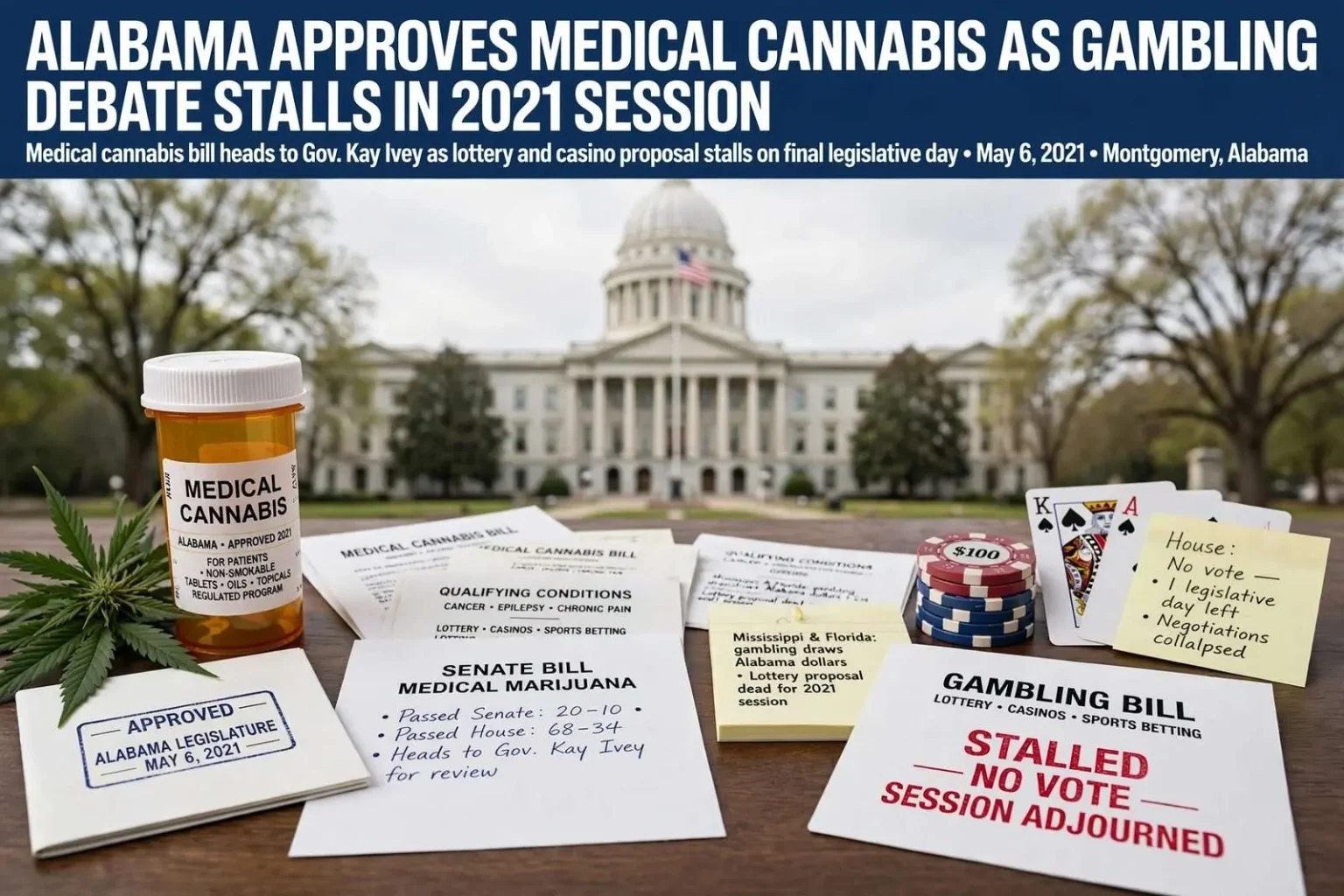
Alabama is poised to become the 37th state to allow medical cannabis after the Legislature sent a bill to Gov. Kay Ivey’s desk, even as a separate push to legalize gambling stalled with just one legislative day left. The twin outcomes capped an eventful regular session in which two of the most debated social policy questions in the South — medical marijuana and expanded gaming — took very different paths through the State House in Montgomery.
A Strict Medical Cannabis Law
The House gave final approval to the medical marijuana measure on a 68-34 vote, with one abstention, after the Senate had passed it 20-10. The bill cleared both chambers May 6 and was on its way to Ivey, who had said her office would ‘thoroughly review’ it. The margins reflected the delicate coalition behind the legislation: supporters included rural lawmakers representing patients who had lobbied for years, alongside suburban members who backed the bill only because of its tight restrictions.
Sponsored by Republican Sen. Tim Melson, a physician from Florence, the measure is one of the strictest in the country, limiting the qualifying conditions and banning smokeable flower. Patients would receive the drug only through a regulated chain running from licensed cultivators to processors to dispensing sites, and forms such as tablets, oils, topical applications, and other non-smokable preparations. The qualifying-conditions list covers chronic conditions such as cancer-related pain, epilepsy, and other serious diagnoses, and doctors must certify patients through a formal process under the oversight of a new state medical cannabis commission. That structure — a dedicated commission, a closed production chain, and a short list of approved conditions — was designed in large part to answer critics who warned the program could drift toward recreational use.
Supporters say it will give patients relief while keeping a tight regulatory framework. Advocates pointed to the experience of neighboring states that had already launched programs, arguing that Alabama had the advantage of studying what worked elsewhere and building a more controlled system from the start. For families who had driven to other states for treatment, or who had gone without, the vote marked the end of a years-long effort that had repeatedly stalled in previous sessions.
South Alabama lawmakers were central to the debate. Rep. Matt Simpson, R-Daphne, pushed an amendment that would have repealed the law automatically if the federal government reclassified marijuana — a proposal that was ultimately tabled. Simpson’s argument reflected the legal tension that hangs over every state cannabis program: marijuana remains illegal under federal law, and a reclassification could have rewritten the ground rules overnight. House Speaker Pro Tempore Victor Gaston, R-Mobile, spoke in favor of the bill. Every Mobile and Baldwin County senator voted to approve it; only Simpson and Republicans Shane Stringer and Harry Shiver opposed it in the House.
Beth Lyons, a Mobile-based lobbyist for the Baldwin County Association of Greenhouse Growers, said Alabama’s late arrival could be an advantage. ‘We have a very well-regulated industry we have created,’ she said. The greenhouse growers’ interest is straightforward: Alabama’s agricultural sector, from its established nursery industry to its indoor growing operations, sees licensed cultivation as a natural extension of existing greenhouse capacity. A tightly limited number of cultivator licenses, awarded under state rules, could channel the new market toward established growers rather than outside operators.
Analysts estimate as many as 290,000 patients could eventually qualify. That projection, drawn from the prevalence of qualifying conditions in the state’s population, explains both the commercial interest in the program and the caution of its critics. State regulators will spend the months after enactment writing rules, issuing licenses, and standing up the commission before the first dispensary products reach patients, a process that takes considerable time even in states with model programs to copy.
Gambling Left for Another Year
The gambling bill, which would have authorized a lottery, casinos and sports betting, passed the Senate but stalled in the House. Negotiations collapsed after a raucous day saw lawmakers run out the clock on a lottery-only version. The collapse was the culmination of months of competing proposals, each narrower than the last, as the House and Senate proved unable to agree on how far to go. What began as a sweeping constitutional amendment aimed at untangling Alabama’s patchwork gaming laws ended with lawmakers unable even to pass the single most popular piece — a simple lottery.
Alabama remains one of the few states without a state lottery, and without any legal casino gaming beyond the historically tolerated electronic bingo halls at the Birmingham Racing Course, VictoryLand in Shorter, and Greenetrack in Eutaw, along with the three compact-covered casinos run by the Poarch Band of Creek Indians at Wetumpka, Atmore, and Montgomery. Every previous attempt to write a consistent statewide framework — several in the past two decades — has died in a Legislature where the politics split along regional, religious, and institutional lines rather than simple party lines.
For coastal Alabama, the stakes are personal: Mississippi and Florida — the two states closest to Mobile and Baldwin counties — both offer gambling that draws Alabama dollars across the border. Mississippi’s Gulf Coast casinos in Biloxi and along Highway 90 have drawn Mobile-area visitors for decades, and the state’s riverboat and resort casinos capture much of the gaming traffic from south Alabama. Florida’s lottery, meanwhile, sells tickets to border-county residents who drive across the line weekly, and sports betting’s spread across the Southeast has added a new layer of leakage that lawmakers cited repeatedly in the debate.
Florida lottery records show more than 1,620 Alabama residents claimed prizes above $600 between early 2018 and March 2019, with at least 183 from Mobile County. Those numbers capture only the winners at the reporting threshold — the far larger population of regular players crossing the line for tickets leaves no record at all. Supporters of the legislation argued that the state was forgoing hundreds of millions of dollars that a lottery and regulated casinos would keep at home, money that in neighboring states funds scholarships, education budgets, and local infrastructure.
Sports betting added a modern wrinkle to the old debate. Neighboring states had moved to legalize it after a federal ban was struck down, and proponents warned that Alabama was surrendering a new market to Tennessee, Mississippi, and Florida while its own residents placed bets through apps and bookmakers beyond the state’s reach or tax authority. Opponents, however, saw expanded gaming as compounding one problem rather than solving it, and the coalition needed to pass anything — much less a constitutional amendment subject to statewide vote — never formed in the House.
Lyons remained hopeful a deal could still come together. ‘I think there’s hope for an agreement,’ she said. With only one legislative day left in the session, though, the practical effect was postponement: any revived effort would have to start again in the next session, with new negotiations and the same political arithmetic. For patients awaiting medical cannabis, the session ended with a waiting period of months as the state builds its program; for gaming supporters, it ended with the familiar realization that Alabama’s lottery and casino question will be back on the ballot in Montgomery, in one form or another, in the years ahead.
How the Session Unfolded
The split outcome was not for lack of effort. Both measures spent the session moving through committee hearings where physicians, patients, pastors, sheriffs, and industry representatives filed past the microphones, and both drew amendments up to the final days. The medical cannabis bill survived because its restrictions gave reluctant members a answer to worried constituents: a short conditions list, a ban on smoking, a new commission, and a pharmacy-style chain of custody. The gambling bill failed because every design choice — how many casinos, where, who regulates them, whether a lottery stands alone or inside a constitutional rewrite — cost it votes somewhere else in the building.
The final-week scramble illustrated the arithmetic. House members weighed a lottery-only bill as a fallback that would have put a constitutional amendment before voters, but the clock ran out amid floor fights and procedural delays before it could clear. Senators who had voted for the full package watched the House nibble it down to a shell, while House members from both parties argued that a lottery alone would betray voters who wanted a comprehensive fix to the state’s bingo-hall status quo. When the last day arrived, there was nothing left to pass.
For Mobile and Baldwin County, the session’s results will be felt in different ways and on different timelines. The cannabis program will roll out through state licensing that could benefit local greenhouse operators and create dispensary and processing jobs, though patients should not expect products on shelves immediately. The gaming question returns to Montgomery unresolved, with coastal lawmakers once again carrying the argument that Alabama dollars are funding Biloxi and Tallahassee instead of schools and roads at home. Both issues carry forward into the next session, where the coalitions built this year — and the amendments that failed this time — will shape the next round of debate.