Mobile Sunrise Rotary Marks World Polio Day, Recalling Alabama’s 1941 Outbreak
The Mobile Sunrise Rotary Club marked World Polio Day with a club meeting recalling Alabama's 1941 polio outbreak and Rotary's decades-long campaign that has helped vaccinate more than 2.5 billion children worldwide.
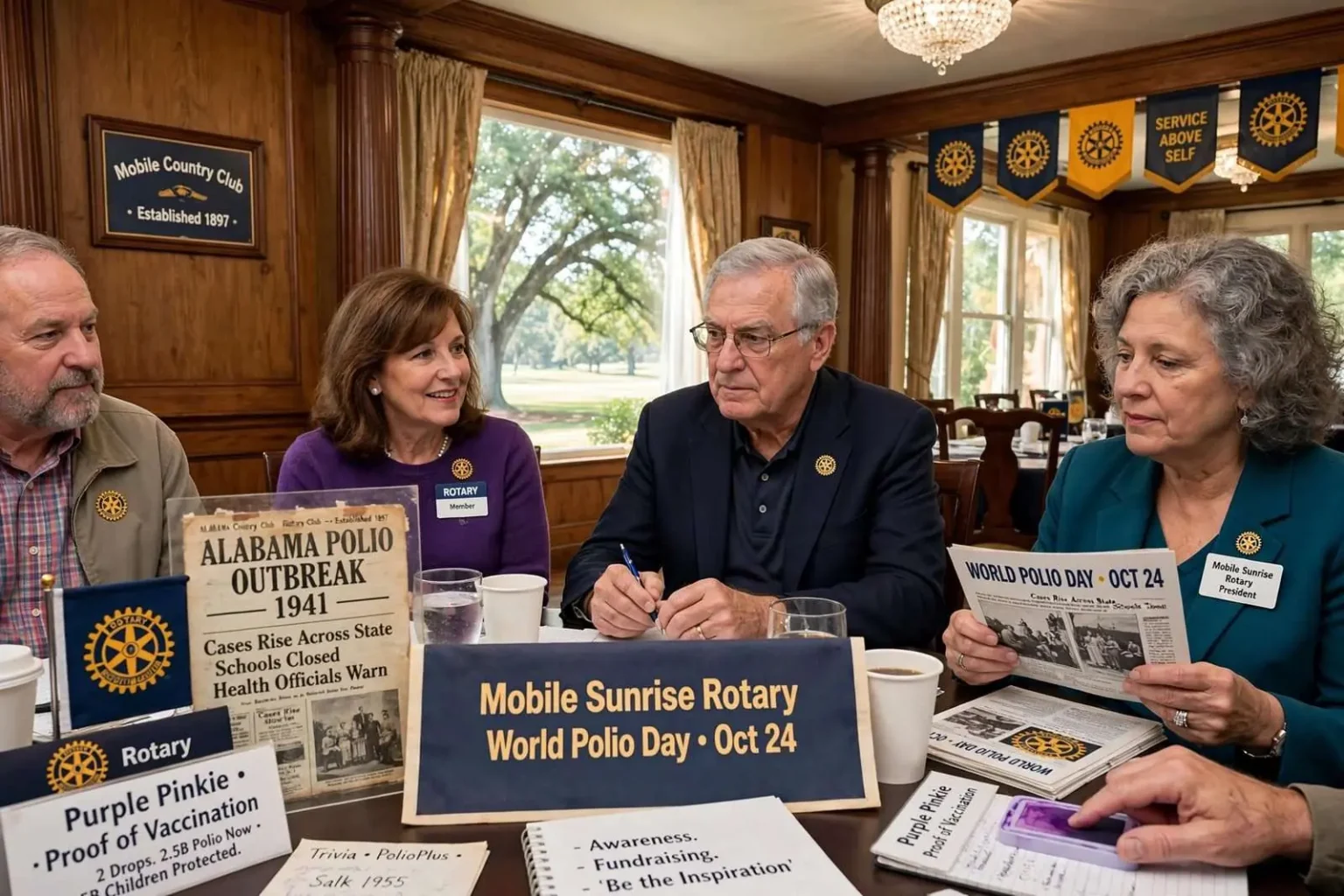
Members of the Mobile Sunrise Rotary Club gathered at their weekly meeting at the Mobile Country Club to observe World Polio Day, an annual recognition held each Oct. 24 in honor of Dr. Jonas Salk, whose birthday falls on that date.
Club members split into teams for a round of Jeopardy-style trivia focused on the Rotary Foundation and its PolioPlus campaign, and guests were invited to join in the questions and conversation.
The trivia format has become a favorite device of Rotary programs because it turns a history lesson into a contest — and the history being quizzed is substantial. The Rotary Foundation’s PolioPlus campaign is one of the longest-running public-private health partnerships in the world, and its chapters include moments Mobile members know well, from the founding commitments of the late 1970s to the immunization drives that continue in the last countries where the virus circulates. The club has set its sights on doing more next year, with members planning additional public events aimed at raising awareness and support for the fight to end polio for good.
When polio came to Alabama
The observance carries particular weight in Mobile, a city with its own history of the disease. In 1941, newspapers across Alabama reported widespread polio outbreaks statewide. Some who contracted the virus experienced only mild, flu-like symptoms. Others were left permanently paralyzed, and some died. At the time, there was no way to stop the virus once it took hold.
The summer outbreaks of that era followed a pattern that terrorized American communities for the first half of the twentieth century. Polio struck hardest in warm months, when children playing in public pools and wading fountains were thought to be at greatest risk, and parents responded with quarantines, canceled church picnics and warnings to keep children away from crowds. Alabama newspapers of the period carried the count of new cases alongside the weather, and communities shut their swimming pools when the numbers climbed. Survivors who were paralyzed faced a lifetime of bracing, surgery or, in the most severe cases, the iron lung — the tank respirator that breathed for patients whose chest muscles the virus had silenced.
Polio attacks the nervous system and can spread through direct contact with an infected person or through contaminated food and water. For decades it had no cure and no reliable means of prevention, leaving families across the state to watch and wait each summer as outbreaks swept through communities.
The vaccine that changed everything
That changed in 1955, when Dr. Salk developed a vaccine that halted the virus’s spread. Rather than patent the discovery, Salk and his collaborators chose to make it freely available, reasoning that the breakthrough belonged to the world rather than to any one inventor’s bottom line.
The decision made Salk a national figure overnight, and the rollout that followed was one of the largest public health mobilizations in American history — schoolchildren lined up in gymnasiums and auditoriums for injections, with Alabama’s health departments joining the nationwide campaign. Within a generation, the paralytic disease that had emptied swimming pools each summer had become, in the United States, a memory. The vaccine’s success is what made eradication thinkable, and it is the anniversary the Rotary clubs mark each October.
Rotary’s global push
In 1979, Rotary International, together with area clubs in Mobile, committed to leading a global push to eradicate polio entirely. In the decades since, Rotary’s efforts have helped vaccinate and protect more than 2.5 billion children worldwide.
The scale of that progress is stark. In 1979, more than 350,000 polio cases were reported worldwide across more than 100 countries. Today, only a small number of countries continue to report cases of the wild poliovirus.
Rotary’s role in that progress is logistical as much as financial. Club members have flown at their own expense to India, Nigeria, Pakistan and Afghanistan to staff immunization booths, and the organization’s advocacy helped unlock billions in matching funds from governments and global health partners. The endgame has proven the hardest stretch: reaching children in conflict zones and remote regions, and convincing hesitant families village by village. Health officials caution that the job is not finished until every country receives an all-clear, a goal that depends on doctors, nurses, researchers, analysts and field workers continuing their work in the hardest-to-reach places.
A reminder close to home
The stakes of continued vigilance were underscored recently when the Centers for Disease Control and Prevention reported clusters of children in Colorado and Minnesota diagnosed with acute flaccid myelitis, a rare condition that mimics some symptoms of polio. Health officials say the cases are a reminder that vigilance against paralytic illnesses remains important even as polio itself nears eradication.
Acute flaccid myelitis remains poorly understood — researchers have associated many cases with common respiratory viruses, but no single cause has been pinned down — and its appearance in American children startled families who think of polio as a historical matter. The lesson Rotary speakers draw from it is continuity: the surveillance networks, laboratory capacity and vaccine science that defeated polio are the same tools that stand ready against whatever comes next.
Mobile Sunrise Rotary meets on Wednesday mornings at the Mobile Country Club, and each year the club raises money both for the campaign to end polio and for local charities. Guests are welcome to attend.
The club is encouraging community members to join its “Be the Inspiration” giving effort to help end polio for good, and those interested in learning more about Mobile Sunrise Rotary or other area Rotary clubs can find information through Rotary International’s website.
Local Rotary service in Mobile stretches back generations, with clubs funding scholarships, youth programs and international exchanges alongside the global health work, and the morning meeting format that gives the Sunrise club its name draws members who serve before the workday begins. For the members who played trivia in honor of World Polio Day, the point of the game was the scoreboard that matters most: a disease that once filled Alabama newspapers with dread each summer now survives in only a handful of places on Earth — and the generation that finishes the job is already in the room.
The numbers behind the campaign explain why Rotary keeps asking. PolioPlus and its partners — the World Health Organization, UNICEF, the U.S. Centers for Disease Control and Prevention and, more recently, the Bill and Melinda Gates Foundation, which matches every Rotary dollar two to one — have built the largest public health campaign in history around a simple act: two drops of vaccine on a child’s tongue, repeated until the virus has nowhere left to spread. National immunization days close schools and bus stops as vaccination posts; volunteers track every village and caravan route; and laboratory networks confirm when a region is truly clear. Rotary members raise money for that machinery year-round through district dinners, purple-pinkie campaigns and club giving, and Mobile Sunrise’s own fundraising feeds the same pipeline.
The 1941 Alabama outbreaks the club recalled remain within living memory for some Mobile families. Stories from that generation include classmates who vanished from school for weeks, returned with leg braces or not at all, and swimming holes declared off-limits by the health department. The physical therapists, orthopedic surgeons and respiratory specialists who served polio survivors built much of Alabama’s rehabilitative medicine in response to those years, an infrastructure legacy that outlasted the disease itself. It is the kind of history a local Rotary program can claim firsthand: members whose parents lined up for the first Salk shots, and whose grandparents remembered when the threat arrived with the summer heat.
For guests invited to Wednesday’s meeting, the club’s message was double-barreled — a celebration of how far the campaign has come, and a solicitation for the last mile. Contributions to the “Be the Inspiration” effort are matched and stretched by the international giving structure, multiplying a single club’s collection, and the club’s planned public events next year aim to bring that case to audiences beyond the Mobile Country Club dining room. The trivia questions, meanwhile, will keep their answers simple: a vaccine given freely, an army of volunteers, and a disease with fewer places to hide every year.
World Polio Day observances now take place in thousands of communities across dozens of countries each October, but the anniversary carries a local flavor wherever a club meets. In Mobile, that has meant Mayor’s office proclamations, purple-pinkie awareness stations, and programs that connect the global campaign to Alabama’s own memories of the disease. The Sunrise club’s trivia morning was the lighter end of that spectrum, but organizers hope it plants the same seed — that a member or guest will carry the story to a business meeting, a classroom or a family dinner table, which is how a fundraising campaign that runs on volunteers actually grows.