Foley Credit Card Theft Case Led to Arrests in 2008
A 2008 WKRG report covered allegations that two Baldwin County women used stolen credit cards during a shopping spree.
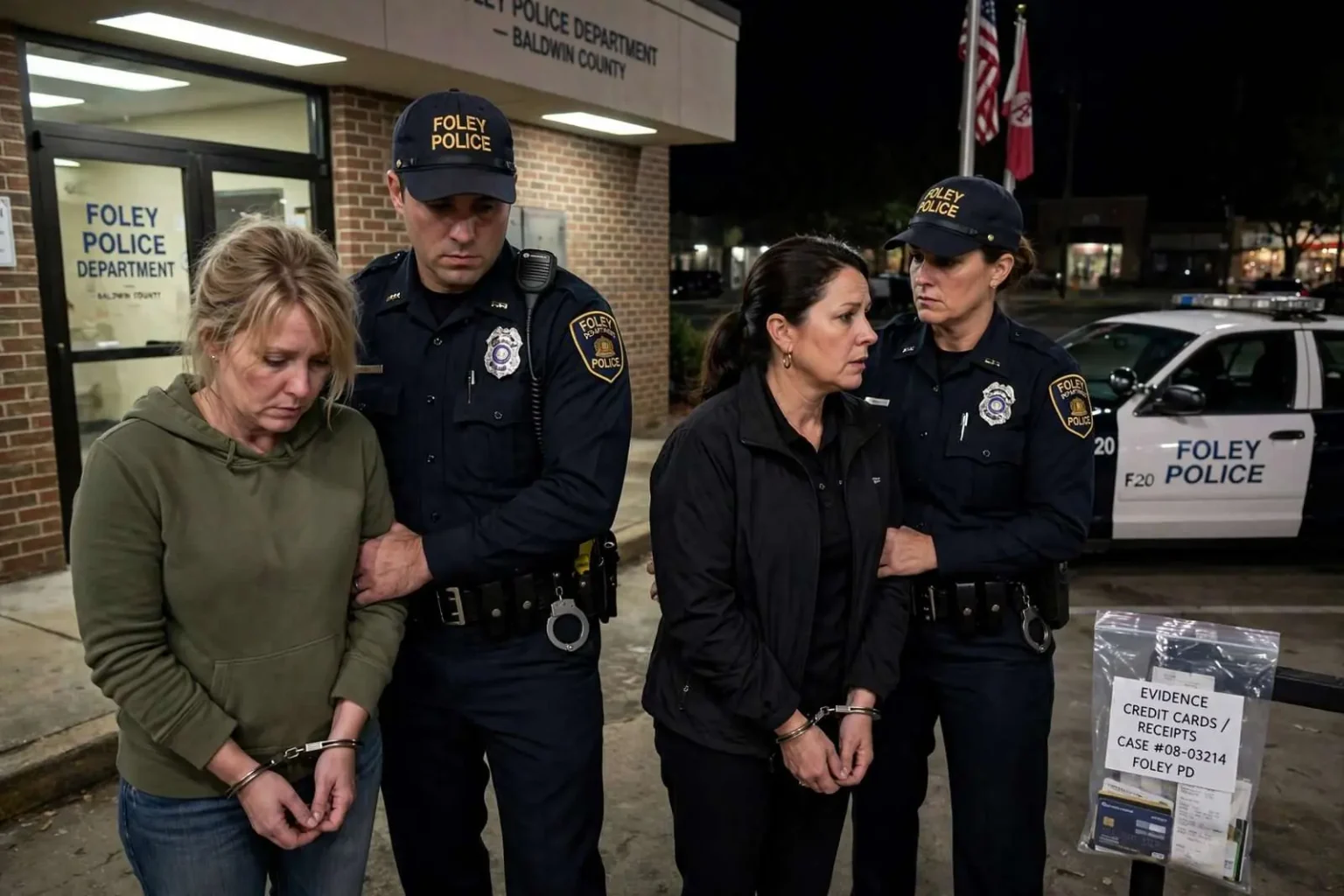
FOLEY, Ala. — Foley police arrested two Baldwin County women in a 2008 credit-card theft case, according to a local station, in an investigation that traced a string of fraudulent purchases across the city in a matter of days. Police alleged that Brenda Porter and Michell Allen used stolen cards over three days, signing the cardholder’s name to nearly $2,000 in purchases — a spree that moved from one register to the next while the victim, likely unaware the cards were even gone, continued to carry on with daily life.
The report said surveillance footage captured many of the transactions, giving investigators a visual record of the purchases and a tool for matching the suspected users to the cards. That evidence played a central role in building the case, as detectives compared store video with the timeline of charges to establish where and when the cards were used. Surveillance systems by that era had become standard equipment at retailers large and small, and cases like this one illustrated how frequently that technology converted a series of anonymous transactions into an identifiable trail.
Credit-card theft cases follow a familiar arc. A theft occurs — a purse, a wallet, cards taken from a vehicle or workplace — and, before the loss is reported and the account frozen, the thief or an associate moves quickly to spend as much as possible. Cards without PIN requirements can be used at stores and gas stations with nothing more than a signature, and crooked users often attempt to imitate the cardholder’s name in the signature line to delay detection. In the Foley case, police alleged that pattern directly: the signature of the cardholder’s name on purchases totaling nearly $2,000 over three days.
How the investigation comes together
For the Foley Police Department, the investigation required the kind of patient, detail-oriented work that defines most financial crime cases. Detectives gathered transaction records from merchants, aligned them with timestamps from surveillance video, and pieced together the route the suspects allegedly traveled through the city. Each purchase became a data point — a location, a time, an amount, a signature — and collectively those data points built a narrative that prosecutors could present to a court.
Victims of card theft face a cleanup process of their own. Banks and card issuers generally zero out liability for unauthorized charges once they are reported, but the victim must cancel accounts, wait for replacement cards, and sort through which charges were legitimate and which were not. Merchants, meanwhile, absorb the loss on fraudulent purchases where goods have already left the store, a cost that gets built into the price of doing business and, ultimately, into the prices honest customers pay.
The arrest process itself unfolded according to standard procedure. Once investigators identified the suspects and developed probable cause, warrants were sought and the arrests were carried out by Foley officers. Booking procedures documented the charges, and the case file — transaction records, video stills, witness statements, and the tally of alleged losses — was prepared for referral to prosecutors. From there, decisions about formal charges, bond, and court dates moved into the hands of the judicial system, as they do in every criminal case.
Alabama law treats theft of a credit card and fraudulent use of a stolen card as criminal offenses, with penalties that scale with the value involved. A spree reaching nearly $2,000 over three days places the alleged conduct in the range where felony charges are possible under state law, and prosecutors typically pursue such cases alongside any related charges, such as receiving stolen property or identity fraud, depending on the facts developed in the investigation.
The 2008 context
The case landed in 2008, a year when financial crime was very much in the public conversation. The national economic downturn was deepening, and local police departments across the country reported increases in theft and fraud offenses as financial pressure mounted on households. Credit- and debit-card fraud, in particular, was an area of growing concern for retailers and banks, and the retail industry was still in the early years of its shift toward the chip-card and security technologies that would later make simple signature-based fraud harder to carry off.
In that environment, cases like the Foley investigation served as a reminder to residents of how quickly a stolen card could be exploited. Law enforcement agencies in Baldwin County — one of Alabama’s fastest-growing counties, with a retail corridor that stretches from the Eastern Shore communities down through Foley toward the beach towns — cooperated regularly on property and financial crimes, since stolen cards rarely respect city limits. A card taken in one jurisdiction could be used in three others within an hour, making multi-agency communication an essential part of closing a case.
The local station’s report on the arrests captured the essentials: two Baldwin County women in custody, an allegation of a three-day spending spree under a stolen name, nearly $2,000 in purchases, and surveillance footage tying it together. For Foley police, the arrests represented the end of a swift investigation; for the alleged victims and the merchants involved, the start of the process of accounting for what was taken.
As with any criminal allegation, the charges in the case were accusations at the time of the arrests, and the suspects were entitled to the presumption of innocence and to their day in court. This account is a historical summary of police allegations and arrests as reported in 2008. It does not state final court outcomes, which were resolved through the judicial process that followed the arrests.
The Foley Police Department serves a city that has grown into one of Baldwin County’s principal retail centers, anchored by its downtown and by the large shopping destinations that have developed along the Highway 98 and Highway 59 corridors. With that retail volume comes a corresponding volume of property crime, from shoplifting to the kind of card fraud alleged in the 2008 case, and the department’s investigators handle financial crimes as a routine part of the caseload. Foley’s position in the heart of the county — just west of Highway 59’s route to Gulf Shores and Orange Beach — puts it on the path of both local shoppers and the tourist traffic that surges through Baldwin County in every season.
Retail surveillance in 2008 was a patchwork of analog and digital systems. Larger chains had largely converted to digital recorders that kept days or weeks of footage on hand, while smaller merchants still relied on older equipment of varying quality. Detectives working fraud cases routinely toured from store to store collecting video, a process that rewarded speed since some systems recorded over themselves within days. The ability to match a suspect on video to a transaction slip — the amount, the time, the signature — was often the difference between a case that could be charged and one that could not.
What victims can do
Law enforcement agencies use cases like this one to reinforce the advice given to cardholders who discover a theft. Report the loss immediately, since the window between theft and cancellation is precisely when thieves spend the most. Review account statements line by line for charges that are not yours, because small test purchases often precede larger ones. Ask merchants for copies of receipts and footage showing the fraudulent use, which helps both the bank’s fraud investigation and the police report. And monitor credit reports afterward, since a stolen card is sometimes accompanied by other identifying information that can be exploited later.
Banks, for their part, have steadily built automated fraud detection into card systems — flagging purchases that break a customer’s pattern, occur in distant locations, or cluster in suspicious bursts. In 2008 those systems were cruder than today’s machine-learning tools, but they already caught many fraudulent transactions before cardholders noticed anything amiss. The human report, however, remained the fastest way to kill a compromised account.
For the courts, credit-card fraud cases present distinctive evidence questions: proving who actually used the card, establishing the signer’s knowledge that the card was stolen, and tallying the total value of the fraud across many small transactions. Surveillance footage and signature comparison figure prominently in meeting those burdens, which is why the video cited in the Foley case mattered so much to the alleged charges. Witness testimony from merchants and clerks who interacted with the card users typically rounds out the prosecution’s case.
The 2008 Foley arrests remain a snapshot of an era in Gulf Coast retail crime — before chip readers and tap payments transformed the landscape, when a stolen card and a practiced signature could carry a thief through days of shopping undetected. The case ended where every such case must: in the courts, where the evidence gathered by Foley detectives would be tested against the presumption of innocence, and where the final word on the allegations would be written not in a news report but in the record of the judicial process itself.