Foley Police Investigated Suspicious Death in 2008
A 2008 WKRG report covered Foley police investigating a woman's body found inside a West Section Avenue home.
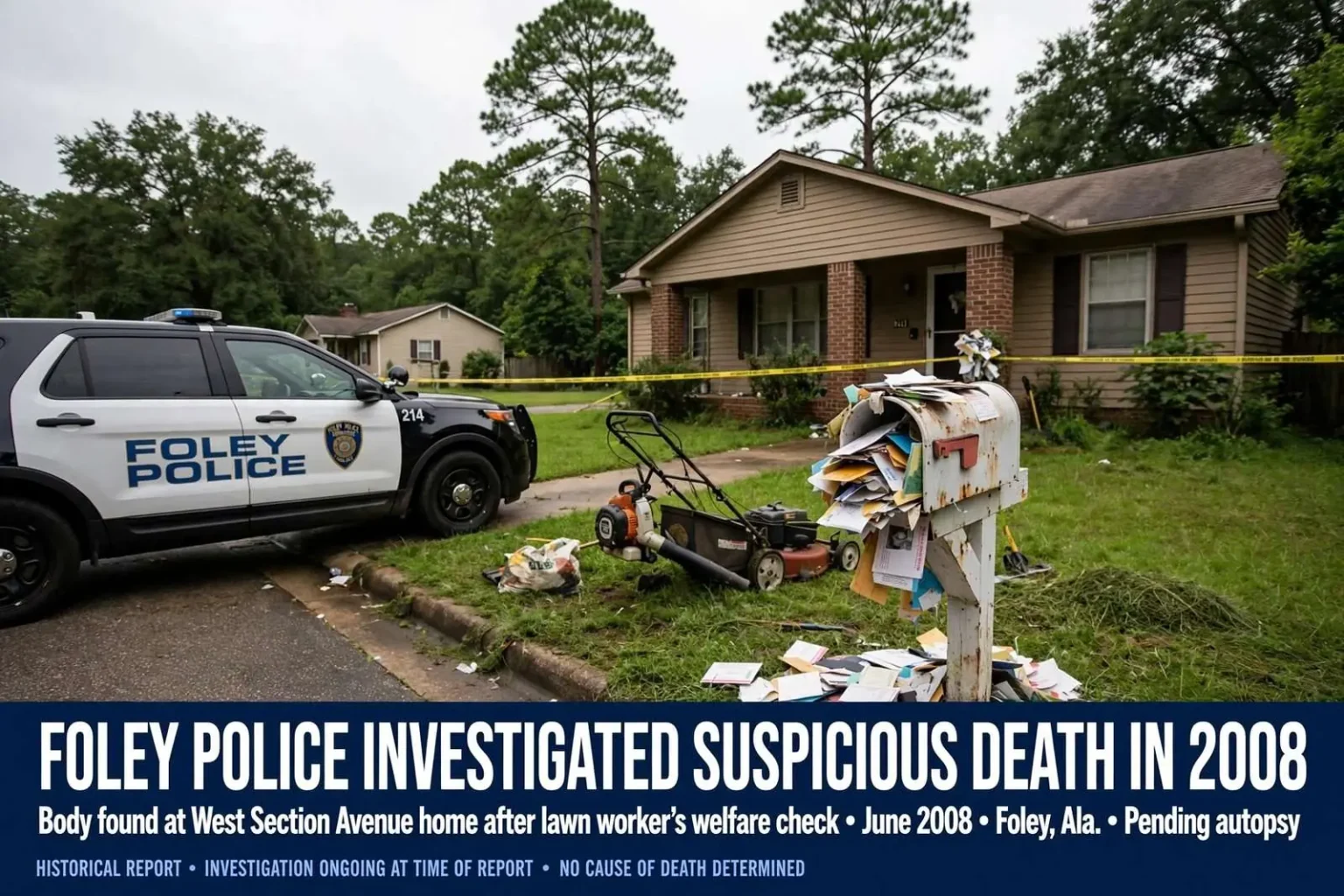
FOLEY, Ala. — Foley police investigated a suspicious death after a woman’s body was found inside a home on West Section Avenue in June 2008, according to a local news report from the time.
Police were alerted by a lawn worker who said the resident had not answered the door and that the mailbox had filled with mail, prompting the report that led officers to the house.
Investigators said their preliminary work indicated possible drug activity at the home. At the time of the report, police had not publicly identified the woman or determined the cause of death, pending autopsy results.
This is a historical account of a preliminary investigation reported in 2008. It does not state later findings or court outcomes, and nothing in the original report established how the woman died or whether any crime occurred.
How a welfare call becomes a death investigation
The tip that brought police to the West Section Avenue home came from an unlikely but familiar place: a lawn worker keeping a scheduled appointment. Service workers, mail carriers and neighbors are frequently the first people to notice when something is wrong at a residence — newspapers piling up, mail uncollected, a door unanswered across several days — and a request for a welfare check is often the first official step in discovering a death that no one else has reported.
When officers arrive and find a deceased person under circumstances that are not immediately explained, the call is classified as a suspicious death rather than a confirmed homicide or an obvious natural death. That classification is deliberately neutral. It directs investigators to treat the scene as a potential crime scene — securing the home, documenting everything, awaiting forensic results — while leaving open every possibility from natural causes to foul play until the evidence says otherwise.
In the Foley case, the preliminary indication of possible drug activity at the home added a line of inquiry without resolving the central question. Possible drug activity is a circumstance investigators note and pursue, not a cause of death, and police said at the time that no determination had been made about how the woman died.
Foley and its police department
Foley sits in southern Baldwin County, a city of more than 10,000 people at the time of the 2008 report and one of the fastest-growing communities on the Alabama Gulf Coast. Anchored by its historic downtown and the Tanger Outlets center that draws shoppers from the beach towns, Foley serves as a commercial hub for the communities between Mobile Bay and the Perdido, and its police department handles the full range of municipal law enforcement for a city straddling both residential neighborhoods and heavy retail traffic.
Baldwin County’s population growth through the 2000s shaped the environment local departments worked in. New subdivisions, an expanding year-round population and a tourism economy that swelled the region’s population seasonally all added demands on small-city police forces, and unexplained deaths — while rare in any community — draw significant investigative resources when they occur.
For a case like the one on West Section Avenue, a small-city department typically brings in support as the investigation requires: the Alabama Department of Forensic Sciences for the autopsy, the district attorney’s office for consultation on charges, and in some cases assistance from county or state agencies if the evidence points toward a crime that exceeds local investigative capacity.
The autopsy and the waiting
The cause and manner of death in an unexplained fatality rest with forensic pathologists, not with the police department investigating the scene. In Alabama, autopsies in such cases are conducted through the state Department of Forensic Sciences, and the results — toxicology, tissue examination, the pathologist’s determination of cause and manner — routinely take weeks to finalize, particularly when toxicology screens are involved.
That waiting period shapes what police can say publicly. Until the autopsy and toxicology work are complete, a department cannot state whether a death was natural, accidental, a suicide or a homicide, and public statements in the interim are limited to what investigators observed: that a body was found, that the death is being treated as suspicious, and that the investigation continues.
Identification follows its own process. If the woman found in the home could not be formally identified through documents or family notification, investigators would use forensic means to confirm her identity before releasing her name — another step that contributes to the silence in the early days of such a case.
What the neighbors notice
The details in the original report — the unanswered door, the mailbox filling with mail — describe the ordinary evidence of a life interrupted that accumulates around any home where someone has died alone. Postal carriers and lawn services keep schedules that make them accidental witnesses, and it was a lawn worker’s concern, passed along to police, that brought the West Section Avenue house to official attention in June 2008.
Police departments generally encourage residents to make such calls rather than assume someone else has. A welfare check that ends with an explanation is a few minutes of an officer’s time; one that finds an emergency can save a life, and one that finds a death starts an investigation on the footing of prompt discovery rather than days of delay.
For the neighborhood, the discovery of a body inside a house on a residential street brings its own aftermath: officers at the door, questions from reporters, and a stretch of days in which the home is treated as an active scene. In Foley in June 2008, the report describes exactly that scene unfolding on West Section Avenue.
What the record shows — and does not
The 2008 report stands as a snapshot of a preliminary investigation. It documents the discovery of the body, the lawn worker’s alert, the preliminary indication of possible drug activity at the home, and the pending autopsy, and it stops there.
It does not include the autopsy findings, the woman’s identity, whether the death was ultimately ruled a crime, or whether anyone was ever charged. Those details, if they exist in the public record, would be found in later reporting, court filings or records from the agencies that handled the case — none of which are part of the account summarized here.
What the report preserves is the opening chapter of a small-city death investigation: an alert service worker, a house on West Section Avenue, a department treating the death as suspicious, and a Gulf Coast community waiting on answers that the initial reporting, by its nature, could not yet provide.
Drug activity as an investigative thread
When investigators noted possible drug activity at the West Section Avenue home, it opened a standard set of follow-ups: interviews with anyone who visited or knew the residence, a review of any calls police had made to the address before, and coordination with drug enforcement officers who might have prior knowledge of activity in the area. Such a thread can inform the direction of an investigation without ever appearing in its conclusion, and its presence in the preliminary reporting says only that investigators were not treating the death as fully explained.
The distinction matters for how the public reads an early report. A preliminary indication of possible drug activity is not a finding about the death itself — the woman may have been a user, a bystander, or entirely uninvolved — and responsible reporting at the preliminary stage, like the 2008 account summarized here, frames it as exactly what it is: one observation among many that the autopsy and investigation would either confirm or discard.
Deaths connected to drug activity present particular investigative challenges. They may involve people reluctant to speak with police, records that exist only in informal networks, and a timeline that stretches back days or weeks before a body is found — complications that small-city departments navigate with whatever help county, state and federal partners can provide.
Unexplained deaths in a growing county
Baldwin County in 2008 was adding residents at one of the fastest rates in Alabama, and the growth carried implications for how cases like this one unfolded. Newcomers arrive without the long local relationships that once helped small-town investigators place a person in context, and the transient workforce that follows construction and tourism leaves fewer people who notice when someone goes quiet.
The region’s medical infrastructure also shaped the case. With forensic autopsies handled through the state system and based in Mobile, the logistics of examination and identification for a Baldwin County death added time to every step, and the early public record of such cases is often frozen for weeks while the science is completed.
None of that is unusual — it is the ordinary machinery of a death investigation in a mid-sized Southern county. But it explains why the June 2008 report from West Section Avenue reads the way it does: a discovery, a description, a preliminary thread and a list of questions the reporting could not yet answer, preserved exactly as it stood in the summer of 2008.