As Mobile Grows, Old Debate Over the George Wallace Tunnel Resurfaces
As Mobile's population grows, residents and commuters revisit the debate over tunnel congestion and a possible future Mobile Bay bridge to the Eastern.
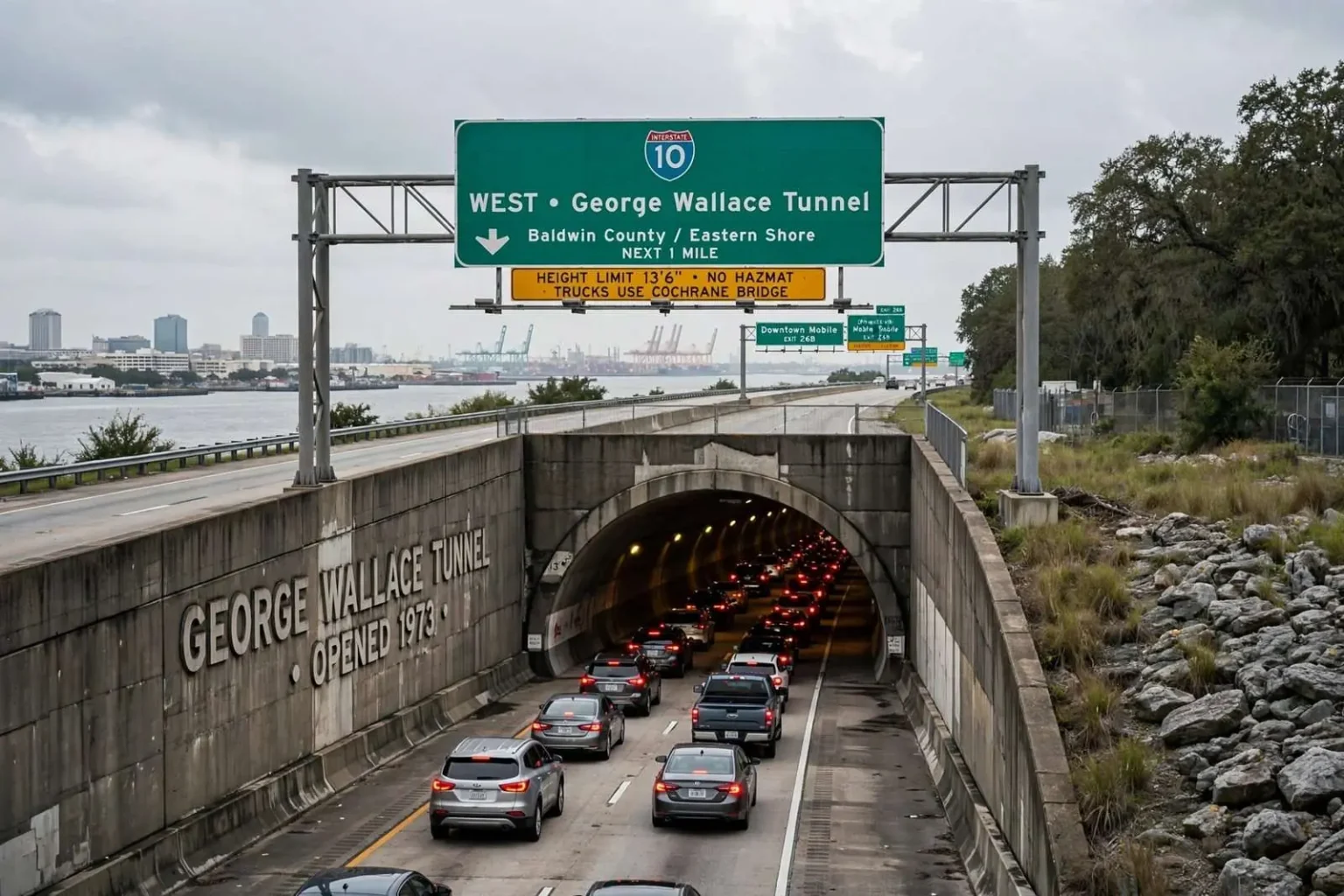
As Mobile continues to grow, so does the conversation about whether the city’s aging infrastructure can keep up, and one perennial topic has resurfaced: traffic trouble in the George Wallace Tunnel, the underwater crossing that carries Interstate 10 traffic beneath the Mobile River between downtown and Baldwin County. Talk of new tunnels and causeway improvements has picked up again as officials weigh how to handle the region’s growing population and the traffic that comes with it. For many longtime commuters, that conversation inevitably raises the question of whether construction crews and lane closures will make an already tight squeeze even tighter in the meantime.
The tunnel has been part of Mobile’s landscape for a half-century. Opened in 1973, the George Wallace Tunnel was built as a pair of twin tubes, each carrying two lanes of Interstate 10 traffic, and it remains one of the most distinctive stretches of highway on the Gulf Coast. Drivers drop beneath the Mobile River just past the downtown waterfront and climb back to the surface on the far bank, where the highway continues east toward the Eastern Shore and, eventually, the beaches of Baldwin County. The crossing replaced the older Bankhead Tunnel, which opened in 1941 and still carries surface traffic downtown, as the primary route for interstate traffic between the two sides of the river.
Because the tunnel bores beneath a working harbor, it comes with constraints that a bridge never would. The approach grades are steep by interstate standards, the curves are tight, and trucks carrying hazardous materials are routed away from the crossing entirely, sending heavy freight traffic north over the Cochrane-Africatown USA Bridge on the U.S. 90 and 98 truck route. Commercial drivers who exceed the tunnel’s height clearance face the same detour. Those workarounds keep the tubes safe, but they also concentrate a steady share of the region’s largest vehicles onto a single northern crossing while funneling nearly everything else through four lanes beneath the river.
That funnel effect has only intensified as the region has grown. Baldwin County has ranked for years among the fastest-growing counties in Alabama, and much of that growth is tied by the highway to Mobile’s job centers. Every morning, commuters from Daphne, Spanish Fort, Fairhope and points beyond funnel onto Interstate 10 West and down into the tunnel; every evening the flow reverses. The tunnel was engineered for a different era of traffic volumes, and drivers feel the mismatch daily in the form of slowdowns that can begin well before the entrance plaza and stretch back toward the Causeway or the downtown exits.
The congestion has fed a long-running policy debate that flares up whenever growth or infrastructure makes headlines. State and local officials have studied everything from additional crossings to improvements along the U.S. 90 Causeway, the low-level route that skirts the southern edge of the Mobile-Tensaw Delta. A high-profile effort to build a new bridge over the Mobile River and replace the Interstate 10 Bayway with an elevated span collapsed amid years of public opposition to tolling, leaving the existing infrastructure to carry a growing load. Against that backdrop, residents have returned to a familiar argument about the tunnel itself.
Is It the Tunnel’s Design or Drivers’ Habits?
Beyond construction concerns, there’s a longstanding debate about the tunnel itself: is the persistent congestion and erratic driving there really about the tunnel’s design, or about the way people drive once they’re inside it? The question comes up on local social media pages and around office coffee pots with remarkable regularity, and it splits into two camps with sharply different diagnoses of the problem.
Some commuters appear to speed up the moment they enter, seemingly eager to get through and back into open air. The behavior is common enough that regular users of the crossing describe it as almost ritual: traffic that had been crawling through the approach suddenly surges once the ceiling closes in, with drivers racing the half-minute or so it takes to pass beneath the river. Safety-minded observers argue that the enclosed tubes, with their limited shoulders and restricted sight lines, are precisely the wrong place for acceleration, and that the tunnel’s geometry leaves little margin for error when drivers treat it as a sprint.
Others slow down or grow visibly anxious, a reaction some only half-jokingly attribute to a mild fear of enclosed spaces underwater. For those drivers, the experience of thousands of tons of river overhead is genuinely unnerving, and the instinct to brake compounds the stop-and-go pattern behind them. Transportation planners have long noted that abrupt speed differences within a single roadway, rather than volume alone, are a major driver of phantom congestion, and the tunnel offers a textbook case: one driver’s claustrophobia becomes the next driver’s brake lights.
Dropped cell phone calls inside the tunnel add another layer of frustration for drivers used to staying connected on their commute. The thick concrete and steel that hold back the Mobile River also block radio signals, so calls and streams cut out in the middle of the crossing and reconnect on the far side. In an era when a growing share of commuters rely on navigation apps, hands-free calls and streaming audio to manage their day, the dead zone is a small but persistent annoyance — and one more reason drivers describe the tunnel as the least pleasant few hundred yards of their day.
From Diagnosis to Possible Fixes
The design-versus-behavior debate matters because it shapes what fixes people are willing to consider. Those who blame the design point to solutions that would require major construction: a wider or taller crossing, a second tunnel, or an entirely new route across the river. Those who blame driver behavior argue for cheaper measures — consistent enforcement, better signage, variable speed messaging on the approaches — that could smooth flow through the existing tubes without moving a single ton of earth. In practice, the two positions usually blend together, since neither better behavior nor better design can alter the underlying fact that four lanes beneath the river are carrying demand built for many more.
City and state engineers, for their part, continue to treat the tunnel as a maintenance priority. The structure requires regular inspections of its pumps, ventilation equipment and structural components, work that occasionally brings lane closures of its own. Those maintenance windows are a recurring reminder that the crossing, like all of the region’s river infrastructure, is aging, and that keeping it serviceable is a year-round job that competes with the same budgets that would fund any larger replacement.
Wish-List Ideas for a New Crossing
The tunnel’s traffic headaches have fueled bigger-picture wish-list thinking about how Mobile might eventually replace or supplement it. One idea floated informally by residents is a large signature bridge spanning Mobile Bay, connecting downtown Mobile to the Eastern Shore — something akin to a smaller-scale version of San Francisco’s Golden Gate Bridge. The image appeals to civic pride as much as to traffic engineering: a single dramatic span rising over the bay would announce Mobile’s growth in a way that a tunnel bored beneath the river never could, and it would eliminate the claustrophobic squeeze that so many drivers love to complain about.
Under that vision, a new span could run alongside the existing Causeway, preserving the low-level route across the bay for drivers who prefer it while giving others a faster, more open alternative to the tunnel. The Causeway, which carries U.S. 90 along the edge of the delta, has its own devoted following among locals — fishermen, cyclists and commuters who appreciate the open water views and the access to the delta’s launches and restaurants. Any grand project that routed around or over it would have to reckon with the wetlands, the floodplain and the communities that line the existing roadway, which is part of why the idea has remained a wish-list item rather than a funded plan.
The region has been down the big-project road before. The push for a new Interstate 10 crossing over the Mobile River and a rebuilt Bayway advanced through years of study before stalling when the accompanying toll proposal met fierce resistance from commuters and Baldwin County officials. The episode left a lasting imprint on the infrastructure conversation: residents here are acutely sensitive to how new crossings would be paid for, and any future proposal — tunnel, bridge or otherwise — would start from the assumption that tolls are politically fraught. It also left the existing assets, tunnel included, with no clear replacement on the horizon.
In the meantime, the alternatives to the tunnel each carry trade-offs that commuters know well. The Bankhead Tunnel handles downtown surface traffic but is older still and similarly constrained. The Cochrane crossings north of downtown add miles for Eastern Shore traffic and carry much of the region’s truck load. The Causeway offers a scenic but slower route that floods access during severe weather. None of them, individually or together, changes the arithmetic that the four-lane tunnel remains the single most direct link between Mobile’s downtown and the growing suburbs across the bay.
For now, the George Wallace Tunnel and the Causeway remain the primary links between Mobile and the Eastern Shore, carrying a steadily increasing share of the region’s daily commuter traffic. Whether that changes with new construction, a future bridge, or simply drivers adjusting their habits, the conversation about how Mobile moves between its two shores looks likely to keep resurfacing as the region continues to grow. Until something larger changes, commuters will keep taking a breath, dropping under the river, and debating the whole way across whether the problem is the tunnel — or the people driving through it.