
Kim Family Releases Third Video of Alleged Hazing at Davidson High School as Final Juvenile Appears in Court
The Kim family released a third video of an alleged hazing incident at Davidson High School as the final juvenile charged appeared in Mobile County court.
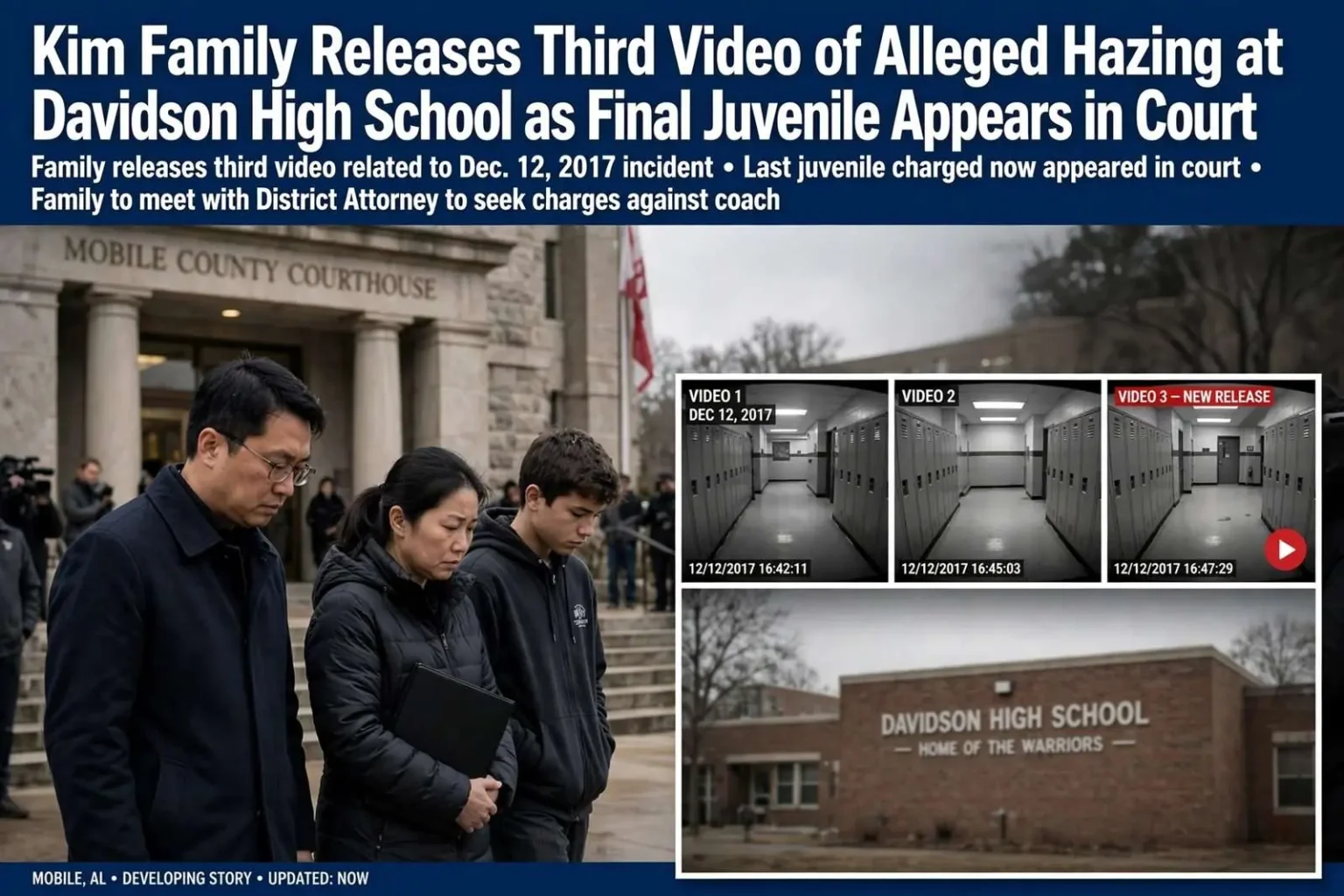
The family of a Davidson High School student has released a third video related to an alleged hazing incident that occurred on December 12, 2017, according to reports from Mobile. The release came as the last of the juveniles charged in the case appeared in court, keeping the months-old controversy at the center of public attention even as the legal process moves quietly through juvenile proceedings.
The videos, which the Kim family has released in stages, document the alleged hazing that set the case in motion. Each new release has renewed discussion across Mobile about what happened on the Davidson campus that December day, what school officials knew, and what consequences should follow — questions that have now persisted well beyond the initial police investigation.
All of the juveniles involved have apologized for the hazing incidents, a point that emerged through the court process. The apologies, delivered through attorneys and court proceedings rather than public statements, mark part of the resolution of the juvenile side of the case, though they have not satisfied the victim’s family, who continue to press for accountability at another level.
Following the court session, the Kim family said it planned to meet with the district attorney’s office to ask that charges be brought against Davidson High School coach Fred Riley. The family’s argument centers on the responsibility of the adults who supervised the program where the alleged hazing occurred — and on their belief that the juveniles’ apologies do not settle the question of adult oversight.
The district attorney had not announced any decision on that request at the time of the report. The case remained a developing story, with further proceedings expected in juvenile court, and the family’s meeting with prosecutors looming as the next flashpoint.
What the videos show and why they matter
The three videos now released by the family form the evidentiary backbone of the public’s understanding of the case. In hazing disputes, accounts from participants and witnesses often conflict, and institutions under scrutiny tend to characterize events with careful, minimizing language. Video changes that dynamic: it fixes what happened in a form that cannot be softened, and it forces every party — the school system, the prosecutors, the defense attorneys — to work from the same record.
For the Kim family, the staggered releases have served a deliberate strategy. By releasing footage in stages, they have kept the case in the news across weeks, sustaining pressure on institutions that might otherwise have preferred the matter resolved quietly. Each release has been timed to moments in the court calendar, ensuring that when the public reads about a juvenile court appearance, it also sees again what the case is actually about.
The videos have also framed the debate about where responsibility lies. A hazing incident does not happen in a vacuum — it happens in a program, on a schedule, under coaches and administrators whose supervision was either adequate or not. That question of adult accountability is now the central dispute of the case, and it is the one the family is taking to the district attorney.
How juvenile cases work in Mobile County
The proceedings that have unfolded in Mobile’s juvenile court operate under rules very different from adult criminal court. Juvenile charges are handled as matters of delinquency rather than public prosecution, hearings are closed, and the records are sealed. The public learns of outcomes mainly through the families involved and through attorneys speaking on the courthouse steps — which is why so much of what the community knows about the Davidson case has come from the Kims themselves.
The goals of juvenile court are officially rehabilitative rather than punitive: a juvenile found responsible for an offense typically faces probation, counseling, community service and supervision rather than incarceration. The apologies from all of the juveniles involved fit within that framework, and resolutions in cases like this often include requirements to complete counseling and stay in good standing at school.
But juvenile resolutions only reach the juveniles. The system has no mechanism by which to charge a coach or a school — those decisions belong to the district attorney, and to the school system’s own employment and administrative processes. That gap between what juvenile court can decide and what the family believes justice requires is exactly where this case now sits.
The family’s push against the coach
The Kim family’s planned meeting with the district attorney’s office is the next move in their campaign to extend accountability beyond the students charged. Asking prosecutors to charge coach Fred Riley places the family’s argument squarely on the duty of supervision: that an adult responsible for the program where the hazing occurred either knew or should have known what was happening, and that the criminal process should not end with the children involved.
Charging decisions of that kind are among the most difficult a district attorney faces. Prosecutors must weigh the evidence of what the adult knew and when, the legal standard for criminal negligence or failure to supervise, and the practical reality that a charge against a school employee sets off enormous consequences for a public institution. District attorneys decline a large share of such requests, but the meeting itself — requested by a family with video evidence and sustained public support — carries weight that an ordinary complaint would not.
The family’s persistence has already shaped the case’s visibility. From the first video release to the last court appearance, they have refused to let the incident be processed as a closed juvenile matter, and their public framing has kept attention on the school district’s response as much as on the students’ conduct. Whether that pressure produces charges remains the open question of the case.
Hazing in Alabama schools
The Davidson case sits within a broader pattern that Alabama schools and legislatures have wrestled with for years. Hazing has a long, documented history in school athletic programs across the country — rituals of initiation that are often defended as tradition and that escalate, in some programs, into assaults that injure and humiliate students. Every high-profile case renews the argument about where team culture ends and criminal conduct begins.
School systems respond to such cases with a familiar toolkit: administrative leave for staff pending investigation, disciplinary hearings, policy reviews and training programs. The Mobile County Public School System — the largest school district in Alabama — has its own procedures for investigating incidents on campus, and outcomes on the employment side typically trail the criminal process, since districts wait for law enforcement’s facts before making permanent personnel decisions.
For students and parents, the practical questions are about safety and supervision: who watches the locker rooms and the practice facilities, what the reporting channels are, and what happens to a student who reports hazing. Advocates for stronger anti-hazing policies argue that the answer has to include clear consequences for supervising adults, precisely because students cannot police the culture of a program by themselves.
What comes next
Further proceedings are expected in juvenile court, where the remaining formalities of the juveniles’ cases will play out under seal. The outcome there will close the legal chapter for the students, but the family’s meeting with the district attorney’s office will determine whether a second chapter opens against an adult.
The district attorney’s decision — whether to charge, to decline, or to defer while reviewing evidence — will be watched across Mobile, and it will not satisfy everyone regardless of direction. If charges are brought, the case moves into a new round of proceedings with national attention possible; if they are not, the family’s options shift to civil action and to the school system’s internal processes.
What is already settled is the family’s resolve. Three videos, months of court appearances, and a standing request to prosecutors have kept a December 2017 incident in Mobile’s public conversation long after most school cases fade. The Kim family has said its goal is accountability for everyone responsible for what happened to their son — and the question of who that includes now sits on the district attorney’s desk.
The school community’s response
Inside Davidson High School, the case has shadowed an entire school year. Students and parents have followed each video release and court date, and the incident has become part of the wider conversation about athletics culture at a school whose programs are a source of community pride. Parents across Mobile County have used the case to ask their own questions: not whether hazing happens somewhere, but whether it could happen in their child’s program, and what protections exist.
The case has also tested the relationship between the school system and the public. District officials, constrained by student privacy laws and personnel rules from discussing details, have offered few public comments, which has left the videos and the family’s statements to fill the information vacuum. That imbalance — a family that can speak freely, an institution that largely cannot — has defined the public record of the case.
Advocates in Mobile have pointed to the episode as a reason to strengthen reporting channels for students and to train coaches on recognizing and stopping initiation rituals before they turn criminal. The distance between a locker-room tradition and a juvenile court charge, they argue, is exactly the distance that adult supervision is supposed to cover — and the December 12 incident is what happens when it does not.
As the case moves forward, both the juvenile court proceedings and the family’s meeting with the district attorney’s office remain on the calendar. The Mobile community — and the Davidson family, students and alumni watching from the sidelines — will be waiting for both.


