Street in Tillmans Corner, AlabamaTillmans Corner in Mobile County.

Historical report, published from archived local news coverage.

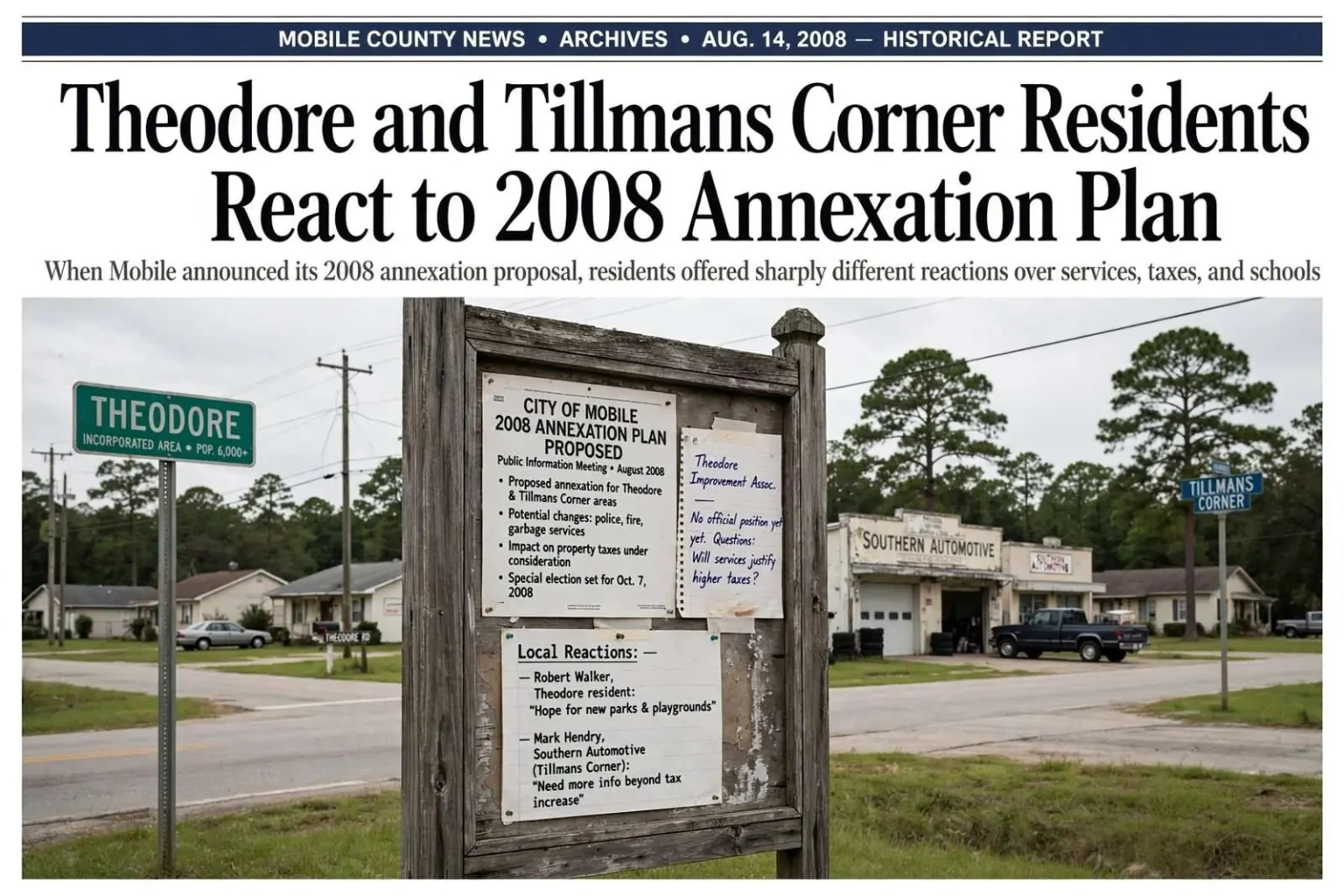
When Mobile announced its 2008 annexation proposal, residents of Theodore and Tillmans Corner offered sharply different reactions, according to an archived local news report published Aug. 14, 2008. The proposal — which would have brought the sprawling unincorporated communities south of the city into the Mobile city limits — landed in neighborhoods where opinions about city services, taxes and local identity had been forming for decades.

The communities in question were among the largest unincorporated population centers in Alabama. Theodore, along the US-90 and Rangeline Road corridors, and Tillmans Corner, the dense commercial crossroads at the intersection of US-90 and Five Notch Road, had grown into de facto cities without city governments: their residents paid Mobile County taxes, relied on the county sheriff and county services, and watched the Mobile city boundary sit just to their north.

Annexation proposals of this scale raise every municipal question at once — who provides police and fire protection, what happens to property tax bills, who controls planning and zoning, and whether the promised services justify the added cost. In the summer of 2008, residents of both communities were working through those questions in civic meetings, storefront conversations and the pages of the local press.

Theodore’s Skepticism

Randy Torbert, vice-chairman of the Theodore Improvement Association, said the group had not taken a position but questioned whether possible police, fire and garbage-collection improvements would justify higher taxes. His framing captured the central bargain of annexation: the city offers a service package, and residents weigh it against the property taxes that come with city residence.

The Theodore Improvement Association’s non-position reflected the divide Torbert described. Community associations in unincorporated Mobile County function as the closest thing residents have to local government — organizing road improvements, representing the area before county commissioners, and giving neighborhoods a collective voice. Taking a side on annexation, with membership split, was a step the association was not prepared to take.

Torbert’s question about value-for-taxes was the recurring theme of the debate’s skeptical side. City residents pay Mobile’s property tax rate in addition to county taxes, and whether the city’s police presence, fire coverage and garbage collection add up to more than residents already received from county and district services was the calculation each household had to make for itself.

Robert Walker, a longtime Theodore resident, came down on the other side. He supported annexation and said he hoped it could bring playgrounds and parks to the area — the amenities argument for joining the city. Unincorporated communities depend on county parks and school recreation land, and for residents without municipal parks nearby, the promise of city investment in playgrounds and green space was a tangible, family-scale benefit that abstract tax debates lacked.

See also  Tennis Anyone? Mobile Councilman's $3,100 in Taxpayer-Funded Lessons Draws Colleagues' Rebuke

Tillmans Corner Wanted Details

Mark Hendry, owner of Southern Automotive in Tillmans Corner, said he wanted more information about what the city would offer beyond an added tax increase. As a business owner in one of the county’s busiest commercial districts, Hendry’s questions ran to the practical: what would annexation change for a shop on the US-90 corridor, in licensing, in services, in the cost of doing business.

Tillmans Corner’s stake in the debate was distinct from Theodore’s. The community is one of the most densely commercial areas in unincorporated Mobile County, home to auto shops, restaurants, retail strips and the heavy traffic those businesses draw. Annexation would have put that commercial base inside the city’s business-license and revenue structure — a shift whose costs and benefits depended on details the proposal had not yet fully answered for many owners.

Hendry’s demand for information rather than opposition or support reflected where a substantial share of residents stood in August 2008: unconvinced either way, waiting for the city to make a case specific enough to evaluate.

The Schools Question

The report also raised questions about the possible effect on Mobile County Public Schools, noting that officials said an earlier Schillinger Road Corridor annexation had reduced school-system revenue. For many residents, the education funding question outweighed the service debates — because school revenue follows property tax lines, and annexation redraws those lines.

The mechanics are specific to Alabama. School systems are funded in part through property taxes earmarked for education, and when territory annexes into a city that operates its own school system, questions arise about which system serves the area’s students and which one collects the education-related taxes. Mobile County Public Schools, one of the largest systems in the state, covers the vast unincorporated county along with the city itself, and county officials had watched previous annexations trim the tax base that supports it.

The Schillinger Road Corridor annexation, cited by officials in the 2008 report, was the recent precedent. Territory that moved into the city limits had carried school-related revenue with it, and the loss registered in the county system’s budget — the kind of consequence that rarely appears in annexation brochures but lands in classrooms. For parents in Theodore and Tillmans Corner, the question was whether their neighborhoods’ annexation would repeat that pattern and what it would mean for the schools their children attended.

See also  New Orleans Royalty at the Saenger: Allen Toussaint and Irma Thomas Bring Six Decades of Soul to Mobile

The Stakes of the 2008 Proposal

The proposal’s scale made it one of the most consequential municipal questions Mobile had faced in years. Annexing Theodore and Tillmans Corner would have added tens of thousands of residents to the city overnight, extended city services miles further south, and expanded the city’s commercial tax base by some of the busiest retail and service corridors in the county. For the unincorporated communities, it would have meant their first city government — mayoral representation, city council districts, municipal planning — after generations as county territory.

The debate arrived amid the larger story of Mobile’s growth politics. Cities across Alabama had spent decades competing for population and tax base through annexation, and unincorporated suburban communities had watched the boundaries creep toward them one corridor at a time. The 2008 proposal was a bigger bite than most: not a highway-frontage strip but entire communities, with the full weight of identity and self-determination that annexation questions carry.

That identity dimension ran beneath the service debates. Theodore and Tillmans Corner residents have long identified with their communities — their own high school loyalties, business associations, and community organizations — and annexation asked whether those places would remain county communities or become Mobile neighborhoods.

This is a historical account of responses at the time and does not report the proposal’s later outcome. What the Aug. 14, 2008 report preserved is the texture of the debate: a community association holding its position, a longtime resident asking for parks, a business owner asking for details, and school officials asking everyone to count the cost to the county’s classrooms.

Why the History Still Matters

Annexation debates return to the Gulf Coast regularly, and the 2008 exchange remains a useful record of how the region’s largest one weighs the question. The arguments on both sides — service value against tax burden, amenities against identity, city revenue against school funding — are the permanent vocabulary of municipal expansion in Alabama, where annexation law lets cities grow while unincorporated communities decide whether to join them.

For current residents of Theodore and Tillmans Corner, the 2008 report is a reminder that their communities’ relationship with Mobile has been an open question before, debated by name in public meetings and archived in the local press. The names and businesses change; the calculation — what the city offers, what it costs, and who decides — does not.

How Annexation Works in Alabama

Alabama’s annexation framework shapes every debate like the 2008 one. Municipalities expand through legislative act, through annexation elections in the territory to be annexed, or through adjacent-property petitions — mechanisms that give both the city and the affected residents a role. A proposal of the scale Mobile contemplated in 2008, covering entire communities, would move through those processes over months or years, with public meetings and referendums deciding the outcome.

See also  Mobile County Confirms Third COVID-19 Death, a 56-Year-Old Man

That timeline is part of why the debate’s texture matters. Residents in the proposed annexation territory have extended opportunities to organize, question city officials and vote their preferences, and civic institutions like the Theodore Improvement Association serve as the organized voice through which those preferences get expressed. The association’s deliberation over a position in August 2008 was the process working as designed.

The financial mechanics are equally structured. Annexed property moves onto the city’s tax rolls at the city’s rates, in addition to county taxes that remain; in exchange, the territory gains access to city services — police districts, fire stations, garbage routes — on the city’s schedule. Municipal planners model those transitions in detail, and residents’ questions in 2008 about exactly which services would arrive, and when, were questions the city’s own projections had to answer.

The Communities Today

Theodore and Tillmans Corner remain among the most consequential population centers in unincorporated Mobile County — dense, growing communities whose relationship with the city has continued to evolve since the 2008 debate. The corridors that Mark Hendry’s Southern Automotive called home still anchor some of the county’s busiest commercial traffic, and Theodore’s neighborhoods still organize through the civic associations that gave residents their collective voice in 2008.

The schools question, too, remains live wherever boundary questions arise. Mobile County Public Schools’ footprint spans the city and the county alike, and any proposal that moves territory — or tax base — between jurisdictions still triggers the same revenue questions officials raised when citing the Schillinger Road Corridor precedent.

For readers revisiting the debate through this archived report, the value is in seeing how the region’s residents talked about growth when it arrived at their door: specifically, personally, and with an eye on the property tax bill, the parks their children would play in, and the schools that would serve them either way.