Tennis Anyone? Mobile Councilman’s $3,100 in Taxpayer-Funded Lessons Draws Colleagues’ Rebuke
Councilman Thomas Sullivan says he followed every city procedure in spending $3,100 in public money on tennis lessons and tournament travel for supporters' children. Four of his colleagues say it was flatly improper.
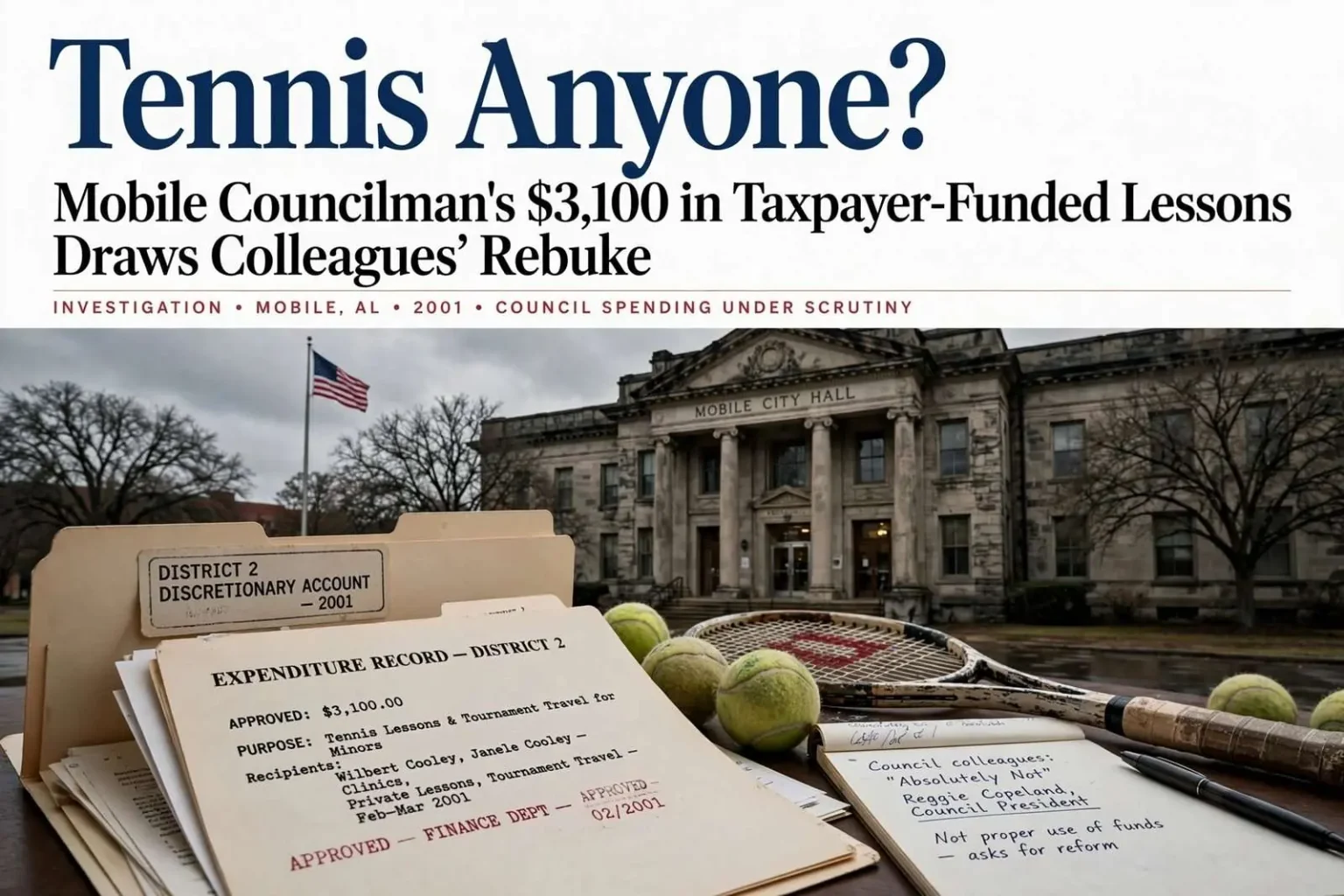
Mobile City Councilman Thomas Sullivan says he did nothing improper when he directed $3,100 in taxpayer dollars toward private tennis lessons and tournament travel for the children of his political supporters. His colleagues, for the most part, disagree.
Of the officials contacted, four said plainly that the spending was not proper. Three declined to comment.
Efforts to reach Mayor Mike Dow were not immediately successful.
What Was Spent
The expenditure, authorized in 2001 out of the discretionary account allocated to District 2, covered two months of clinics, matches, private lessons and tournament travel for two children, Wilbert Cooley and Janele Cooley.
They are the children of Wilbert Cooley and Kandee Cooley. All four Cooleys have been involved in Sullivan’s campaigns for office.
“Absolutely Not”
Council President Reggie Copeland was the bluntest. Asked whether the spending was proper, he answered: “No, I do not. Absolutely not.” Copeland said the episode had produced a steady stream of ribbing around City Hall. “There’s a guy in the office and he said, ‘Mr. Copeland, my son wants to go to baseball camp. Can you pay for it?’” He was not laughing.
“It was wrong and he has got to live with it.” Copeland, first elected in 1985 and planning to seek a sixth term in the summer’s municipal elections, predicted the episode would force reform. “I expect that there will be some changes,” he said.
“We’ll probably have discretionary projects come before the full council and eventually we may do away with them. That would put an end to a lot of calls we get for money for projects that are questionable.”
The Joke and the Judgment
Councilman John Peavy, who rejoined the council in September after a 12-year absence, opened with the gallows humor that had sprouted around the affair.
“It’s not an ethics question for me since I’m a fairly decent tennis player myself and I’m able to give a major break on lessons to whomever in my district needs that help,” he joked, noting that jokes about golf, tennis and even bowling had been circulating for weeks. Then he turned serious.
“It’s just foolhardy to think that any individual attention in that fashion should be paid for with city funds. I certainly don’t agree with it.” Peavy said he expects policy changes and questions whether discretionary accounts should exist at all.
If they do, he said, they should be devoted overwhelmingly to capital projects. “It’s a slippery slope when you give money to minor agencies and causes,” he said.
“It can blur your vision. It certainly did his.” Peavy, 51, is organizing a campaign for mayor in the August city elections, anticipating Dow’s withdrawal from office.
Silence and Sympathy
Mobile County Commissioner Sam Jones, 58, who has also said he would strongly consider a mayoral bid if Dow does not run again, declined: “I’m not going to have any comment on that at all.” Former Council President Clinton Johnson — the District 3 councilman since the mayor-council form of government took effect 20 years ago — chose discretion over criticism. “I may have an opinion on that, but I consider Tom a friend, a colleague here for 16 years and a colleague of mine for 27 years or so at the state rehabilitation department,” Johnson said.
“I pray that it turns out well for Tom. But it is best and most appropriate for me not to comment at this point.” Councilman Fred Richardson also passed.
“I don’t know if an opinion is in order here,” he said.
“Some Questions You Don’t Have to Think About”
District 4 Councilman Ben Brooks was unequivocal.
“I would not do it and I don’t think it was the right thing to do,” he said. “Some questions you have to think about. This one, you don’t.” Brooks went further, questioning the entire premise of discretionary funding at every level of government. He recalled that he and Councilwoman Connie Hudson had once proposed abolishing the accounts and using the money for employee raises.
When the council split $3.5 million in excess sales tax revenue seven ways — roughly $450,000 per district — Brooks said his preference was to let each member direct the money within his or her own district, but only for capital work: roads, parks and the like. A number of members resisted earmarking it that way, though in practice most of the money did end up going to capital projects.
Councilwoman Connie Hudson used the moment to describe her own line-drawing. She said she resigned from volunteer board positions with the Mobile Arts Council and America’s Junior Miss because both receive city appropriations.
Until an ethics ruling clarified matters, she said, unpaid volunteer service with such groups had been considered a gray area. “We hold a public trust and certainly can’t do anything that would in any way appear to be a conflict of interest,” Hudson said.
“You can’t be too careful.”
Sullivan’s Defense
Sullivan rests his case on process. “We have a procedure we follow when we request financial assistance for any person or organization or any school,” he said.
Once a request arrives and the councilman judges it legitimate, it goes to the finance department for approval, then to the legal department, then to the mayor for signature. “That is our procedure and that’s the one that was followed,” Sullivan said.
“Neither departments nor the mayor had any objections or questioned anything.” Should a similar request come to him again, he said, he would consider it on its merits and act according to the city’s policies.