
Mobile County names new county engineer and public works director
Mobile County has named Bryan Kegley county engineer and Ricky Mitchell public works director, completing an 18-month reorganization of its engineering.
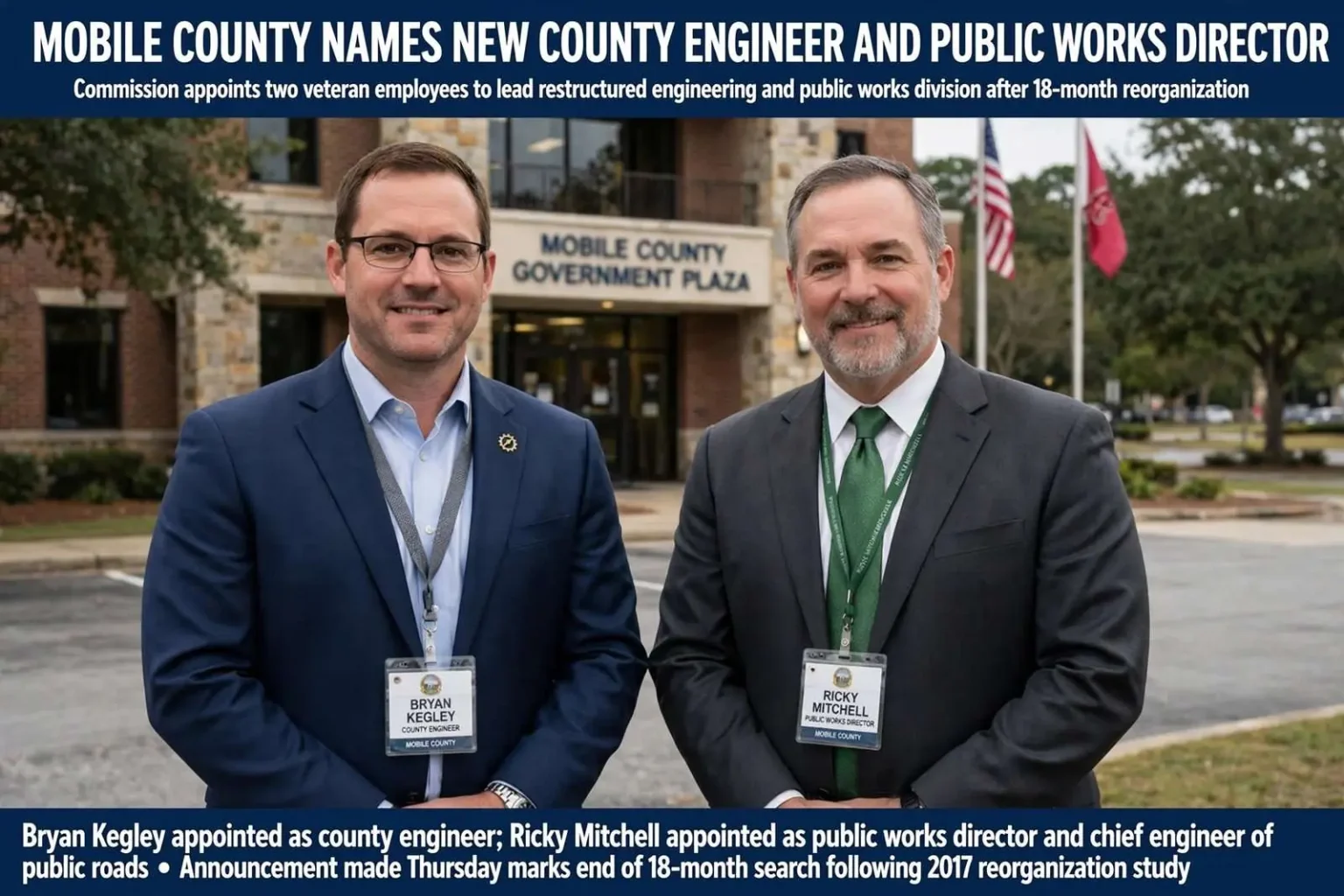
The Mobile County Commission on Thursday named two veteran employees to lead its restructured engineering and public works operations, filling roles left open after the 2016 retirement of longtime County Engineer Joe Rufer. Commissioners voted during a conference meeting to appoint Bryan Kegley as county engineer and Ricky Mitchell as public works director and chief engineer of the division of public roads.
The move caps an 18-month search and a reorganization of the department that began after a 2017 outside evaluation, commissioned for about $30,000, concluded the engineer position held too much direct control over a wide range of county functions. The consultant’s finding was structural rather than personal: in a county government of Mobile’s size, concentrating roads, buildings, parks and environmental services under a single appointed official created bottlenecks and left too few checks on day-to-day decisions.
Following the consultant’s recommendation, the commission divided duties that had previously rested with the county engineer alone and created the public works director post. Some functions, including parks and recreation and environmental services, were moved out of the department entirely and placed under county administration, eliminating what the firm described as duplicative internal operations.
A long road to the announcement
The 18-month gap between Rufer’s retirement and Thursday’s vote tested the department and the commission alike. Interim leadership kept road projects moving, but major decisions on contracts and capital spending waited for a permanent structure, and the outside evaluation commissioned in 2017 became the blueprint for the vote that finally resolved it. County administrators spent that period studying the consultant’s recommendations, consulting with department heads whose functions were affected, and building the job descriptions that Thursday’s applicants eventually filled.
The public interviews in March gave residents an uncommon look at the county’s senior hiring process, with commissioners questioning both internal and external candidates on their management philosophies, their handling of the department’s budget and their view of the new split structure. The decision to promote from within followed months in which both men had, in effect, been auditioning in their acting roles.
The reorganization reflected a wider trend in county government across Alabama, where administrators have increasingly separated engineering functions from general services so that each can be managed, budgeted and evaluated on its own terms. In Mobile County, the state’s second-largest, the stakes are significant: the department touching every road, bridge and county building is also one of the county’s largest budget lines.
The new structure
Under the new structure, Kegley supervises road projects while Mitchell oversees building maintenance and equipment services, with each taking on additional responsibilities beyond those primary roles. The split gives the county a dedicated engineer focused on its transportation network and a director responsible for the facilities and fleet that keep the rest of county government running.
Both were selected from a field of applicants after public interviews in March. The commission’s choice of two internal candidates over outside applicants signals confidence in the bench it already had, and it spares the county the year of institutional memory loss that often follows an executive hire from out of town.
Kegley, a Baker High School and University of South Alabama graduate, has served as the county’s assistant engineer since August 2011 and is a licensed professional engineer and land surveyor. His tenure in the assistant’s role put him directly under Rufer during the years when the department’s road program, bridge work and right-of-way acquisitions were running at full pace, and his dual licensure is uncommon enough that it lets the county handle surveying questions in-house.
Mitchell has been deputy public works director since 2011 and is a graduate of Pinson Valley High School and the University of Alabama at Birmingham, also a licensed professional engineer. His portfolio has covered the less visible but equally demanding work of keeping county buildings operational and maintaining the equipment fleet that road crews, sheriff’s deputies and other departments depend on daily.
The two have effectively run engineering functions since Rufer’s retirement and now oversee a department that typically accounts for roughly 30 percent of the county’s multi-million-dollar budget. That share of the budget reflects the reality of county government in Alabama, where counties carry responsibility for an extensive network of roads and bridges outside the cities, and where engineering costs arrive in nine-figure projects as well as routine resurfacing contracts.
In a statement announcing the hires, the commission’s president praised the pair’s institutional knowledge and the continuity their promotions provide, noting that the county had already relied on both men to keep the department functioning through the 18-month transition. County officials have said the internal promotions also preserve relationships with the Alabama Department of Transportation, municipal public works directors and contractors who work with the county on shared projects.
Both men now carry professional credentials that match titles that existed only on paper since the reorganization began. The engineer’s position carries statutory responsibilities in Alabama county government, including signature authority on county road and bridge work, while the chief engineer designation within the public roads division formalizes Mitchell’s role in the department’s engineering decisions. Sorting out those lines of authority was one of the consultant’s central concerns, and the commission’s vote completed that work.
What the county engineer does
The office Kegley inherits is one of the most technical positions in Alabama county government. Every county outside those with a consolidated road department must have a licensed engineer serving as county engineer, a requirement written into state law, and the job spans bridge inspections, road design, drainage projects, work within state and federal right-of-way, and the certification that comes with an engineer’s seal. Mobile County’s network of county roads and bridges serves unincorporated communities from Citronelle to the bayfront, and the engineer’s decisions determine which resurfacing projects, culvert replacements and safety improvements move first.
The new public works director role, by contrast, is an administrative creation tailored to Mobile County. By moving building maintenance, equipment services and the former parks and environmental functions into clearer lanes, the county effectively split a job that had become too broad, a structure the consultant argued would speed decisions and improve accountability when something goes wrong.
Why it matters to residents
For county residents, the appointments show up in practical ways. The condition of a rural road after a storm, the timing of a resurfacing contract, the speed of a culvert repair that keeps a neighborhood from flooding: all of it flows from the engineering division’s priorities and staffing. An 18-month leadership gap, even one managed by capable interim hands, is felt in projects that waited and contracts that slipped a season.
The reorganization also changes how residents and contractors interact with the county. Projects that once queued behind a single office can now be routed to the division that actually handles them, and the separation of parks and environmental services from engineering means those functions report to county administrators who can weigh them alongside other general government services rather than competing with roadwork for the same desk.
Continuity was the commission’s other priority. Both appointees spent years inside the department, and neither will need a learning curve on the county’s road inventory, its ongoing projects or its relationships with the state and the municipalities. In county engineering, where projects take years from design to ribbon-cutting, keeping the people who already know the files is worth as much as any new idea.
The budget scale explains why the commission treated the restructuring with such care. A department that consumes roughly 30 percent of the county budget touches every unincorporated resident through road maintenance, every county employee through the buildings they work in, and nearly every department through the equipment services that keep vehicles on the road. Restructuring an operation of that size carries risk in both directions: split too little, and the old bottlenecks remain; split too much, and coordination suffers. The consultant’s design was meant to find the middle, and the two appointees now own the task of making it work.
Mobile County’s geography adds to the challenge. The county stretches from the urban core of Mobile to rural communities in the north and west, and its road network runs from major commuter corridors to low-lying routes that flood with the tide. Balancing resurfacing schedules against drainage needs, and city-franchise agreements against unincorporated road obligations, is the daily arithmetic the engineering division has always managed, now under two leaders rather than one.
The appointments close out a transition that began the day Rufer retired in 2016, but they also open the period that will define the reorganized department. Kegley and Mitchell will be measured by whether the split structure delivers what the consultant promised: faster decisions, clearer accountability and an engineering operation proportionate to the county’s size and budget.
For now, the county’s road program, its buildings and its fleet are in the hands of two engineers who came up through the department they now lead, and who take over at the moment the county’s investment in restructuring is supposed to pay off.


