First Jobs, Part Two: Crab Picking in Bayou La Batre and a Quarterback Sweeping the Shop
More Mobile-area figures recalled the work that started them off, including a summer picking crab in Bayou La Batre that produced a lifelong vow about education, and a future NFL quarterback cleaning parts.
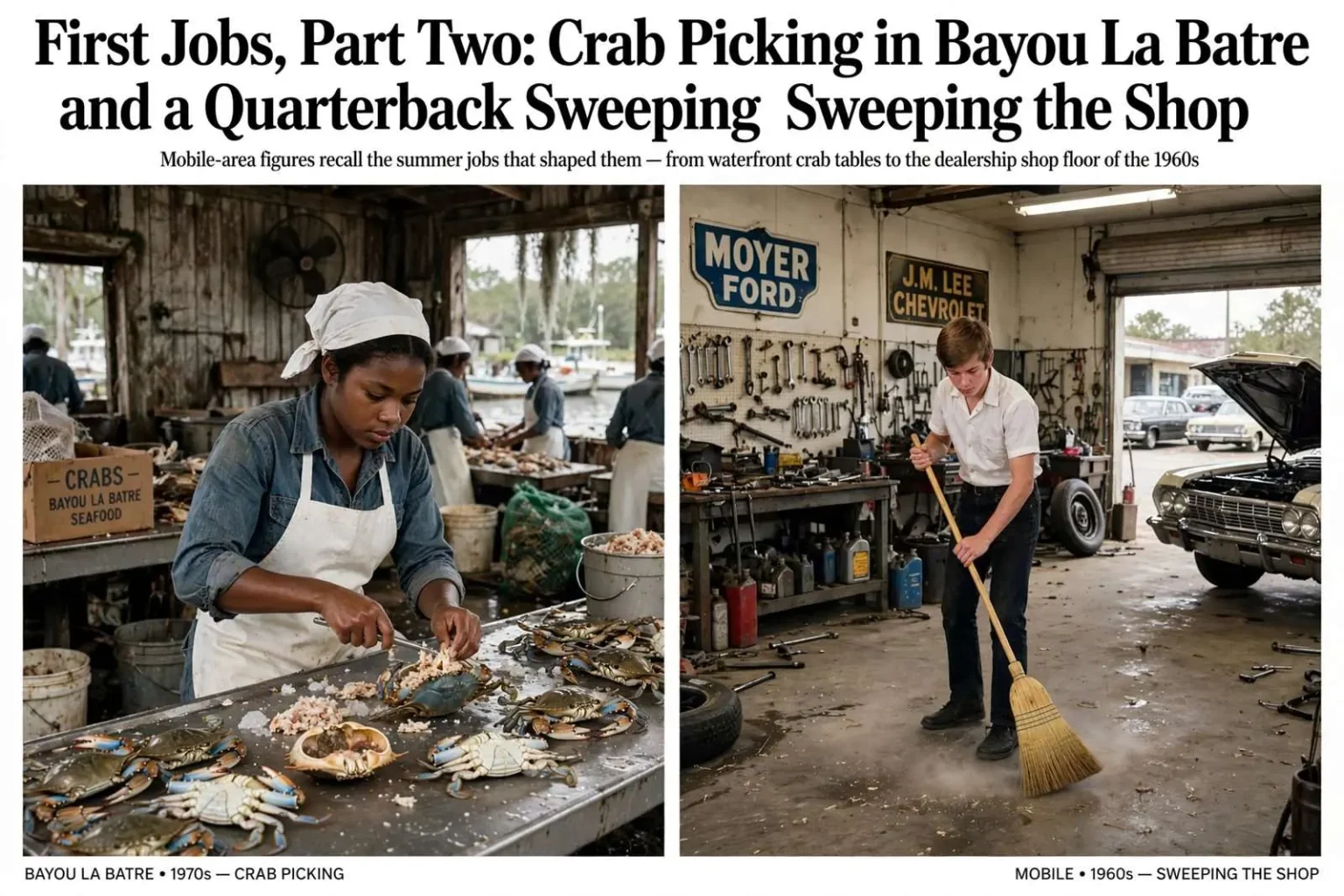
The first job is a peculiar kind of memory. Decades later, people remember the exact wage, the smell of the place and the specific indignity, long after they have forgotten far more consequential things. Asked to recall the work that started them off, a second group of Mobile-area figures obliged. The crab table Barbara Drummond, then executive assistant to Mobile Mayor Sam Jones, offered the account with the sharpest point on it. The commodity of choice on her first job was crab. She rose at dawn, piled into a Grand Bay cousin’s crowded old pickup truck and rode to Bayou La Batre, where a white apron, a cap and a crab picking device were waiting for her. The device, she said, quickly became her worst enemy. For weeks she stood on her feet delicately removing crabmeat from shells. It was during those weeks, she said, that she made a vow to achieve the highest level of education she possibly could. Crab picking is an honorable profession. The wounds in her hands were evidence that it was not going to be hers.
The goal of that grueling summer was modest and entirely of its time: enough money for stylish clothes for the Fourth of July and a ticket to a James Brown concert. She got the clothes. Her mother vetoed the concert. Bayou La Batre, Alabama’s seafood capital, has built its economy on the backs of generations of crab pickers, shrimp headers, and oyster shuckers. The city’s waterfront processing plants, clustered along the bayou that gives the town its name, employ hundreds of workers during peak seasons, many of them women from the surrounding communities of Coden, Grand Bay, and Irvington. The work is seasonal, repetitive, and physically demanding — hours of standing at stainless steel tables, hands moving in rhythms passed down through families, the scent of brine and crustacean permeating clothes and hair. For a teenager in the 1970s, it was a rite of passage, a summer job that paid better than babysitting or retail but exacted a toll in sore wrists and cracked fingernails.
Sweeping the Shop
Ken Stabler, the retired pro football quarterback, gave the shortest answer and one of the most evocative. His first work came at the Moyer Ford and J.M. Lee Chevrolet dealerships in the early 1960s, where his father worked as a mechanic. He cleaned parts, washed cars and swept the shop. The dealerships, located on Government Street in Mobile’s midtown corridor, were among the city’s largest employers in an era when American manufacturing still anchored the middle class. Stabler’s father, a skilled mechanic, represented the blue-collar backbone of Mobile’s post-war economy — men who could diagnose a carburetor by ear, who took pride in work that left grease under their fingernails. For the future NFL star, sweeping the shop was less about the work itself than about proximity: to his father, to the rituals of male labor, to the world of engines and torque that smelled like opportunity.
Greg Saad, a real estate executive, started even younger. At seven he inherited his brother’s job as a shoe shine boy at a barber shop on Michigan Avenue in Oakdale, shining shoes for 25 cents a pair, 35 cents for a spit shine, and no tips allowed. He swept hair and did as he was told. The proprietor and his partner were both deaf, so the shop was mostly quiet. They were, he said, very good to him. Oakdale, a neighborhood in north Mobile that developed in the 1920s and 1930s around the streetcar lines, was home to a tight-knit community of Lebanese and Syrian immigrants who had settled in Mobile in the late 19th and early 20th centuries. The Saad family, like many in this community, built their foothold through small businesses — groceries, dry goods, barber shops — that served both their own community and the broader city. The barber shop on Michigan Avenue was more than a workplace; it was a social hub where men gathered for haircuts, conversation, and the quiet dignity of being served by people who knew their names and their preferences.
Stabler’s dealership jobs were a rite of passage for many Mobile boys of his generation. The city’s car culture — fueled by the causeway, the tunnel, and the sprawling geography that made automobiles essential — meant that dealerships were major employers. Moyer Ford and J.M. Lee Chevrolet were institutions on Government Boulevard and Spring Hill Avenue respectively, and the mechanic’s son sweeping the floor was a familiar sight. Stabler’s hands, which would later throw for 27,938 yards in the NFL, first learned the feel of grease, solvent, and the weight of a push broom. The discipline of showing up early, doing the unglamorous work, and watching his father diagnose engines by sound alone stayed with him through Alabama championships and Oakland Raiders glory.
Quiet Lessons in a Barber Shop
Saad’s barber shop experience offered a different kind of education. The silence imposed by the proprietors’ deafness taught him to communicate without words — to read gestures, anticipate needs, and work without verbal instruction. The fixed pricing (25 cents, 35 cents, no tips) introduced him to the concept of transparent, non-negotiable value. The fact that he inherited the job from his brother at age seven reflected the family-economy culture of mid-century Mobile, where children contributed to household income as a matter of course. Saad went on to build a real estate empire that reshaped Mobile’s commercial corridors, but he credits the barber shop with teaching him the fundamentals of customer service: show up, do the work, treat people with respect.
From Paper Routes to the Courtroom
Ben Brooks, the lawyer and state senator, delivered papers for the Mobile Press-Register in the 1950s, rising at 4 a.m. to fold and throw before school. The route covered a swath of midtown that included the homes of judges, doctors, and business owners whose names he would later know in professional contexts. The early mornings taught him reliability; the complaints about wet papers taught him accountability. The tips at Christmas taught him that service is remembered. Brooks’s paper route was more than a job — it was a survey of the city’s power structure from the ground level, a perspective that informed his later legislative work on behalf of working families.
These first jobs — crab picking, shop sweeping, shoe shining, paper delivering — share a common architecture. They are physical, immediate, and unforgiving of pretense. They pay in cash and calluses. They happen in places that smell like salt water, motor oil, leather polish, or newsprint. And they serve as the foundation upon which Mobile’s professional class built its careers. The city’s lawyers, legislators, executives, and coaches all started somewhere that required them to show up, endure, and learn. The specific indignities varied, but the lesson was the same: work is what you do when no one is watching, and the habits formed in that first summer or after-school shift echo through a lifetime.
The Mobile Work Ethic in Context
Mobile’s economy in the mid-20th century offered a distinct menu of entry-level work. The port, the shipyards, the seafood plants, the paper mills, and the military bases created a labor market where physical work was abundant and visible. Children of dockworkers, mechanics, and mill hands often started in the same industries, learning the rhythms of shift work, union halls, and the informal seniority systems that governed advancement. Children of merchants and professionals often started in family businesses — sweeping the floor of a hardware store, stocking shelves at a pharmacy, answering phones at an insurance agency. The class markers were real but permeable; a paper route or a crab house summer was a shared reference point across social strata.
The transition from that world to the service-and-knowledge economy of the late 20th century changed the nature of first jobs. Fast food, retail, and office temp work replaced the waterfront and the shop floor for many teenagers. But the core lessons — punctuality, humility, the connection between effort and reward — remained constant. Drummond’s crab house wages funded her education; Stabler’s dealership discipline shaped his football preparation; Saad’s barber shop silence honed his negotiation instincts; Brooks’s paper route mapped his city. In each case, the first job was not just a source of income but a classroom without walls, teaching the skills that formal education could not.
A Vanishing Landscape
Many of the workplaces that hosted these first jobs no longer exist in their original form. The crab houses of Bayou La Batre have consolidated and automated; Moyer Ford and J.M. Lee Chevrolet have been absorbed into larger dealer groups; the barber shop on Michigan Avenue has given way to a strip mall; the Mobile Press-Register has ceased daily print publication. The physical sites of these formative experiences have been erased or transformed, leaving only the memories of the people who worked there. But the stories persist, passed down at family gatherings, referenced in speeches, woven into the city’s understanding of itself. Mobile is a place where people remember where they started, and where the distance between that first paycheck and the last one is measured not just in dollars but in the character built along the way.