Troopers Seek Vehicle After Teen Struck, Injured in Theodore
Alabama State Troopers are searching for a pickup truck involved in a hit-and-run crash that seriously injured a Theodore teenager. The driver fled the scene
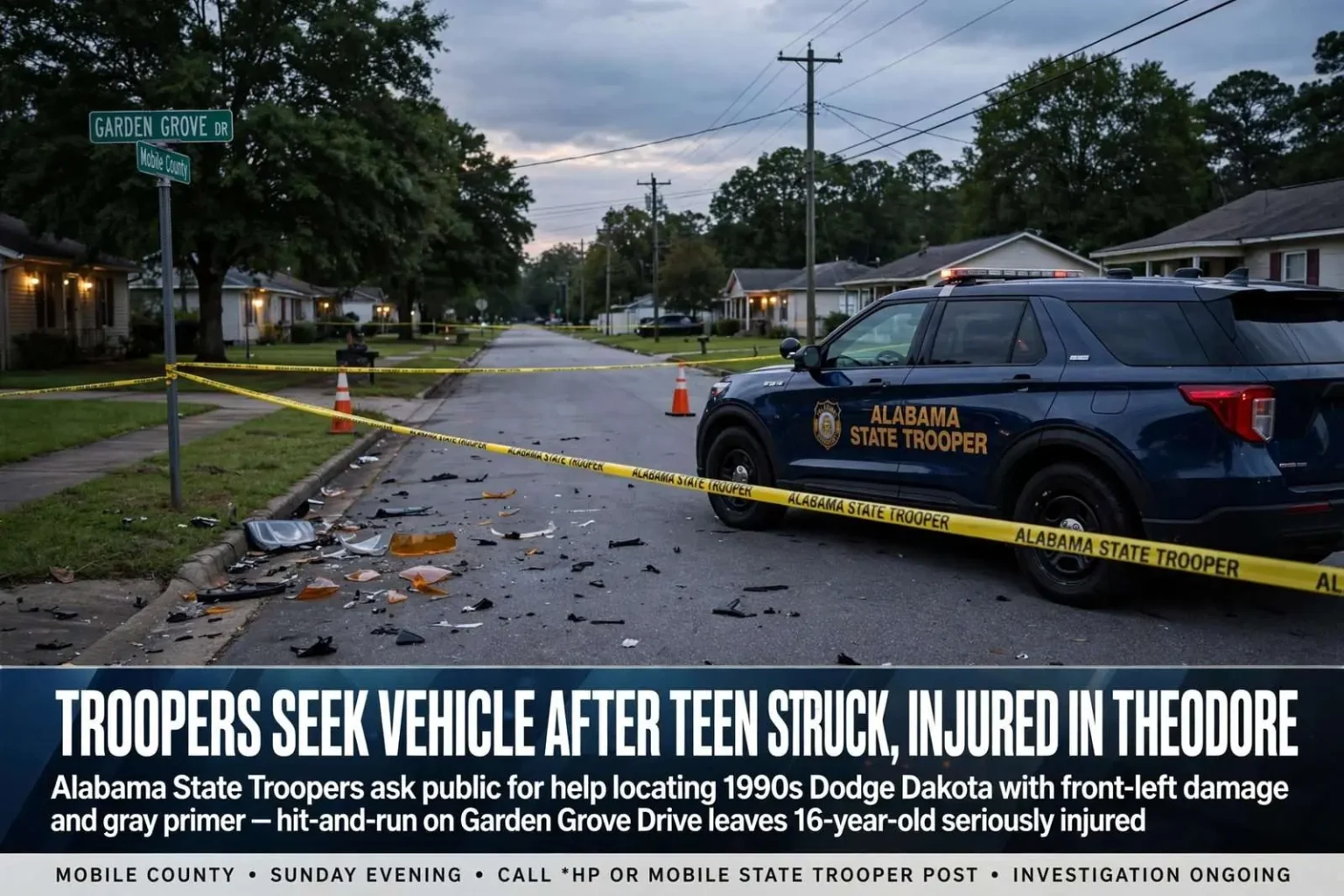
Alabama State Troopers are asking for the public’s help locating a vehicle involved in a hit-and-run crash that left a 16-year-old Theodore boy seriously injured.
The collision happened on a Sunday evening on Garden Grove Drive in Theodore, an unincorporated community in south Mobile County.
According to State Trooper spokesman Steve Jarrett, a vehicle struck the teenager and then left the scene without stopping, last seen heading in the direction of Theodore Dawes Road.
A truck troopers hope someone recognizes
Investigators believe the vehicle involved is a Dodge Dakota pickup truck from the later 1990s model years. Troopers said the vehicle may show damage to its front left corner and headlamp area, and could have gray primer visible on the front bumper — details investigators hope will help residents identify the truck if they’ve spotted it in the area.
That combination of details is specific enough to be decisive. Late-1990s Dodge Dakotas are distinctive — a compact mid-size pickup sold in steady numbers through the decade, many still on the road in rural and suburban Mobile County — and front-end damage on a truck that age is common enough that the gray primer is the detail that narrows the field. Primer shows where bodywork has been done but not yet painted, and a gray patch on the front bumper of a dark, twenty-year-old pickup is visible to anyone who knows to look. A neighbor, coworker or family member who has recently noticed that combination on a Dakota — or noticed a Dakota that was suddenly missing or freshly repaired — holds the thread troopers are asking for.
The teenager, described only as a boy from Theodore, was seriously injured in the crash and required medical treatment. Authorities updated the public a few days later to confirm his age.
Serious injuries in a pedestrian strike at neighborhood speeds are sadly common: a truck’s front corner delivers its force to a victim’s legs and lower body first, and the impact that follows with the roadway does the rest. The delay in confirming the boy’s age reflected the usual caution of an active investigation; once authorities verified the basic facts, they corrected the public record so that anyone with information in the area understood they were looking for a crash involving a teenager, not an adult.
Why hit-and-run cases are hard to close
Hit-and-run cases like this one can be especially difficult for investigators to solve without cooperation from the public, since fleeing drivers often have a head start before law enforcement is notified.
The arithmetic is unforgiving. In a residential hit-and-run, no one calls 911 until after the driver is gone — often minutes after, and sometimes only once the victim is found. Troopers arriving on Garden Grove Drive have a description of a direction of travel and, if they are fortunate, the vehicle details the victim or a witness managed to see. The driver, meanwhile, has had every minute since the impact to park the truck, assess the damage and begin deciding what to do with it.
State troopers emphasized that anyone with information, even minor details about a damaged pickup truck matching the description, could prove critical to identifying the driver responsible.
Under Alabama law, leaving the scene of an injury crash is itself a crime, and the penalties grow with the severity of the harm: a driver who flees a crash causing serious physical injury faces felony exposure on top of whatever charges the underlying collision brings. Investigators know that many hit-and-run drivers are found close to home, and that the vehicle — harder to hide than a person — is usually the case’s undoing. A damaged truck sitting in a driveway, behind a fence, or at a repair shop is what troopers are counting on someone to notice and report.
Body shops and parts suppliers become part of the search as well. A late-1990s Dakota with a damaged left corner needs a headlamp assembly, a fender, perhaps a bumper — and the shops and salvage yards of Mobile County see that kind of order. Troopers can and do canvass them, but a call from the public often arrives first.
The street where it happened
Garden Grove Drive sits in a part of Theodore that mixes residential streets with routes frequently used by drivers cutting between larger roadways in the area, making pedestrian and roadside safety an ongoing concern for residents.
Theodore is one of south Mobile County’s largest unincorporated communities, a spread of subdivisions, schools and commercial strips between Mobile and the Alabama Port area, threaded by state highways and county roads that carry heavy commuter traffic. Streets like Garden Grove Drive were built as neighborhood streets, but drivers use them as shortcuts between the main roads — U.S. 90, Theodore Dawes Road and the connecting grid — and the traffic that cuts through does not always move at residential speeds. In the evening hours, when children and teenagers are out walking, biking or heading home from practice, that mismatch between street design and street use is exactly the condition in which a pedestrian strike happens.
Troopers urged drivers throughout south Mobile County to remain vigilant, particularly in neighborhoods where children and teenagers may be walking or biking near roadways during evening hours.
The message is aimed at more than the driver responsible. Sunday evening is among the busiest times for neighborhood foot traffic — families walking, kids riding bikes before dark — and the area’s streets offer few sidewalks and less lighting. Drivers cutting through are asked to treat every residential street as a place where a pedestrian might step out, and to slow to a speed that leaves room to stop.
How to report information
Anyone with information about the crash or the vehicle involved was asked to contact troopers by dialing *HP from a cell phone or by calling the Mobile State Trooper Post directly.
The *HP (*47) line reaches the Alabama Law Enforcement Agency’s highway patrol dispatch statewide and works from any cell phone at no cost to the caller. Callers should be ready to give what they have, even if it is incomplete: where the truck is usually parked, when they last saw it, whether it has a gray patch on the bumper, or anything they heard about the crash secondhand. Anonymous tips are accepted, and troopers stress that the person who provides the break in a case like this one is often not a witness to the crash at all, but someone who simply noticed a damaged truck in the days that followed.
For the injured 16-year-old and his family, the investigation’s outcome matters twice: it determines whether the driver faces charges, and it answers the question that every hit-and-run leaves behind — who it was, and why they did not stop.
How troopers build a hit-and-run case
Once the scene on Garden Grove Drive was processed — measurements of the point of impact, debris from the truck’s damaged corner, photographs — the investigation shifted to identification work. The debris itself tells part of the story: pieces of a headlamp assembly, paint transfer and trim fragments can be matched to a specific make, model year range and impact point, which is how troopers arrived at a late-1990s Dodge Dakota with front-left damage. Physical evidence of that kind, once the truck is found, becomes the proof that connects it to the crash.
Investigators then work the human side. Neighbors are canvassed for anyone who saw the truck before or after Sunday evening; nearby security and doorbell cameras are collected for the hour around the crash; and the direction of flight — toward Theodore Dawes Road — gives the search a starting geography. A vehicle traveling that way at that hour had limited places to go, and every street it could have taken leads past houses where someone may have noticed it.
The victim’s account matters too, when he is able to give one. Teenagers struck by vehicles often retain a fragment of what they saw — the color and shape of the truck, whether it slowed, which way it went — and even a partial recollection can confirm or refine the physical evidence. Troopers have said only that the boy was seriously injured and required treatment; updates on his condition have not been released, and the focus of the public appeal remains the vehicle.
The plea for “even minor details” is not rhetorical. Cases like this are routinely broken by a caller who reports something that seemed too small to matter: a truck that appeared at a house it had never sat at before, the sound of a crash followed by an engine accelerating, a fender suddenly creased in a coworker’s parking spot. Each report is checked, and one of them is usually the case.
What happens when the truck is found
If and when investigators identify the Dakota and its driver, the legal sequence begins. A vehicle with matching damage can be seized for forensic examination, and the driver faces questions that fleeing only complicated: why they left the scene of a crash that seriously injured a child. Under Alabama law, failure to stop and render aid after an injury crash is a felony when the victim is seriously injured, and it is charged separately from any impairment, recklessness or licensing violations the underlying crash supports. Hit-and-run drivers sometimes hope the delay will make the underlying crash impossible to prove; in practice, the flight itself becomes the most serious charge they face.
Troopers have not released a timeline for the investigation and will update the public as the case develops. Until then, the appeal stands: a late-1990s Dodge Dakota, front-left damage, a gray primer patch on the bumper, last seen Sunday evening heading toward Theodore Dawes Road. Anyone who has seen that truck — anywhere in south Mobile County, at any point in recent days — is asked to call *HP from a cell phone or contact the Mobile State Trooper Post.