Downtown Mobile’s Battle House Hotel Named World Top 500 for 2015
The Battle House Renaissance Hotel & Spa in downtown Mobile earned a spot on Travel + Leisure's Top 500 Hotels in the World list for 2015, city's only entry.
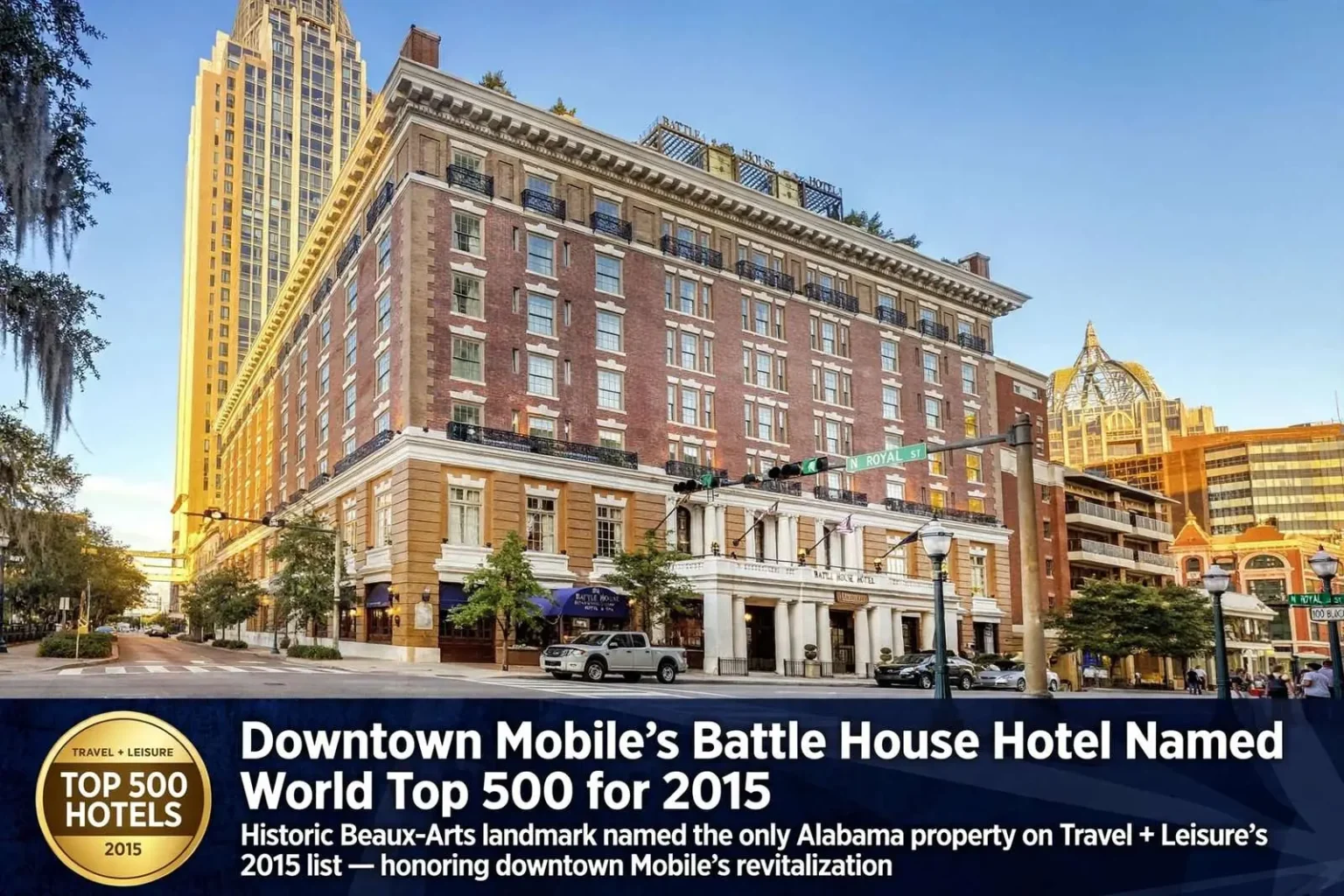
The Battle House Renaissance Hotel & Spa, the Beaux-Arts landmark anchoring downtown Mobile’s North Royal Street, has been named one of the “Top 500 Hotels in the World” for 2015 by Travel + Leisure magazine, a distinction hotel leadership called a point of pride for the entire city.
General manager Margo Gilbert said the recognition reflects on more than just the property itself. She called it an honor for the hotel, the local area and the state of Alabama as a whole, crediting the staff, ownership and a sustained commitment to guests for the achievement.
Gilbert said the accolade felt especially meaningful given how far downtown Mobile has come in recent years, describing the honor as a reflection of the exciting transformation underway in the city’s core. The hotel’s blocks of Royal, St. Francis and Government streets sit at the heart of that revival, where restoration of historic buildings has marched block by block through the decade.
Travel + Leisure’s rankings placed the Battle House ahead of a long list of well-known properties nationally, including hotels in Beverly Hills, Fort Lauderdale, Atlanta, Las Vegas, New York and Dallas, among others. The magazine’s list included 239 U.S. hotels overall for 2015, and the Battle House was the only Alabama property to make the cut — a singular distinction in a state whose lodging market otherwise centers on the beach resorts of the Gulf Coast.
In its write-up, the magazine praised the hotel as a Beaux-Arts landmark that blends old-world grandeur with modern amenities, pointing to a recently added 10,000-square-foot spa as one highlight. The publication also singled out a specific menu item as an insider tip for visitors, encouraging guests to try the seared salmon salad served beneath the restored stained-glass cathedral ceiling of the hotel’s Trellis Room dining space.
More than 160 years of history
The hotel first opened its doors in 1852, giving it more than 160 years of history in downtown Mobile before this latest recognition. It previously appeared on the Travel + Leisure Top 500 list in 2009, following a major renovation project that restored much of the building’s historic character while updating its guest facilities.
That earlier renovation, completed after the hotel had stood dark for decades, ranks among the most consequential private investments in downtown Mobile’s modern history. The restoration returned the landmark to service as a full-service hotel, recreated the grand public spaces that had defined the original, and reopened the Trellis Room’s stained-glass ceiling as one of the city’s signature dining backdrops.
The Battle House’s guest list across its long history reads like a ledger of the American South. Presidents, titans of industry, and generations of Mardi Gras royalty have passed through its lobby since the 1850s, and the building’s legend includes the famous tale of a fire in its early years and the marching order Mobile’s citizens issued afterward — stories that have made the hotel as much a character in Mobile’s history as a building on its streets.
For a city working to build on downtown revitalization efforts throughout the 2010s, the Battle House’s standing in a national ranking offers both a symbol and a tool. The hotel anchors the convention and visitor traffic that downtown restaurants and attractions depend on, and its recognition in Travel + Leisure puts Mobile in front of a national travel audience that many mid-sized Southern cities struggle to reach.
Gilbert’s framing of the award — as belonging to the staff, the ownership, and the state rather than the property alone — tracked with the hotel’s role in the local economy. Hundreds of workers across housekeeping, culinary, events, and management make a hotel of this scale operate, and the general manager’s emphasis on sustained commitment to guests pointed to the daily service standards that national rankings ultimately measure.
The North Royal Street address places the hotel in the middle of Mobile’s most concentrated historic district. Within walking distance stand the Saenger Theatre, the Mobile Museum of Art’s downtown satellite exhibits, Bienville Square, and the restaurant rows that have filled the city’s restored commercial blocks, making the Battle House the natural headquarters for visitors sampling downtown on foot.
The hotel’s Beaux-Arts designation connects it to an architectural tradition of grand American hotels built at the turn of the twentieth century — buildings designed to announce a city’s arrival. Mobile’s version of that ambition emerged from the port wealth of the era, and the Battle House’s public rooms were conceived on a scale intended for banquets, balls, and the Carnival celebrations that define the city’s social calendar each winter.
The 10,000-square-foot spa highlighted by the magazine represented the modern half of the property’s old-and-new formula. Amenity competition among ranked hotels has intensified nationally, and the addition gave the Battle House a wellness offering on par with the resort properties that dominate Travel + Leisure’s list, while its business and meeting facilities serve the corporate traffic generated by Mobile’s port, aerospace, and shipbuilding industries.
The Trellis Room, with its cathedral ceiling of restored stained glass, has become the property’s most photographed space and its fine-dining anchor. The magazine’s insider tip — the seared salmon salad — put a specific Gulf Coast dish in front of the publication’s national readership, the kind of detail travel editors use to make a ranked property feel particular to its place rather than interchangeable with any grand hotel.
Appearing on the Top 500 list twice — in 2009 and again in 2015 — gave the recognition a durability that a single year’s placement would lack. The 2009 listing followed the renovation’s completion; the 2015 listing arrived six years into steady operation, suggesting the hotel had sustained the service standards that first drew the magazine’s evaluators rather than benefiting from a one-time novelty.
For downtown Mobile’s revitalization narrative, the hotel’s national standing arrived alongside other markers of the district’s recovery: restored storefronts filling with restaurants and shops, residential conversions bringing residents back to the upper floors of historic buildings, and the steady expansion of the convention calendar that keeps hotel rooms occupied on weekdays as well as weekends. The Battle House, as the district’s flagship lodging property, sits at the center of all three trends.
The recognition also lands within Alabama’s broader tourism economy, where the beach communities along the coast draw the bulk of visitors and the state’s cities compete for the business and cultural travel market. A downtown historic hotel rated among the world’s top 500 gives Mobile a credential none of its peer cities in the state can claim, and hotel leadership made clear the honor was one they intended to defend through the same daily standards that earned it.
Travel + Leisure’s evaluation process draws on reader surveys and editorial assessments, weighting service, location, design, food, and value. A hotel’s appearance on the list therefore reflects not a critic’s visit but the accumulated judgment of the magazine’s substantial travel readership — frequent travelers comparing properties across cities and countries. For the Battle House, that means the ranking was earned one guest experience at a time over years of operation.
The company the Battle House kept on the 2015 list underscores the scale of the achievement. Properties in New York, Las Vegas, and Beverly Hills operate with marketing budgets and room rates that dwarf a mid-sized Southern city’s flagship, and Travel + Leisure’s rankings have long mixed such marquee names with regional landmarks that outperform their size. The Battle House’s placement in the latter company is exactly the niche downtown Mobile’s revival has sought for its historic assets.
The hotel’s Renaissance affiliation, part of Marriott’s portfolio of distinctive properties, connects the locally significant landmark to a national reservation and loyalty system that feeds it business travelers and event bookings beyond what an independent property of its size could generate alone. The combination — a historic building with a global distribution network — has been the template for downtown revivals in other Southern ports, from Charleston to Savannah, where restored landmarks anchor the visitor economy while chains handle the volume.
Mobile’s Carnival connection deserves particular mention in the hotel’s story. During Mardi Gras season, downtown’s streets fill with parade crowds and the city’s mystic societies hold their balls and receptions in the historic hotels and halls nearby. The Battle House’s ballrooms and public spaces have long served as venues for that season, making it not merely a place visitors sleep but a stage on which the city’s most distinctive tradition performs each winter.
The 1852 founding date also makes the Battle House one of the oldest hotel lineages in the South. Buildings rebuilt on the same site across generations carry their history forward in fragments — architectural details, portraits, and stories — and the Battle House’s renovation preserved and presented those fragments deliberately, allowing guests to read the property’s past in its public rooms. That depth of narrative is precisely what travel editors and their readers reward, and what new construction cannot replicate at any price.
For the city, the Top 500 recognition in 2015 served as both confirmation and invitation: confirmation that downtown’s flagship could stand in national company, and an invitation to the visitors who consult such lists when planning travel through the Gulf South. Six years after its first listing, the hotel’s second appearance suggested the invitation still stood — and that Mobile’s oldest grand hotel intended to keep earning it.