Getting Schooled in Real Estate: Mobile County’s $8.95 Million Bet on an Old Office Building
The Mobile County school system's proposed purchase of the old Kellogg, Brown & Root building drew sharp criticism from commercial real estate professionals, and a vigorous defense.
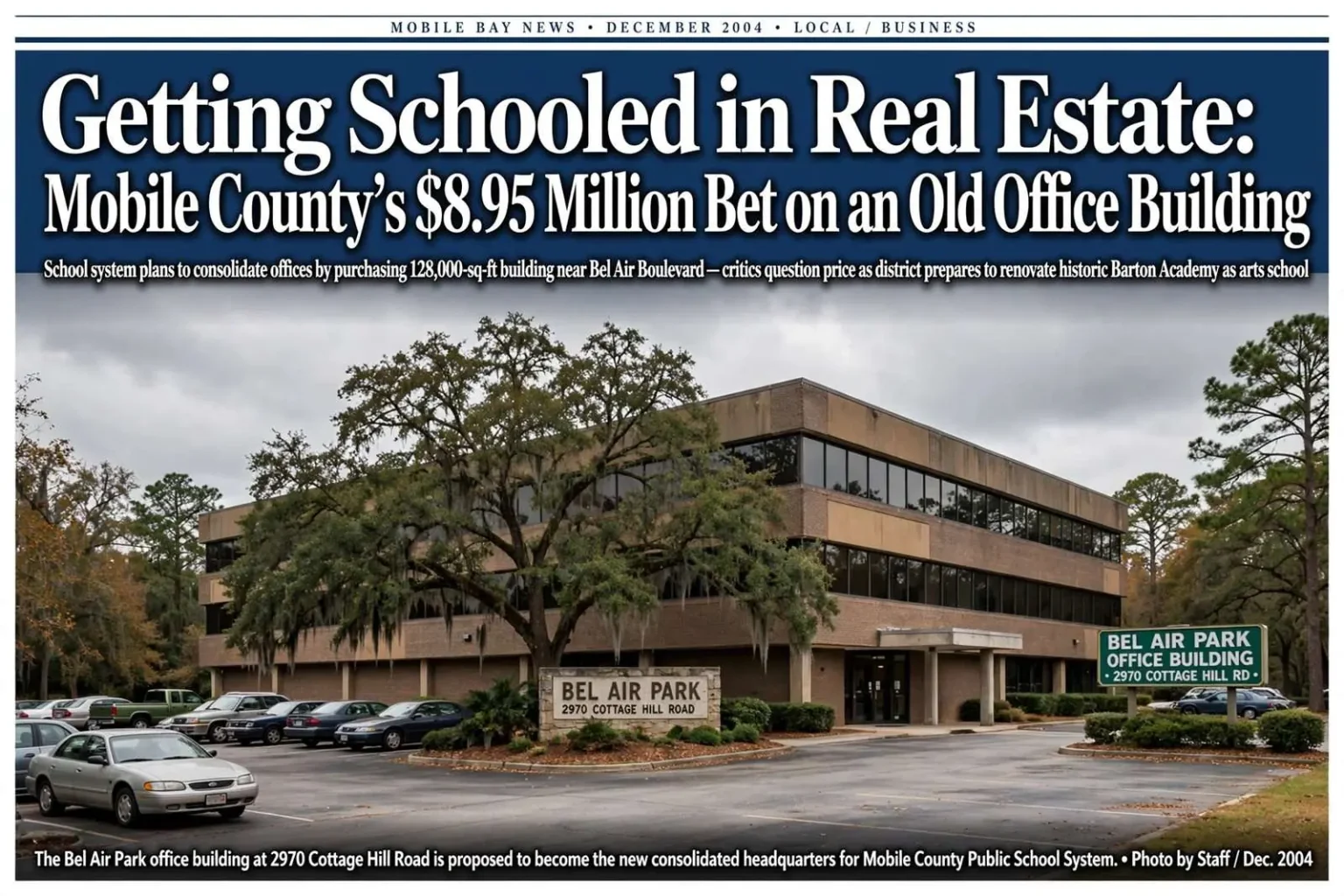
The Mobile County Public School System’s proposed $8.95 million purchase of an office building on Cottage Hill Road has drawn spitballs from some of the most experienced commercial real estate professionals in the Mobile area – and a vigorous defense from the people who negotiated it.
The building at 2970 Cottage Hill Road, known as Bel Air Park, is a late-1970s structure of about 128,000 square feet near Bel Air Boulevard, with 510 parking spaces and easy access to Interstate 65. Kellogg, Brown & Root had been its anchor tenant until the company closed its Mobile office. With a $1.3 million renovation added to the purchase price, the acquisition works out to roughly $80 a square foot.
Why the school system wants out of Barton Academy
The system is trying to consolidate central offices that are currently scattered among three buildings. Its historic home, Barton Academy on Government Street at Lawrence Street, is by nearly everyone’s account obsolete, insufficient and ill-suited to administrative work. Under the school board’s plan, Barton would be renovated as an arts school.
Superintendent Harold Dodge recommended the purchase to the Board of School Commissioners of Mobile County, reportedly after the owners cut the sales price by $350,000.
John Peebles, a partner in the commercial and industrial firm of Peebles and Cameron and the school system’s adviser in the negotiations, said critics “are apparently not knowledgeable about the current state of availability of comparable office product.”
Barton and the Yerby building behind it total about 60,000 square feet, he said – roughly 60 percent of what the administration needs even after an expensive renovation, and still leaving functions split among three locations. Renovating Barton as a school, its original purpose, is materially cheaper than converting it to offices.
Timing matters as well. Bond funds earmarked for the arts school must be committed and largely spent by fixed deadlines to preserve their tax status, Peebles said, meaning renovation work at Barton has to begin by the start of 2005 and be materially finished by the end of that year. New construction for the administrative offices, he argued, would blow that window. New construction would also cost $120 to $150 a square foot – well above the Bel Air Park figure.
Owning, he added, is far cheaper than leasing, and the building is unusually well wired, with redundant fiber capacity throughout that Brown & Root had demanded as a condition of its lease.
The critics: a 100,000-pound gorilla should act like one
Several brokers were unconvinced. A common theme ran through their comments: in Mobile’s soft office market, a tenant seeking 100,000 square feet or more is in the driver’s seat, and the value of existing space is tied directly to the rent it can command.
Bernie Heggeman of Heggeman Realty argued the system should build new on land it already owns, warning that old roofs and outdated mechanical systems are “a great unknown” over a 20-year horizon.
Gavin Bender of Gleason & Associates said that at a lease rate near $8.50 a foot the building’s income-based value would be low enough to justify a much lower sales price – though at $11 a foot, he said, an $80 purchase “is a fair deal for both parties.”
Greg Saad of Saad & Vallas Realty Group put the building’s value at no more than $7.5 million, or about $54 to $59 a square foot, based on net operating income, and suggested the board lease short-term and plan a new facility.
Richard Weavil of The Weavil Company said flatly that a tenant of that size ought to “steal something” in this market.
One veteran broker who asked not to be named called $70 a foot “laughable” for what he considered second-tier space, and said $35 would be his ceiling.
Others were more forgiving. Bestor Ward of Ward Properties said $80 a square foot finished “really is not too out of line to be upset about,” given that new construction easily runs past $100, particularly the way government builds. Lee Metzger, a broker with 25 years in the market, said that if the system could get rent at $8.50 a foot it would be doing taxpayers a favor.
Nearly every broker interviewed reached for the same comparison: the school board’s earlier purchase of the old Gayfers building on Bienville Square, intended as the arts school and now acknowledged by the board as an ill-considered move. Measured against that, several said, Bel Air Park looks like an improvement.
The other offers
John Toomey, who represents the building’s owners – a Dallas-based investment group – said his side had offered aggressive lease terms, free rent for a few months, and a lease with an option to buy. School officials preferred a purchase.
He also disputed the notion that the owners were making a killing: the group paid $8.8 million for the building four years ago and did not anticipate losing its anchor tenant.
Toomey confirmed that the old First Southern Federal Tower at Airport Boulevard and I-65, more recently the Union Planters building, sold within the past year for about $18 a square foot – “the bank just dumped it,” he said – but noted the property was not available when the school system went looking.
White-Spunner Associates said it offered the system a seven-acre site at Dauphin Street and Sage Avenue for a 95,000-square-foot, build-to-suit building at under $100 a foot, with a 50-year land lease at $50,000 a year as an alternative. Blacksher White-Spunner said school representatives remained focused on an existing building.
Attorney B.J. Lyon, a former owner of Bel Air Park, called $8.95 million “a strong price” and pointed to longstanding design deficiencies and air conditioning zone problems.
Hanging over the entire conversation is the 35-story, $162 million RSA Battle House Tower rising downtown, scheduled for completion in the spring of 2006 with 500,000 square feet of office space. “It will really affect the market in this town, no ifs, ands or buts about it,” Toomey said. “Most of the owners in town want to get out real bad.”
Brian Metcalfe of Metcalfe & Company raised the question no one had fully answered: what does the whole shuffle cost – buying a third building, renovating Barton and selling Gayfers – measured against simply renovating Gayfers? “I would like to see all the numbers put out there,” he said, “and I don’t know that they have been.”
Mobile County Public Schools is one of the largest school districts in Alabama, serving roughly 50,000 students across the city of Mobile and surrounding areas. The district’s administrative offices have historically been spread across multiple buildings, with Barton Academy serving as a central administrative location that long predated modern office requirements.
Barton Academy, on Government Street in downtown Mobile, opened in 1836 as the first public school in Alabama. The building has been repurposed multiple times over its nearly two-century history, including use as a school, an administrative center and a cultural venue. Its rehabilitation as an arts-focused school has been a longstanding goal of district planners.
The Mobile office market in the early 2000s was characterized by high vacancy rates and soft rental rates, which gave large tenants significant negotiating leverage. Several major buildings in the city, including the old First Southern Federal Tower and the Bel Air Park complex, were sold or repositioned as a result of those market conditions.
RSA Battle House Tower, the 35-story office tower developed by the Retirement Systems of Alabama in downtown Mobile, opened in 2006 and added 500,000 square feet of office space to the city’s central business district. The tower, designed byarchitecture firm TVS, became the tallest building in Alabama and helped reshape downtown Mobile’s skyline and rental market.
Mobile’s commercial real estate market in the early 2000s was characterized by oversupply and soft rental rates, which gave large tenants like the school system significant negotiating power. Several major office buildings in the city changed hands during this period as landlords sought to dispose of underperforming assets. The Bel Air Park acquisition was one of several notable transactions involving large blocks of office space during the era.
John Peebles, the commercial real estate broker advising the school system on the Bel Air Park acquisition, was a partner at Peebles and Cameron, one of Mobile’s longest-established commercial real estate firms. The firm’s involvement reflected the complexity of the transaction and the scale of the financial commitment. The deal became a case study in how local governments negotiate large property purchases in soft markets.
The Mobile County school board’s decision to pursue the Bel Air Park purchase became one of the more closely watched commercial real estate transactions in the city. The transaction drew attention from brokers and developers because of its size and because it involved a public entity. The arguments for and against the purchase touched on broader questions about how public agencies should approach real estate decisions in soft markets.
Barton Academy, the historic Mobile school building at the center of the administrative consolidation, has been a fixture of downtown Mobile’s Government Street since the mid-19th century. The plan to renovate the building as an arts school reflected both the cost advantages of converting an existing building and the cultural significance of restoring a structure that had been a part of the city’s history for nearly 200 years. The decision to acquire Bel Air Park was driven in part by the need to relocate administrative functions before the Barton renovation could begin.