Mobile Museum of Art Hosts Family-Friendly Mardi Gras Children’s Parade
Young revelers built cardboard box floats and marched in a children's Mardi Gras parade at the Mobile Museum of Art, part of its 50th anniversary celebration.
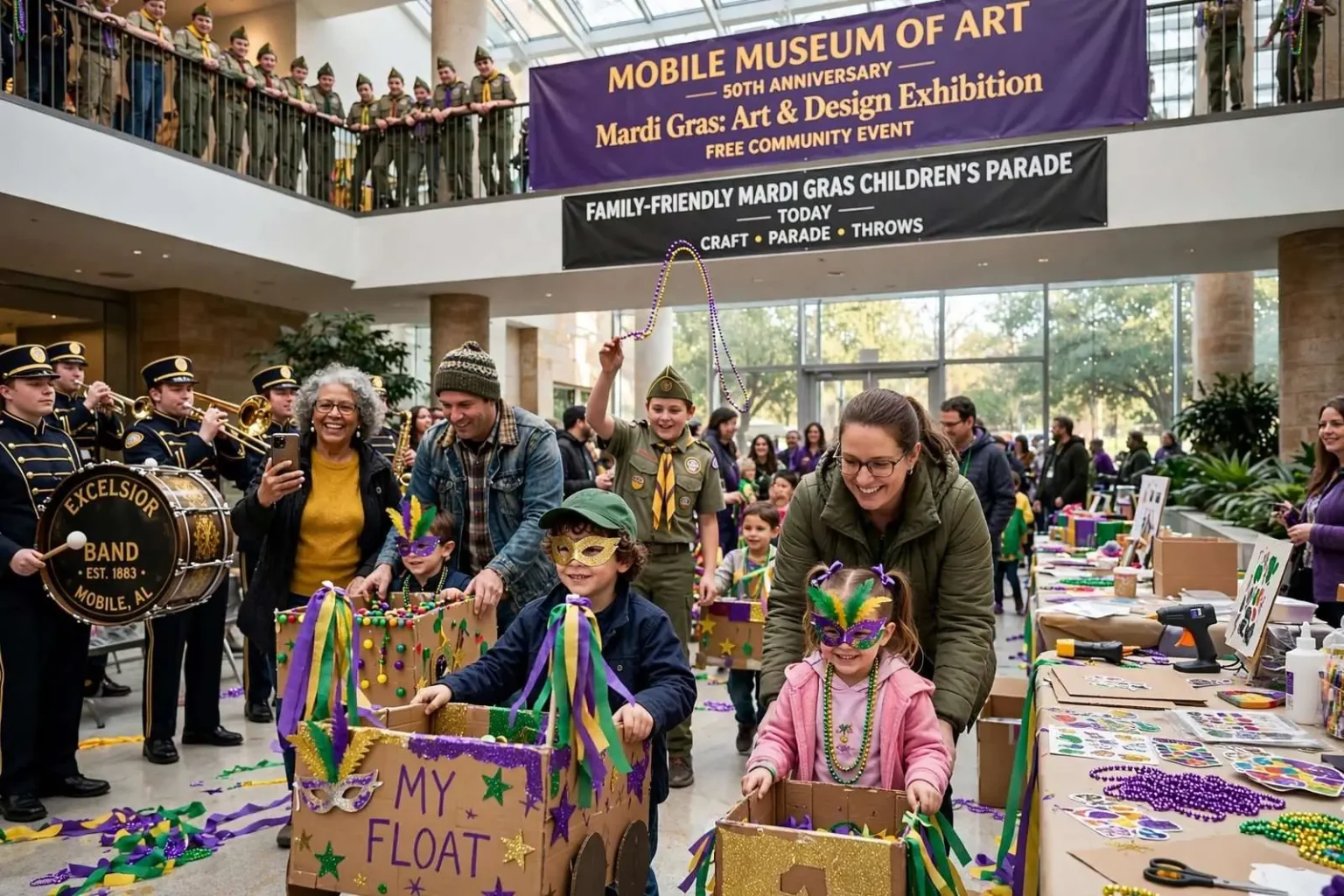
The Mobile Museum of Art turned into a Carnival workshop for the morning as families gathered for the annual Family-Friendly Mardi Gras celebration, a free community event that lets children build their own parade floats and march them through the museum’s halls. For a few hours, one of the city’s premier cultural institutions traded quiet galleries for glue guns and glitter in the name of teaching the city’s youngest residents how its oldest tradition works.
Armed with little more than glue guns, cardboard boxes and imagination, kids and their parents spent about an hour crafting homemade floats decorated with masks and colorful trimmings. The materials were simple by design — the point of the exercise is that a parade float, at its smallest and most personal scale, is something a six-year-old can make with help from a parent and a handful of craft supplies.
Once construction wrapped up, the young paradegoers formed a lengthy procession that wound from the museum’s side entrance around its circular front walkway before ending inside the building’s large glass atrium. The route gave families the full parade experience in miniature: a starting line, a marching stretch where spectators lined the way, and a grand indoor finish where the crowd gathered to catch throws.
The children’s parade was led by the Excelsior Band and members of Boy Scout Troop 227, who tossed throws down to the crowd from the atrium’s upper mezzanine as the procession arrived, giving young attendees a taste of the throws tradition central to Mobile’s Mardi Gras celebrations. For many of the children, it was a first chance to be on the marching side of a parade rather than the sidewalk side.
A tradition scaled down for small hands
One Mobile grandmother, there with her daughter and grandsons, said the event offered exactly the kind of hands-on, low-key fun that appeals to young children during the buildup to Mardi Gras season. Parents at the event echoed the same practical calculation: the big downtown parades arrive with towering floats, loud bands, dense crowds and late nights, and children too small for all that still deserve a Carnival of their own.
Mobile’s claim as the home of America’s original Mardi Gras stretches back more than three centuries, to the early French colonial celebrations on the Gulf Coast, and the city’s modern Carnival season fills weeks of the winter calendar with mystic society parades, balls and gatherings. But the season’s grandest spectacles are built for adults and older children, which is why institutions like the museum have created scaled-down versions aimed at the families who find downtown parades overwhelming.
The procession’s route through the museum itself was part of the fun. Starting at the side entrance and circling the front walkway let each float make a proper entrance before the indoor finale, and parents lining the path got the same spectator experience — waving, calling out, snapping photographs — that they will spend the rest of the season repeating on downtown curbs, only in miniature and at stroller speed.
The Excelsior Band brought its own piece of living history to the procession. Founded in 1883, the band has marched in Mobile’s Carnival celebrations for well over a century and remains one of the city’s most beloved musical institutions, its brass sound as much a signal of Mardi Gras as moon pies and beads. Hearing that band up close — rather than from a crowded curb — was part of what made the museum event distinct for young families.
Boy Scout Troop 227’s role gave the throws tradition its delivery system, with scouts stationed above the atrium floor tossing beads and trinkets to the parade’s young builders. The tradition of throws — trinkets tossed from floats to crowds, with the expectation of a friendly call and a wave in return — is the engine of Mobile’s parade culture, and teaching its etiquette early is part of how the season passes between generations.
With no admission charge for the day, families also had the opportunity to explore the museum’s galleries, including a special exhibition on the art and design of Mardi Gras, mounted as part of the museum’s 50th anniversary celebrations. The pairing was deliberate: a city whose defining festival is built on costume, float design and pageantry turns out to have an art history worth hanging on museum walls, and the exhibition let families move directly from crafting their own cardboard versions to seeing the professional craft behind the real ones.
The Mobile Museum of Art sits in Langan Park, the sprawling green space in west Mobile that also holds the city’s botanical gardens, and its galleries hold a collection that spans centuries and continents. A museum that opened in the early 1960s reached its 50th anniversary with a celebration program that included the Carnival design exhibition, tying the institution’s own milestone to the city’s most recognizable cultural tradition.
The 50th anniversary framing gave the winter program added weight. Fifty years of collecting, exhibiting and teaching in Mobile had earned the museum its anniversary, and choosing to celebrate it with an exhibition on Mardi Gras design — rather than a conventional retrospective — was itself a statement about where the institution’s heart lies: in the city’s own living traditions.
The event has become a fixture on the museum’s winter calendar, pairing the citywide excitement around Carnival season with an activity geared specifically toward younger children who may be too small to fully take part in Mobile’s larger downtown parades. Families who attend one year tend to return the next, and for many the museum event now marks the official opening of Mardi Gras season in their households.
By keeping the celebration contained to the museum grounds, organizers create a controlled, family-friendly environment where children can experience the spirit of Mardi Gras without the crowds and long parade routes associated with the bigger downtown events. There are no barricades, no late hours and no lost-child panic in a crowd of thousands — just a walkway, a band, a troop of scouts and a room full of children who built the floats themselves.
The museum’s role in the season
Museum staff, including the curator of programs, helped coordinate the parade along with volunteers and partner organizations, the kind of behind-the-scenes work that turns a craft activity into a procession with a band, a route and an audience. Institutions like the museum measure their community role partly through events of this kind — programs that pull in families who might not otherwise visit and give them a reason to come back.
The Carnival design exhibition also served the museum’s educational mission in a way that outlasted the morning’s parade. Mobile’s mystic societies employ designers, seamstresses and float builders whose work rivals the theatrical trades of any major city, and an exhibition that treats their labor as art makes the case that Carnival is a folk tradition worth studying, not just attending. Children who glued cardboard crowns in the morning could see the professional versions in the galleries the same day.
Volunteers from across the community helped staff the craft tables, manage glue guns and keep the build session moving, the unglamorous logistics that determine whether a family event runs smoothly. The scale — dozens of children, an hour of construction, a full parade to follow — demanded the same coordination a large event requires, compressed into a museum morning.
The free admission removed the last barrier for families weighing the trip to Langan Park. Museums across the country have learned that community days without admission charges draw a different, broader audience than ticketed events, and the Mardi Gras celebration has become one of the museum’s signature draws each winter — an audience of strollers and grandparents rather than the usual gallery crowd.
For the city as a whole, the event slots into the wider choreography of the Carnival season. Mobile’s Mardi Gras now includes family-oriented events across the calendar, from daytime parades in neighborhoods around the city to school programs and museum activities, all feeding the season that peaks on Fat Tuesday. The museum’s contribution is the season’s gentlest entry point: a parade where the average float is three feet tall and the average marcher is younger than ten.
The grandmother’s verdict — that hands-on, low-key fun is exactly what young children need during the buildup — captured the event’s appeal in a sentence. Carnival in Mobile can be as overwhelming or as gentle as a family chooses, and the museum’s celebration ensures that even the city’s youngest residents have a way in: a glue gun, a cardboard box, a band leading the way, and a mezzanine full of scouts raining beads down on the makers of their very first float.