
Hudson Captures GOP Nod for County Commission, Rivals Fall in Line
Connie Hudson secured the Republican nomination for the open District 2 seat on the Mobile County Commission and quickly won the backing of her former runoff opponent and the county sheriff ahead of the fall election.
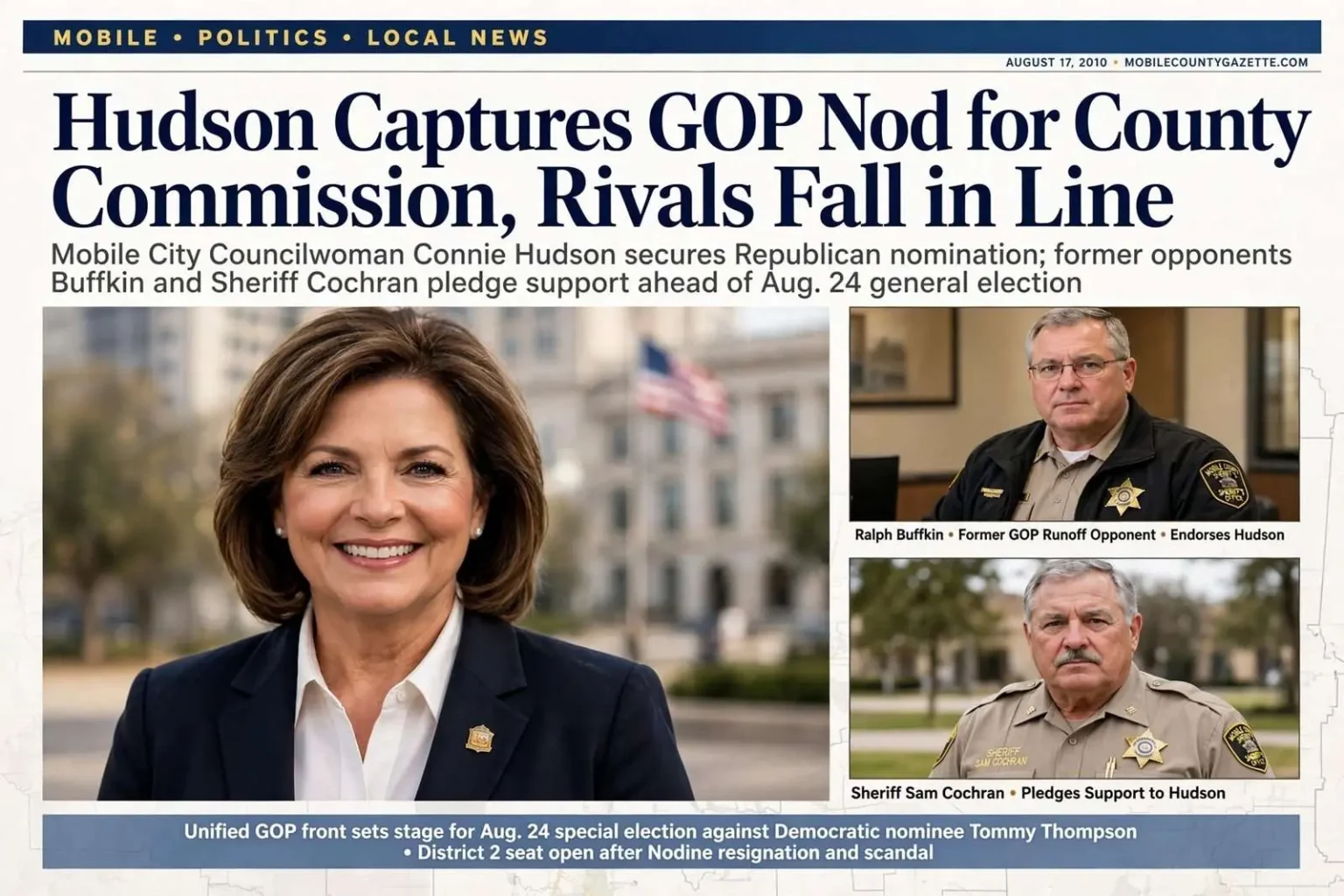
Mobile City Councilwoman Connie Hudson had won the Republican nomination for the open District 2 seat on the Mobile County Commission, and in the aftermath she gathered the support of the very rivals she had just defeated.
Former foes offer support
Hudson could claim the backing of her District 2 GOP runoff opponent, sheriff’s office administrator Ralph Buffkin, and of Buffkin’s leading ally, Mobile County Sheriff Sam Cochran. It was hardly stunning news that Hudson would win the endorsement of her fellow Republicans, but she received it plainly, in advance of her Aug. 24 showdown with Democratic nominee Tommy Thompson. Cochran and his aide pledged their support to Hudson in written statements to her campaign.
Buffkin, meanwhile, had returned to his supervisory position with the sheriff’s office in the wake of his second consecutive runner-up finish in a bid for the county commission seat. In 2004, he lost a runoff for the same office to Stephen Nodine. The pattern made Buffkin a familiar figure in District 2 politics — a steady presence in county government whose two bids for the commission bracketed Nodine’s entire tenure in the seat. His quick endorsement of Hudson closed the Republican primary season with an efficiency that old hands noted was not always the rule in Mobile County politics, where primary wounds have been known to linger into November.
The unified front mattered for practical reasons as well as symbolic ones. A county commission district stretches from suburban subdivisions to rural stretches of north Mobile County, and each primary campaign builds its own network of volunteers, donors and yard signs. By folding the Buffkin and Cochran operations into her general election effort, Hudson effectively started the final stretch with an organization already assembled — while Thompson, unopposed on the Democratic side since the spring, had waited months to learn who his opponent would be.
A seat marked by turmoil
The District 2 seat had come open under extraordinary circumstances. Nodine won a second term in 2008 but resigned about 10 weeks earlier amid impeachment charges. He had since become the subject of both federal and state indictments, the former accusing him of being a drug abuser in possession of a firearm, the latter charging him with murder in connection with the shooting death of his paramour in the spring. The scandal and resignation had triggered the special election that Hudson now stood to win, and the contrast between the seat’s troubled recent history and the campaign’s orderly close was hard to miss.
For voters in the district, the special election offered a chance to reset a seat that had been consumed by the incumbent’s downfall. Commission districts carry real consequences: the three-member Mobile County Commission controls road and bridge spending across the county’s unincorporated areas, shares authority over the county’s budget and health department, and holds influence over the port authority and the county’s economic development machinery. Whichever candidate filled the seat would inherit a full plate of constituent work — and a district that had gone more than a year with its representation consumed by scandal.
With the Republican field settled behind her, Hudson turned to the general election and the task of introducing herself to voters across the district as its would-be commissioner. She had campaigned as a sitting city councilwoman with experience in local government, and the endorsements from Buffkin and Cochran signaled that the county’s Republican establishment had consolidated behind her candidacy. Hudson’s council record gave her a ready-made platform: her district on the city’s western side overlapped substantially with the commission district’s suburban core, and her work on city infrastructure and budget matters translated directly into the arguments she would make about county roads, drainage and fiscal management.
The general election would test whether that unity translated into votes in a district that still had to choose between the Republican nominee and Thompson, the Democrat. District 2 reaches across the county’s northern and western reaches, taking in voters who had supported Nodine through two terms and who would now weigh whether his party’s nominee or the opposition offered the cleaner break from the seat’s scandal. Thompson, a longtime figure in local Democratic politics, spent the months while the Republican primary played out building his own case — arguing that the county needed a fresh start in the district and that his experience made him the safer choice for constituents exhausted by the news.
A forum ahead
Hudson and Thompson were scheduled to meet in a candidates’ forum on Thursday, Aug. 19, at 6:30 p.m. at Forest Hill Elementary School, 4051 Moffett Road. Mobile City Councilman Fred Richardson was sponsoring the forum in conjunction with his Beat 41 Community Meeting, giving residents a chance to hear both candidates before the Aug. 24 vote.
The venue and sponsor gave the forum a distinctive texture. Richardson, one of the longest-serving members of the city council and a fixture of Mobile’s political scene, had long used his Beat 41 community meetings to bring county and city questions directly to voters in his district, and candidates for county office had learned to treat the gatherings as required stops. Forest Hill Elementary, sitting along Moffett Road — the U.S. Highway 45 corridor that runs northwest out of the city — put the candidates before an audience drawn from the neighborhoods where road, drainage and infrastructure questions dominate constituent concerns.
For Hudson, the path from the crowded Republican primary field to the nomination had run through a special election set in motion by Nodine’s downfall. The compressed calendar of a special election — qualifying, primary and runoff packed into a single summer — tested every campaign’s endurance, and Hudson’s ability to finish first in the primary and then win the runoff outright made her the frontrunner heading into the final week. The endorsements that followed suggested the party intended to keep it that way.
The Aug. 19 forum offered the clearest side-by-side look at the two before ballots were cast, and Richardson’s community meeting provided a familiar venue for residents to raise the issues that mattered most to them. Whatever the outcome, the race represented a turning of the page for District 2, a chance for the commission to fill a seat that had been empty since Nodine stepped down and to move past one of the more tumultuous chapters in recent Mobile County government. Hudson entered the final stretch with momentum and the backing of her former competitors, while Thompson prepared to make his own case to voters — and five days later, the district would choose which argument it believed.
The special election also drew attention because of what it meant for the commission’s internal balance. The three-member body operates with each commissioner holding distinct portfolio responsibilities — roads, finance, the county’s health and personnel functions — and a vacant seat has meant those duties redistributed among the remaining two. Whoever won in August would take up a commissioner’s full workload mid-year, from the county’s rolling road resurfacing program to the budget hearings that set spending for the following fiscal year. Both candidates made the learning curve a theme: Hudson argued her city hall experience meant no on-the-job training, while Thompson emphasized fresh perspective on a body that had grown comfortable with its own routines.
The Aug. 24 election date itself carried the residue of the seat’s unusual year. Special elections follow whatever timeline the governor’s writ and the probate judge’s calendar produce, and this one had stretched across the summer — long enough for the Nodine saga to keep generating headlines from two court systems while the campaign to replace him proceeded on a parallel track. Voters had followed both stories at once, and the candidates’ debates over experience and reform were colored by a simple backdrop that neither could escape: the reason the election existed at all.
County government watchers noted that the race also tested Mobile County’s fast-evolving political map. District 2’s suburban precincts had been trending reliably Republican in countywide races for years, but a special election with a low-turnout profile and a Democratic nominee already organized on the ground gave the party its most realistic pickup opportunity in the district in years. Party organizations on both sides treated the August date as a genuine contest rather than a formality, staffing phone banks and sign locations through the final weekend in a way that ordinary commission races rarely inspire.
Whatever the result, the district’s new commissioner would take office with the county entering a season of weighty decisions — a major courthouse and jail funding debate, the continued expansion of the Mobile airport’s international ambitions, and the road programs that tie the county’s rural stretches to its booming suburbs. The seat Nodine’s fall had emptied was, in other words, no ceremonial prize. The voters of District 2 understood that better than anyone; they had watched the cost of getting the choice wrong.