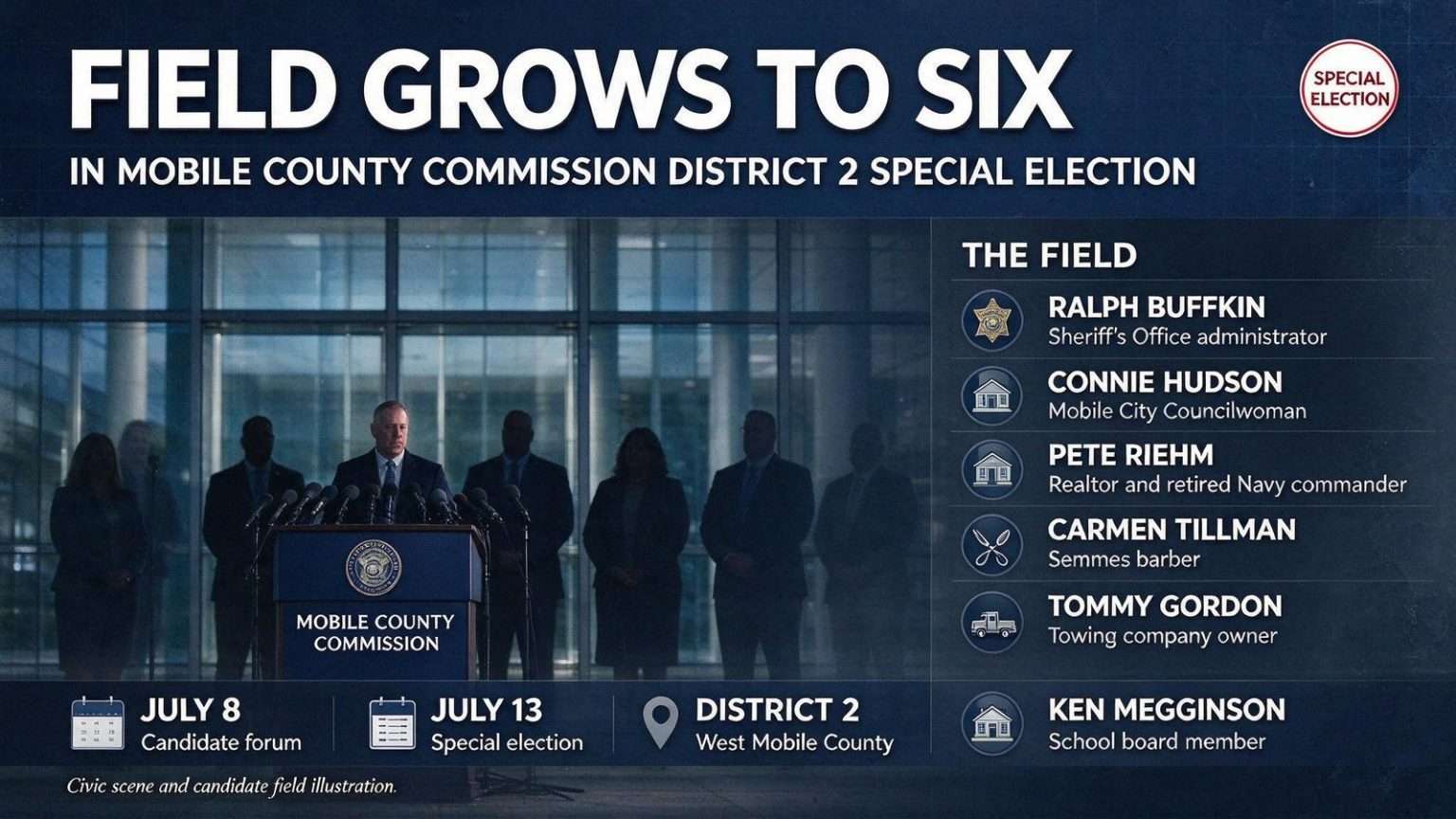
The Republican field in the July 13 special election for the vacant District 2 seat on the Mobile County Commission grew to six candidates this week, as a towing company owner and a sitting school board member joined a race that formed almost overnight after Steve Nodine’s resignation.
The special election compressed everything that normally takes months into a few weeks: qualifying, campaigning, forums and a vote, all scheduled while the county government itself was short a commissioner and facing a budget season. For voters in a district that stretches across much of west Mobile County, the speed of the process meant the campaign would be decided on name recognition and organization built before the race even began.
The newest entries
Tommy Gordon, who owns Gordon Towing on Schillinger Road, qualified Wednesday, becoming the sixth Republican in the contest. A day earlier, Mobile County School Board member Ken Megginson confirmed his candidacy. Megginson, a former schoolteacher who lives in Semmes, said he would announce publicly with a media event the following week, after finishing some school system business, and that he planned an inexpensive, grass-roots campaign. He is known around the county for his cheerful manner and his signature farewell — “Have a happy day!”
Both late entrants represented the western, unincorporated side of the district. Gordon’s towing business on Schillinger Road sat in the middle of the corridor that District 2’s growth had built, and a business owner whose customers are stranded motorists has met more west Mobile residents in person than most politicians meet in a career. Megginson’s school board seat gave him a different kind of footprint: the Mobile County Public School System’s western schools, their parents and the PTAs that follow them.
Grass-roots and inexpensive were not merely style choices in a race like this. With no time to raise serious money and no incumbent to run against, the candidates who could work free networks — churches, civic clubs, business contacts, school communities — had the same practical advantage as the ones with the deepest bank accounts, and Megginson’s plan was an honest statement of that arithmetic.
The full field
They joined a group already in the race: Ralph Buffkin, an administrator in the Mobile County Sheriff’s Office, who lost a 2004 District 2 runoff to Nodine; Connie Hudson, a Mobile City Councilwoman with nine years on the council; Pete Riehm, a commercial realtor, retired Navy commander and conservative organizer making his first run for office; and Carmen Tillman, a Semmes barber. All six were Republicans. No Democrat had announced for the seat.
The field’s composition mapped the district’s competing power centers. Buffkin had the Sheriff’s Office network and, crucially, recent experience running countywide for the same seat. Hudson brought the city council’s western district and the most visible elected record in the race. Riehm represented the conservative activist infrastructure — the movement-minded Republican who runs on principle and organization rather than office-holding. Tillman, like Gordon, was a small-businessman with a storefront constituency, and a barber’s chair in Semmes is as reliable a listening post as Alabama politics offers.
With six Republicans and no Democrat, the July 13 election was effectively the whole contest. Whoever received the nomination — and, depending on the rules governing special elections, possibly the seat itself without a November follow-up — would take the commission seat for the remainder of the term. That reality made the compressed campaign all the more consequential: there was no fallback date, no second chance to introduce a candidate who had not yet reached the voters.
A forum on July 8
The Mobile County Republican Executive Committee scheduled a candidate forum and debate for 7 p.m. on July 8, five days before the election, at a location to be determined. With six candidates, a compressed calendar and no incumbent, the forum shaped up as one of the few occasions voters would have to see the field side by side.
Five days is not much runway after a debate. Any candidate hoping the forum would change minds had to be prepared to make an impression fast — a sharp answer, a memorable contrast, a mistake the others could pounce on. For voters, the July 8 event doubled as a sorting mechanism for a ballot full of names that most of the district could not yet attach to faces.
Glover declines to pick
Talk circulated that state Sen. Rusty Glover, a Semmes Republican and schoolteacher, was endorsing Hudson. Glover said the rumor had a basis but needed clarification. Hudson had called him roughly three weeks earlier, he said, asking for his support with Gov. Bob Riley, who at that point was expected to appoint someone to fill the vacancy until a special election could be held.
“I immediately called the governor’s office and recommended her,” Glover said. “Since that time, it was determined that it would be decided by election.” With the process changed, so was his posture.
“Not only have five of my constituents declared as candidates, but they include one of my barbers and my school board representative,” Glover said. “I believe that any of the five that have announced would serve District 2 very well.” He said he would give advice to any candidate who asked, but would not endorse in the primary or runoff.
In any event, Glover added, he questions what endorsements are worth. “I’m hearing from people that endorsements from politicians will not sway them anyway,” he said. “I hear from many people that they ‘don’t want anyone telling them how to vote.'”
Glover’s position was a textbook read of a special-election electorate. In a race with six credible Republicans from the same end of the county, an endorsement could just as easily alienate the supporters of the other five as consolidate anyone, and the senator’s own constituents — including two of the candidates — were better served by a neutral senator than a committed one. His comment about the appointment process also captured a procedural wrinkle of the vacancy: for weeks it appeared the governor might simply name Nodine’s replacement, until the decision came down that voters would decide it themselves.
A district that has shifted
Glover offered one piece of political geography worth noting. District 2 once split roughly 80/20 between city and county residents. With the sharp growth just outside Mobile’s western limits, he said, the break was now closer to 70/30 — a meaningful change in a low-turnout special election, and one that gave suburban and rural voters near Semmes more weight than they had carried in past cycles.
The shift explains the character of the field. Two Semmes candidates, a Schillinger Road business owner and a school board member who represents the western districts together formed a distinctly unincorporated bloc, while Hudson carried the city’s share. In a low-turnout summer special election, where a few thousand votes can decide the outcome, a shift of ten points in the city-county balance is not a curiosity; it is a map of where the race would be won.
The demographic trend behind the shift was decades in the making. Subdivision development along Schillinger Road, Snow Road, Howells Ferry and the roads feeding them had steadily moved the district’s population west and north, into precincts that had no municipal government of their own. Those voters’ issues — roads, drainage, sheriff’s patrols, schools — are county commission issues by definition, and District 2’s special election was, in substance, a referendum on who would speak for them.
The vacancy itself
Nodine resigned in late May rather than face an impeachment trial, and remained in custody on a murder charge in Baldwin County and a federal firearms charge. His departure left the three-member commission short a vote, with a budget to write and the economic fallout of the Gulf oil spill arriving.
The circumstances made the timing brutal. A three-member commission that loses a member loses its ability to break its own deadlocks, and the county’s budget calendar does not pause for a special election. Meanwhile, the Deepwater Horizon spill — which had begun fouling the Gulf in April — was bearing down on the coast’s tourism and fishing economy, the very industries that Mobile County government would be asked to help steady. The commissioner chosen on July 13 would walk into a body short-handed, mid-budget and confronting the worst environmental disaster in the Gulf’s recorded history.
That context reframed the six candidates’ campaigns. Experience with budgets, emergency management and intergovernmental relations counted for more than it would have in a normal cycle, and voters weighing familiar local names were also, implicitly, weighing who could sit down at a commission dais and function immediately in a crisis. The forum on July 8, five days before the vote, was the district’s one scheduled chance to see which of the six was ready for that.