Dauphin Island Sea Lab Director to Weigh In on Oil Spill Policy
George Crozier, longtime director of the Dauphin Island Sea Lab, was invited to deliver a talk examining how the 1990 Oil Pollution Act fared against the reality of the 2010 Deepwater Horizon disaster.
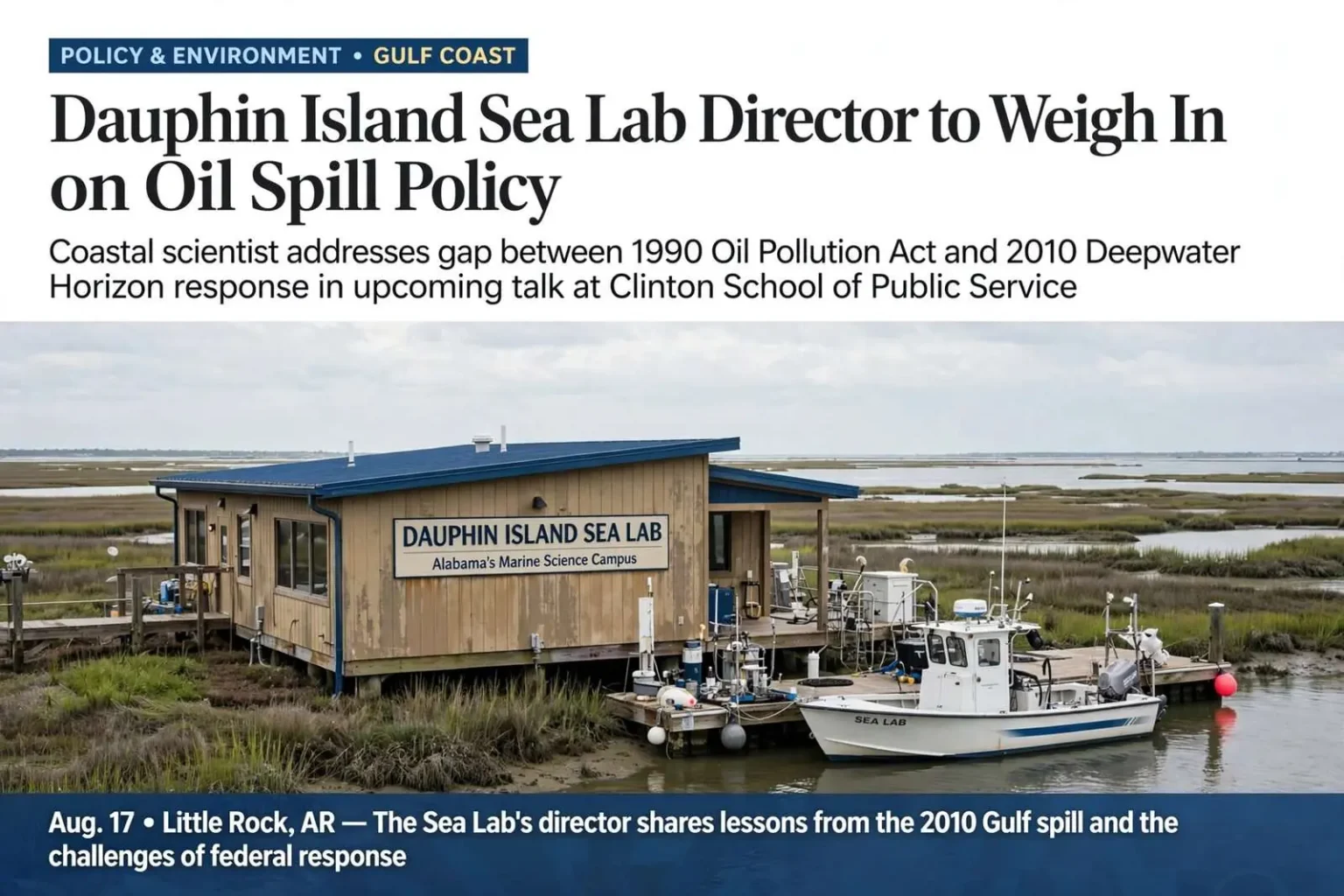
George Crozier, the longtime executive director of the Dauphin Island Sea Lab, was invited to bring an Alabama coastal scientist’s perspective to a national audience, delivering a talk on the gap between the promise of federal oil spill law and its performance during the 2010 Gulf disaster.
An invitation to speak
Dr. Crozier was scheduled to speak Tuesday, Aug. 17, in the distinguished speaker series at the University of Arkansas Clinton School of Public Service, located on the grounds of the William J. Clinton Presidential Center in Little Rock, Arkansas. His talk carried the title “Well Intended Policy and Unintended Consequences: The Story of the Oil Pollution Act and the 2010 Deepwater Horizon Oil Spill in the Gulf of Mexico.”
The subject drew directly on the crisis that had consumed the Alabama coast through the summer, and on the federal law enacted two decades earlier in response to an earlier catastrophe.
Good intentions, hard lessons
The 1990 Oil Pollution Act had been passed in the wake of the Exxon Valdez spill, meant to strengthen the nation’s ability to prevent and respond to oil disasters. Crozier’s argument, as reflected in the title of his talk, was that the law’s aims had not survived contact with reality.
“While hindsight is cheap, there is little doubt that the good intentions of the 1990 Oil Pollution Act went badly unfulfilled when actually put into practice twenty years later,” Crozier said in commenting on his topic.
It was a pointed assessment from a scientist who had spent years studying the very waters the Deepwater Horizon spill had threatened. As director of the Dauphin Island Sea Lab, Crozier oversaw one of Alabama’s premier marine research institutions, a hub for the study of the Gulf of Mexico and the Mississippi-Alabama estuaries, and a resource that had taken on heightened importance as the spill unfolded.
His critique landed on a law with sweeping ambition. The Oil Pollution Act established clear liability for parties responsible for spills, created the Oil Spill Liability Trust Fund to pay for response when responsible parties could not or would not, and required spill response plans from tank vessels and offshore facilities. On paper, it was exactly the framework the Exxon Valdez disaster had shown the country lacked. What the Deepwater Horizon blowout revealed, in Crozier’s telling, was how differently the framework performs when the spill comes from a mile-deep well rather than a grounded tanker.
A coastal voice on a national stage
Crozier’s appearance at the Clinton School placed a South Alabama expert before an audience far from the coastline, in a venue devoted to public service and policy. The Clinton School’s speaker series routinely brings policymakers, journalists, scientists and officials to Little Rock, and the oil spill’s reach — economic, ecological and political — made it a natural subject for a national audience.
For Alabama, the invitation carried its own significance. The state’s coastline is short compared with Louisiana’s or Florida’s, but its barrier islands, estuaries and beach towns absorbed a heavy share of the spill’s consequences. Dauphin Island, the barrier community at the entrance to Mobile Bay, and the beach communities of Gulf Shores and Orange Beach faced tar balls, closed waters and a tourist season in collapse. Having the Sea Lab’s director speak to the policy failures behind those images put a local scientist’s experience into the national conversation about offshore drilling and its oversight.
The setting was fitting in another way: the Clinton Presidential Center stands as a monument to the era in which the 1990 law — signed by President George H.W. Bush after passing with broad bipartisan support — took shape, and the school next door trains the public servants who write and administer the next generation of environmental policy.
The Sea Lab on the front line
The Dauphin Island Sea Lab sits on the eastern end of Dauphin Island, where Mobile Bay meets the Gulf, and functions as Alabama’s marine science campus. Founded as a consortium of state colleges and universities, it runs graduate and undergraduate coursework in marine and environmental science, operates the public Estuarium aquarium and discovery hall, and hosts researchers whose work covers everything from seagrass restoration to fisheries to coastal geology.
When the Deepwater Horizon rig exploded in April 2010 and its damaged well began pouring oil into the Gulf, the Sea Lab’s location made it a front-line observation post. Its scientists watched the spill’s approach to Alabama’s beaches and marshes, tracked effects on the estuarine systems of Mobile Bay and the Mississippi Sound, and became a source of technical knowledge for a public desperate to understand what was happening offshore.
Crozier, who led the institution for decades, was among the region’s most experienced coastal voices. His career spanned the years in which Alabama developed its coastal programs, fought erosion on its barrier islands and debated the tradeoffs of its growing tourism economy — experience that informed his reading of how the spill response was actually working on the water.
What the 2010 disaster exposed
The Deepwater Horizon spill strained the 1990 law at nearly every joint. The scale of the discharge from a deepwater well overwhelmed the response equipment and techniques available, none of which had been designed for a blowout at that depth. Questions about who was in charge of the response, how liability would be calculated and how restoration would be paid for played out over months in public view.
For coastal Alabama, the practical consequences were immediate. Fishing waters closed. Beaches that anchor the economies of Gulf Shores and Orange Beach saw oil products wash ashore. Booming operations stretched across passes and bays. The tourism season — the economic engine of the state’s coastal counties — suffered even where oil never arrived, as national images of the spill kept visitors away.
Crozier’s title phrase, “unintended consequences,” captured the core of the lesson: a law written in response to tanker spills in Prince William Sound turned out to be an imperfect instrument for a deepwater blowout in the Gulf. The gap between what the law promised in 1990 and what the coast experienced in 2010 was precisely the story he traveled to Little Rock to tell.
Why the talk mattered
Public lectures like the Clinton School series rarely change law on their own, but they shape the thinking of the people who eventually will. Crozier’s audience included students preparing for careers in public service — the next set of regulators, responders and policymakers who will write the rules for offshore energy. Giving them an account of the 2010 spill from someone who watched it from Dauphin Island, rather than from a Washington hearing room, served the school’s purpose directly.
It also served the Gulf Coast’s. The region’s experience of the disaster included months of uncertainty, contested science and economic pain that national coverage summarized only briefly. Every public accounting by a coastal scientist helped correct the record about what the spill actually did to communities, habitats and institutions along the northern Gulf.
By the time the well was capped and the response wound down, the Oil Pollution Act’s promise — that spills would be paid for by those responsible and cleaned up competently — had been tested in the most demanding possible circumstances. Crozier’s assessment of how it held up, delivered from two decades of coastal science in Alabama, was the kind of verdict only a frontline witness could offer.
Alabama’s coastal science infrastructure
The Sea Lab’s role in the spill response underscored something Alabama’s coast had long understood: a state with a short shoreline still needs serious marine science capacity. The institution’s consortium model, drawing faculty and students from campuses across the state, concentrates expertise on a single barrier island campus and gives the state a permanent, independent source of knowledge about its own coastal waters.
That capacity matters most in exactly the moments when policy meets the water. During the spill, officials and residents alike needed answers about where the oil was, what the currents were doing, how marshes and seagrass beds would respond and what the long-term effects on fisheries might be. Research institutions like the Sea Lab are among the few places those answers can come from, which is why its director was invited to speak about the spill’s policy dimensions rather than only its ecology.
The barrier island setting itself carries the lessons Crozier has spent a career studying. Dauphin Island sits at the mercy of the same Gulf that produces the region’s hurricanes and received the spill’s oil, and the island’s shifting sands have been the subject of decades of engineering and policy debate. A scientist who has watched one of the coast’s most dynamic landforms evolve brings a long memory to any assessment of how well institutions respond to sudden change.
The policy conversation that followed
By late summer 2010, with the well capped and cleanup crews working the beaches, the regional and national conversation had turned to what would change. Congressional hearings examined offshore drilling oversight. The Coast Guard and industry reexamined response capability. Gulf states pressed for restoration commitments commensurate with the damage.
Speeches like Crozier’s fed that conversation from the scientific side. His argument that the 1990 law’s “good intentions went badly unfulfilled” was not a call to abandon the framework but a demand that policy learn from the stress test it had just failed: response capability must match the depth and volume of modern wells, liability must be clear enough to fund restoration fully, and the science needed to assess damage must exist before the next disaster, not after.
For the Clinton School audience, the talk offered a case study in the difference between enacting a law and achieving its purpose — a distinction at the heart of public service education. For Alabama’s coast, it was a reminder that the state’s experience of the disaster was documented not just in photographs of oiled beaches but in the testimony of the scientists who know those waters best.
Twenty years after the Oil Pollution Act was written, the Gulf had delivered its own audit of the statute. Crozier’s talk brought that audit, with all its hard lessons, to an audience equipped to act on it.