Heavy Rain Triggers Sewage Overflow in Baldwin County
A Robertsdale lift station overflowed after heavy overnight rainfall, sending more than 10,000 gallons of sewage into Rock Creek in Baldwin County.
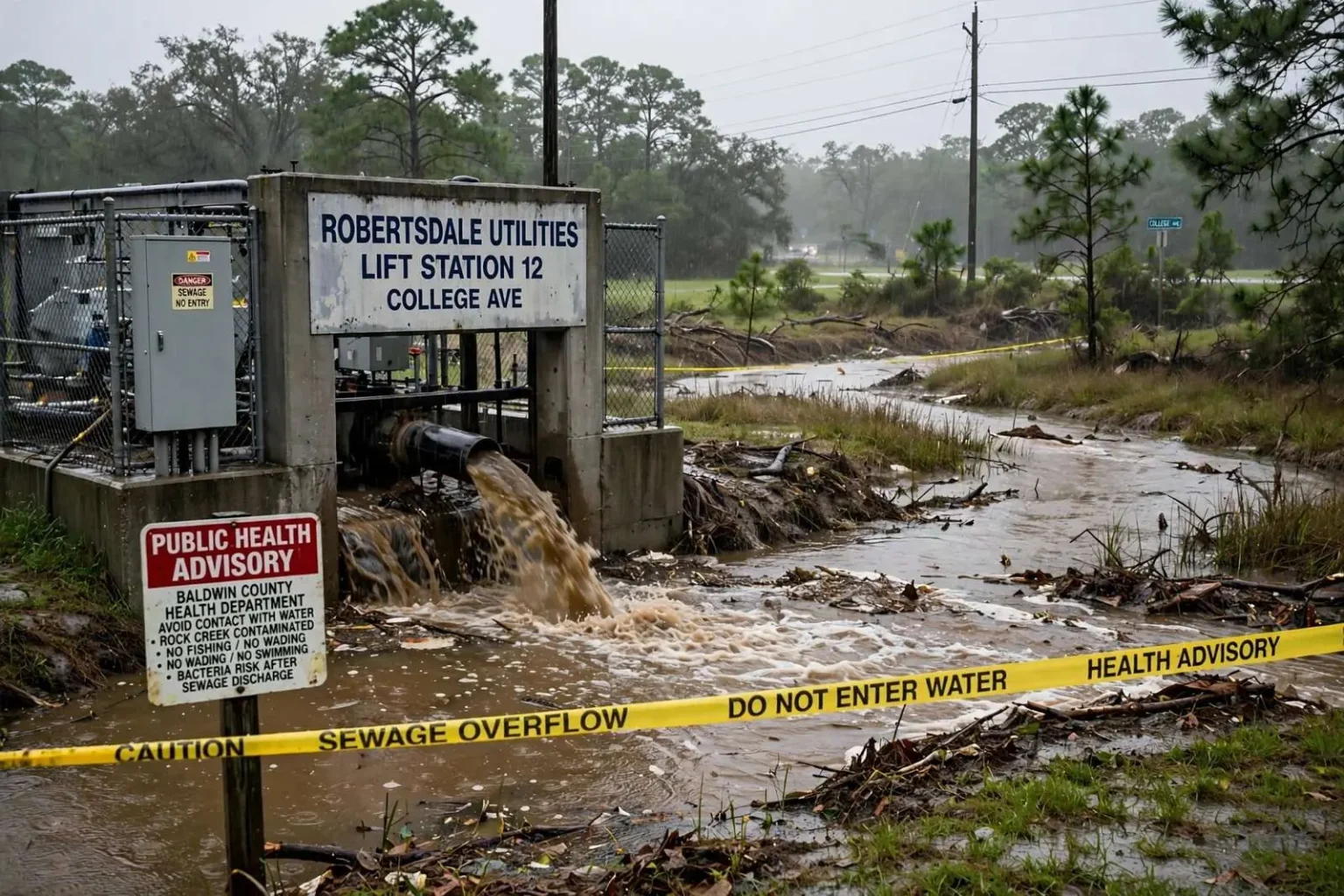
Heavy overnight rainfall overwhelmed a sewage lift station in Baldwin County, leading to a significant discharge into a local waterway and prompting a public health advisory.
According to the Baldwin County Health Department, a Robertsdale Utilities lift station on College Avenue overflowed after storms dumped as much as 3 inches of rain across parts of the county, based on National Weather Service estimates. Health officials said more than 10,000 gallons of sewage were released into Rock Creek as a result of the overflow. The volume of the release placed it among the more substantial overflows reported in the county during recent heavy rain events, and the advisory that followed was issued as a precaution while conditions along the creek were assessed.
Lift stations are a critical but often overlooked part of the wastewater systems that serve fast-growing communities across Baldwin County. They collect sewage from lower-lying neighborhoods and pump it uphill through force mains toward treatment facilities, and when stormwater floods the system faster than pumps can move it, the excess has nowhere to go but out through overflow points and into nearby drainage ways and creeks.
Where the water goes from there
The creek is a tributary that flows eastward, eventually reaching the Blackwater River before continuing on to the Perdido River, which empties into Perdido Bay near the Alabama-Florida state line. That downstream path matters because contaminants released at a single overflow point do not stay put. They move with the current, and the advisory implications can stretch well beyond the stretch of creek nearest the lift station as water makes its way toward the state line.
Waterways in that part of Baldwin County ultimately connect to the Perdido watershed, one of the drainage systems that links the Alabama coast to the Florida Panhandle. Residents along the lower reaches of those streams, including areas used for fishing and paddling, pay attention to spill notices for exactly that reason, since a discharge that begins in Robertsdale can affect water quality downstream for days depending on rainfall and flow conditions.
Rainfall totals across the county during the storm varied considerably, a common feature of Gulf Coast thunderstorm systems where bands of heavy rain can park over one community while another a few miles away sees only moderate precipitation. National Weather Service estimates that put the top totals near 3 inches help explain why the lift station on College Avenue found itself overwhelmed while other parts of the system may have come through the night without incident.
The health advisory and what it means
Because of the spill, the Baldwin County Health Department urged residents who use Rock Creek for recreational purposes to exercise caution, particularly when it comes to handling any fish or seafood caught in the affected waterway following the overflow. Advisories of this kind are a standard response to sewage overflows across Alabama, where state and county health officials work from a well-established playbook once a discharge has been confirmed.
Sewage discharges of this kind can introduce bacteria and other contaminants into waterways, posing health risks to people who come into direct contact with affected water or who consume seafood harvested from it soon after a spill. Elevated bacteria levels can linger after the water looks clear again, which is why health departments typically urge caution rather than declaring waterways safe immediately after the visible signs of an overflow have passed.
Contact with water containing untreated sewage can lead to a range of illnesses, from stomach upset and skin infections to more serious conditions for people with weakened immune systems. Anglers who wade into a creek to retrieve a catch or children who play along the banks are among those most likely to come into direct contact with affected water, which is why advisories specifically call out recreational use and seafood handling.
Cooking fish thoroughly reduces but does not eliminate every concern associated with water quality, and health officials generally advise residents to wash their hands and any equipment that has been in contact with the water after an advisory has been issued. The advisories remain in effect until officials have enough information about bacteria levels and flow conditions to determine that the risk has passed.
Why overflows keep happening in Baldwin County
Lift station overflows are not uncommon during periods of heavy rainfall in Baldwin County, where aging infrastructure and the sheer volume of stormwater can exceed a system’s capacity to move wastewater efficiently. The county has been among the fastest-growing areas of Alabama for years, and new subdivisions, schools and commercial developments add wastewater demand faster than older lines and pump stations in some areas were ever designed to handle.
Utility systems throughout coastal Alabama regularly contend with similar strain during intense rain events, particularly when several inches fall in a short period, as was the case with this storm. In Mobile and Baldwin counties, heavy rain can also raise groundwater levels and infiltrate older sewer lines through cracks and joints, adding volume to the system from every direction at once and leaving lift stations with more flow than their pumps were sized to handle.
Lift stations themselves require constant maintenance. Pumps wear out, floats and sensors fail, and power interruptions during storms can knock stations offline precisely when they are needed most. Utilities that serve growing areas typically prioritize upgrades to their most trouble-prone stations, but the work is expensive, and the pace of replacement rarely keeps up with the pace of growth across the county’s unincorporated areas and smaller municipalities.
Environmental regulators track overflows reported by utilities across the state, and repeated incidents at the same station often draw attention from agencies that can require corrective action. Public reporting of overflows also matters to residents, since health advisories are only useful if people who live near an affected creek hear about them in time to change their plans around fishing, swimming or boating.
What happens next along Rock Creek
Robertsdale Utilities has not detailed what steps, if any, will be taken to prevent similar overflows during future heavy rain events, though such incidents typically prompt a review of pump capacity and line maintenance at the affected station. Utilities that experience overflows of this size commonly evaluate whether additional pump capacity, expanded wet well storage or improved stormwater separation near the station could reduce the odds of a repeat during the next major rain event.
Cleanup and follow-up after an overflow usually involve flushing and disinfecting the affected area where access allows, documenting the volume and duration of the release, and reporting the incident to state environmental officials. The extent of those steps in this case has not been publicly detailed, and the health department’s monitoring is the primary way residents will learn when conditions along the creek have returned to normal.
Baldwin County Health Department officials continued to monitor the situation following the release. Monitoring after a spill of this kind typically focuses on bacteria levels in the affected waterway and on any signs that the discharge is still ongoing, since a second wave of rain could push additional flow through an already strained system.
Residents who noticed unusual conditions along Rock Creek, such as discolored water or an odor near the creek, are generally encouraged to report those observations to the health department, which relies in part on public reports to track how far the effects of an overflow extend. For now, the guidance for anyone who uses the creek remains the same: exercise caution, avoid unnecessary contact with the water, and handle any fish or seafood caught in the affected waterway with care until officials determine the advisory can be lifted.
The incident serves as a reminder of how closely water quality along the Alabama coast is tied to the capacity of the infrastructure hidden beneath the streets of its communities. A single overwhelmed lift station in Robertsdale sent a warning downstream toward Perdido Bay, and until the county’s wastewater systems catch up with its growth, heavy rain will keep testing the limits of that infrastructure with every major storm that rolls in off the Gulf.
Robertsdale sits in the central swath of Baldwin County, a community whose history is tied to the railroad lines and agricultural settlements that shaped the county’s interior more than a century ago. The city has shared in the growth boom that has transformed the county over recent decades, with new rooftops spreading outward from its older core and placing steady new demand on utilities that were built for a much smaller customer base.
State environmental officials also play a role in episodes like this one. Utilities in Alabama are generally required to report significant overflows to the state environmental management agency, and those reports feed a public record that environmental groups and residents can review. Patterns in the data, such as repeated overflows at the same station during heavy rain, can inform where grant funding and regulatory attention are directed in future budget cycles.
The timeline for lifting an advisory depends heavily on the weather that follows the spill. Dry conditions allow creek levels to fall and bacteria to die off naturally, while additional storms can extend the advisory by flushing more contaminants through the system or stirring up sediment along the banks. Officials typically balance laboratory results against flow conditions before giving the all-clear, and residents should expect the caution period to last at least several days after a release of this size.
For neighboring waterways, the calculus is different. Creeks and rivers outside the Rock Creek drainage were not part of the advisory, and normal recreational use continued elsewhere in the county. That distinction is worth remembering, since a single lift station overflow does not signal a countywide problem, even though the county’s wastewater challenges are broadly understood by the agencies that manage its systems.
Longer term, the episode adds to the case local officials have been making for infrastructure investment across one of the fastest-growing corners of the Gulf Coast. Every new subdivision that connects to an older sewer system adds load that the original designers never anticipated, and storms like the one that flooded the College Avenue lift station will keep arriving as long as the Gulf keeps producing them.