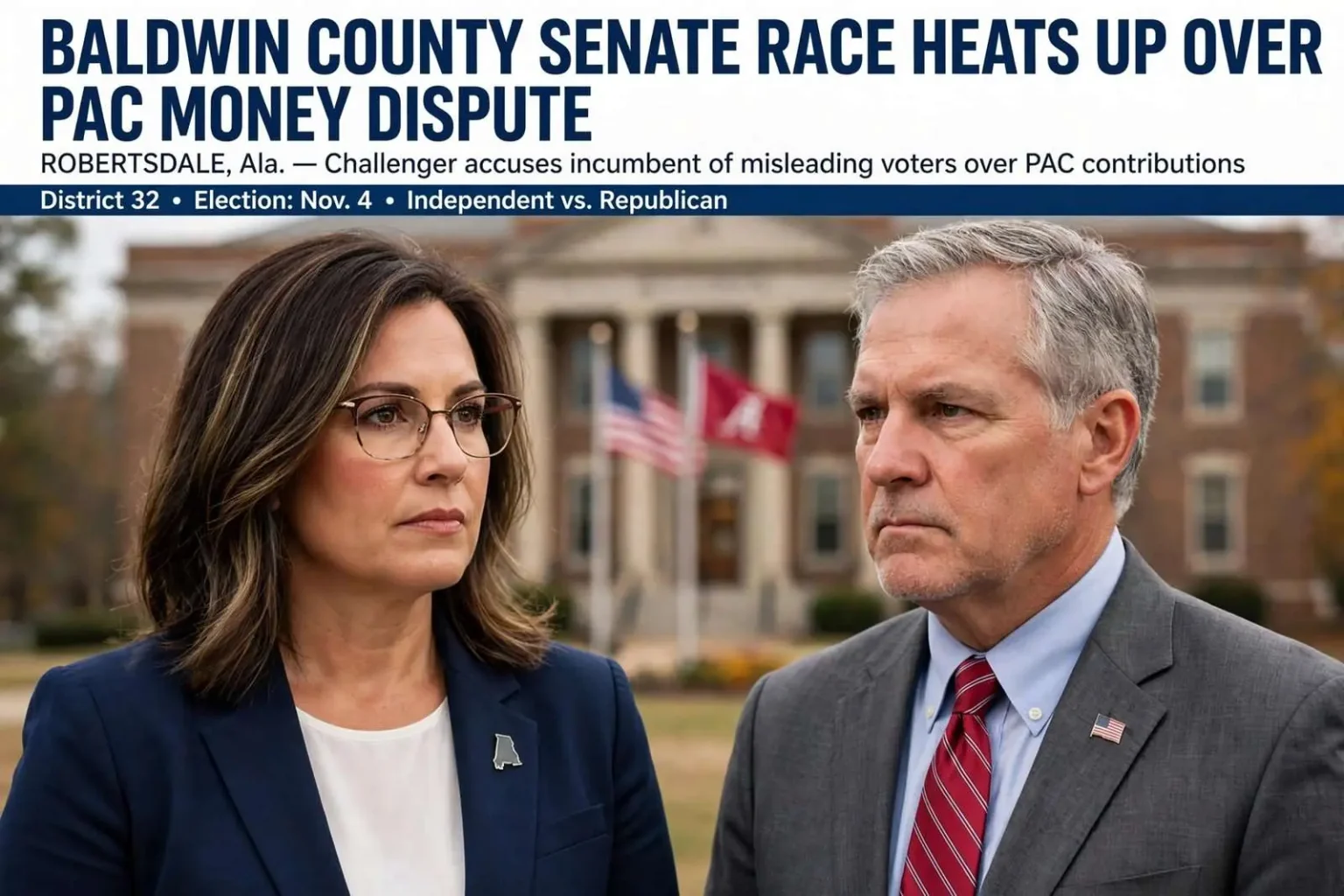
ROBERTSDALE, Ala. — A Baldwin County state Senate race has turned combative over campaign cash, after independent challenger Kimberly McCuiston accused Republican incumbent Trip Pittman of misleading voters about his promise not to accept political action committee money.
The dispute traces back to a candidates forum held in Robertsdale, sponsored by the Common Sense Campaign, where Pittman told the crowd he doesn’t take PAC contributions. “I think that I have lived up to promises I’ve made in terms of not taking special interest money,” Pittman said at the forum. “I’m the only person in Montgomery who doesn’t take PAC money.”
McCuiston says that claim doesn’t hold up against Pittman’s own campaign finance filings, which show tens of thousands of dollars in PAC contributions flowing into his campaign account in 2010 and 2011. Records cited by McCuiston include a $5,000 donation from the Alabama Power Employees PAC, $3,500 from Alabama Acre PAC, $5,000 from the Alabama Medical PAC and two separate $5,000 contributions from DST PAC. “He mentioned it three times during the debate,” McCuiston said. “When you stand up before your own people … then you should be able to believe that person. And once again, he’s spinning.”
Pittman doesn’t dispute that the donations happened, but argues the timing and context matter. He noted Alabama law allows contributions made within 120 days after an election to count toward that prior election cycle — meaning the PAC money he accepted came in even though he ran unopposed in 2010. Pittman said he used those funds, along with other contributions, to help his party take control of the state Senate rather than to benefit his own race. “We were trying to take over the Legislature last time,” he said. “I agreed to take money (from PACs) because there were candidates who were trying to upset incumbents who didn’t have access to PAC funds.”
This election cycle, Pittman’s donor list includes a mix of corporate and lobbying interests: $7,500 from Selma-based government relations firm The Cosby Co., $2,500 each from Alabama Banking Services Inc. and Montgomery lobbying firm Fine Geddie & Associates, and $2,000 apiece from AT&T Alabama, TitleMax and U.S. Steel. Companies including Blue Cross and Blue Shield of Alabama, Austal USA, Columbia Southern University, Cunningham Bounds and Microsoft each gave $1,000.
McCuiston, who is running without a party affiliation, said the volume of corporate money is exactly why she jumped into the race. “This is one of the reasons I ran as an independent,” she said. “The majority of people who look at it, it appears hinky. He’s no longer representing people.”
Pittman, who chairs the Senate’s education budget committee, said he draws a line between accepting reasonable contributions and being unduly influenced, and that he has turned away larger offers and donors who later sought favors. District 32 covers the Eastern Shore and south Baldwin County, and voters will decide between the two candidates on Nov. 4.
Alabama is a state in the southeastern United States bordered by Tennessee, Georgia, Florida, the Gulf of Mexico, and Mississippi. Often called the Heart of Dixie, it spans Appalachian foothills in the north and flat coastal plains in the south. Its largest cities include Birmingham, Montgomery, Huntsville, and Mobile.
Alabama’s history encompasses Indigenous roots, Spanish and French colonial settlement, a cotton-plantation economy, the Civil War and Reconstruction, and the Civil Rights Movement of the 1950s and 1960s, followed by a shift toward manufacturing, aerospace, and technology. Local news across the state frequently reflects this mix of tradition and change.
Baldwin County sits directly east of Mobile County across Mobile Bay and is the largest county in Alabama by land area. It encompasses the Eastern Shore communities of Daphne, Fairhope, Spanish Fort, and Foley and stretches south to the beaches of Gulf Shores and Orange Beach along the Gulf of Mexico.
Long among the fastest-growing counties in the state, Baldwin blends suburban development near the bay with tourism-driven coastal economies. Its proximity to Mobile and its position on the Eastern Shore make it a recurring subject of regional news covering growth, infrastructure, schools, and the balance between development and coastal preservation.
Local government in the Mobile area operates through a combination of mayor-council or commission structures at the municipal level and a county commission in Mobile County, with elected officials handling budgets, public safety, infrastructure, and zoning. Baldwin County has its own commission and a collection of incorporated municipalities.
Decisions made in council chambers and commission meetings affect roads, school funding, economic development, and quality of life, which is why coverage of local government is a staple of regional journalism. The interplay between city, county, and state authorities often determines how effectively the area can address shared challenges.
Because many services residents rely on are delivered at the local level, the choices of elected officials have direct, everyday consequences. Budget priorities, in particular, reveal a community’s values and shape the trajectory of growth and public welfare for years to come.
Charitable and nonprofit organizations form a vital safety net across South Alabama, addressing needs from hunger and homelessness to disaster relief and holiday assistance. Groups such as The Salvation Army operate local corps that provide shelter, food, and seasonal programs funded largely by community donations.
The generosity of Gulf Coast residents, often mobilized after hurricanes and economic hardship, underscores how tightly knit many of these communities are. Local philanthropy also relies on volunteers and corporate partners, and the progress of fundraising efforts is a recurring subject of regional news because it reflects the community’s capacity to care for its most vulnerable members.
Holiday campaigns in particular reveal the scale of need and the reach of volunteer networks. The rhythm of annual giving, from food drives to toy distributions, is woven into the regional calendar and into the coverage that keeps residents informed about how to help and where support is most needed.
Education in South Alabama spans public school systems in Mobile and Baldwin counties, a network of private and parochial schools, and institutions of higher learning including the University of South Alabama, Spring Hill College, and community colleges. Public-school governance rests with locally elected boards.
Boards oversee budgets, curricula, and facilities, often amid debates over funding equity and student achievement. The region’s colleges contribute not only to the workforce pipeline but also to healthcare, research, and cultural life, and education policy set in Montgomery frequently shapes what local districts can do.
Schools are also central to community stability. Enrollment trends, facility conditions, and graduation outcomes are watched closely by families and employers alike, making education a persistent focus of public attention and news coverage across the Gulf Coast.
Healthcare in the Mobile area is anchored by several hospital systems and provider networks that serve patients across southwest Alabama, the Gulf Coast, and into parts of Mississippi and Florida. Large employers in the sector include regional health systems operating hospitals, clinics, and specialty centers, alongside university-affiliated providers.
Access to care, the financial health of nonprofit hospitals, and the integration of behavioral and physical health are ongoing priorities. As in many parts of the country, local healthcare institutions navigate workforce shortages, changing reimbursement models, and the particular demands of serving both dense urban neighborhoods and far-flung rural communities.
The ties between healthcare and the local economy are strong. Hospitals are among the region’s largest employers, and decisions about service lines, expansion, or closure reverberate through surrounding neighborhoods, making health-system news a staple of regional journalism.
Mobile is the county seat of Mobile County in southwest Alabama and the state’s only saltwater port. Situated where the Mobile River meets Mobile Bay near the northern Gulf of Mexico, the city has long served as a commercial and cultural gateway between Alabama and the wider Gulf Coast. Founded in 1702 as Fort Louis de la Louisiane and ruled in turn by France, Britain, and Spain before joining the United States in 1813, Mobile carries a layered heritage distinct from the rest of the state.
Today Mobile anchors a metropolitan area spanning Mobile County and neighboring Baldwin County, and it remains a center for shipping, aerospace, healthcare, and higher education in the region. Its downtown and waterfront have seen sustained revitalization, while historic neighborhoods preserve architecture from its colonial and antebellum past. The city’s identity is shaped as much by its working port and industrial base as by its festivals and food culture, making it a frequent focal point for news about growth and change in southern Alabama.
Mobile Bay is a shallow estuary in southern Alabama where freshwater from the Mobile, Tensaw, and other rivers mixes with saltwater from the Gulf of Mexico. It is among the largest estuarine systems in the United States and supports commercial and recreational fishing, shipping through the Port of Mobile, and wetlands that buffer the coastline from storms.
The bay’s Eastern Shore, in Baldwin County, includes Daphne, Fairhope, and Spanish Fort, while the Western Shore lies in Mobile County. Its ecology and economy have guided settlement for centuries, and the bay figures in regional debates over development, navigation, and conservation. Events on either shore are routinely covered as part of the interconnected life of the Mobile metro area.