Rain Can’t Stop Pole Vaulters at Annual Dauphin Street Vault in Downtown Mobile
Competitors braved repeated downpours during the fourth annual Dauphin Street Vault, a pole vaulting competition in downtown Mobile.
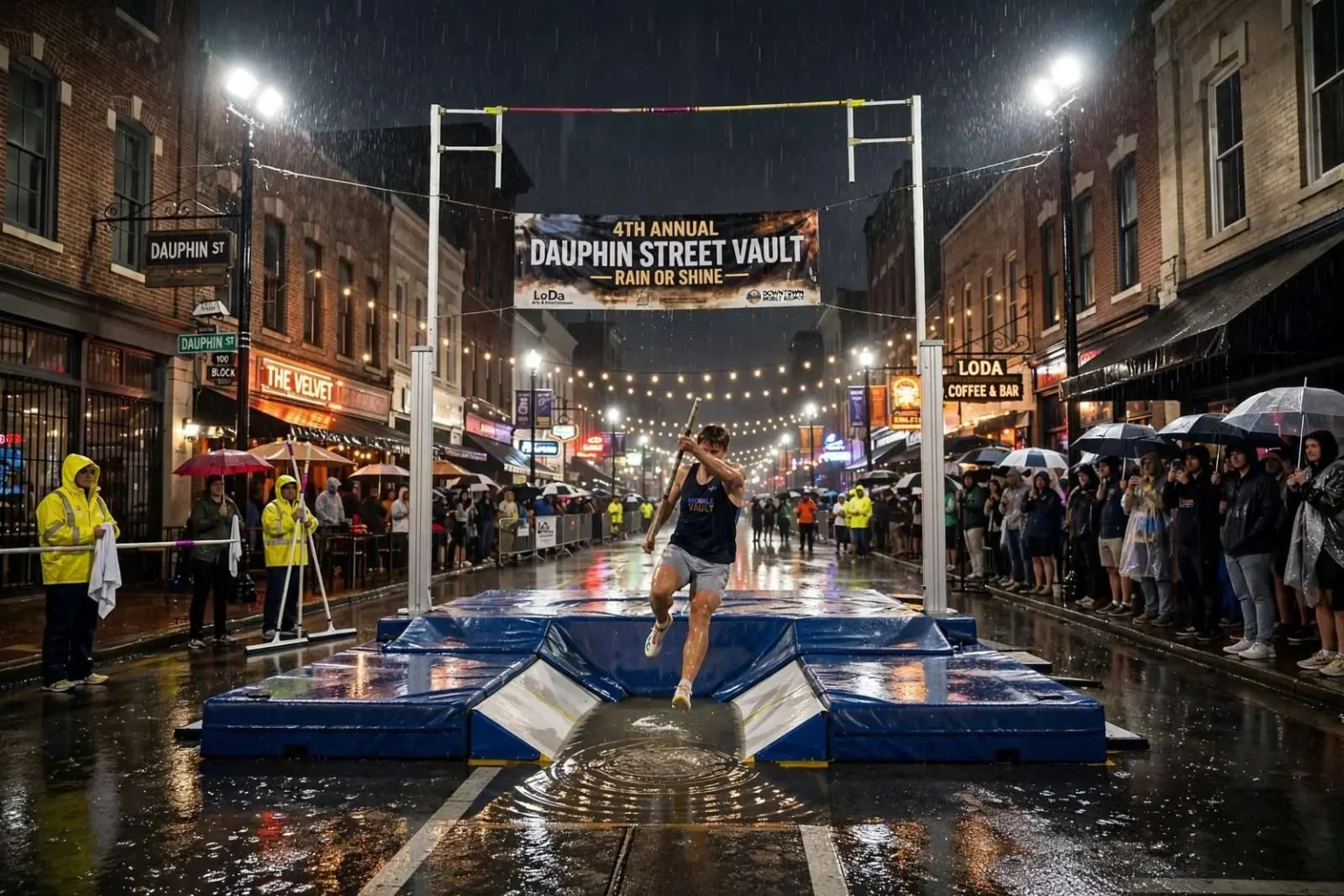
Downtown Mobile’s entertainment district turned into an unlikely track and field venue as the fourth annual Dauphin Street Vault pushed through hours of stop-and-start rain to keep its pole vaulting competition alive. Organizers had promised the event would go on rain or shine, and they held to that promise even as forecasted thunderstorms rolled through the city’s Dauphin Street corridor.
A steady downpour lasting roughly an hour forced many athletes to huddle under awnings and umbrellas while waiting for breaks in the weather, but the competition never officially stopped. The landing pit, the cushioned area vaulters fall into after clearing the bar, briefly turned into a small pool of standing water. Rather than wait it out quietly, some restless athletes took the opportunity to run and dive into the puddled mat just for fun while competition was paused, drawing laughs from the spectators who stayed through the weather.
One official overseeing the event, a 47-year-old veteran of the sport, said rain delays are a familiar part of the Dauphin Street Vault, which typically runs longer than any other event at a typical track meet. In past years, he said, the competition has stretched well past midnight before finishing, and a summer storm in the early evening was hardly enough to call off a street party built around an event that routinely tests everyone’s patience.
How vaulters read the rain
Competitors interviewed streetside said the rain added a layer of difficulty but wasn’t necessarily dangerous, so long as vaulters kept their poles and hand grips dry. A 21-year-old self-taught vaulter said wet conditions mainly threatened a vaulter’s grip and tape, the wrapping that secures the grip area of the pole and gives athletes a consistent feel during the sprint and plant.
While a 27-year-old competitor who also coaches at a private Mobile prep school echoed that sentiment, noting that wet poles are the real hazard since they compromise a vaulter’s control during the jump. Pole vaulting is an event of split-second timing — a fast sprint down the runway, a precise plant of the pole in the box, and a controlled swing and inversion over a bar set higher than the athlete’s own head. Slip anywhere in that sequence and the attempt fails; lose control entirely and the landing pit becomes more than a formality.
That same coach, who has competed in the sport for about a dozen years, said darkness usually ends competition at typical track meets, but organizers of the Dauphin Street Vault come prepared with lighting to keep things going as late as 2 a.m. if necessary. The street setting strips away the curfews of stadium track meets and replaces them with the rhythms of the entertainment district, where the crowd grows thicker as the night goes on.
The rain itself became part of the event’s story, the kind of shared misadventure that street-level competitions tend to collect. Athletes and spectators alike treated the storm as a pause rather than an ending, and when the cells moved through and the runway dried, the bar went back up and the competition resumed where it had left off.
A street meet like few others
The Dauphin Street Vault takes an event usually confined to stadiums and drops it into the middle of Mobile’s best-known nightlife corridor. The concept borrows from a handful of street vault competitions around the country that have made pole vaulting a spectator sport: a runway laid down the pavement, a landing mat set up under strings of lights, and bars of all shapes and themes raised over the street as crowds gather within arm’s reach of the action.
Pole vaulting has a natural theatrical appeal that conventional track meets rarely capture. The event combines sprinting speed, gymnastic strength and an unmistakable element of daring — athletes fling themselves over a bar using a flexible pole as their only means of ascent. On a street closed to traffic, with music and bars surrounding the venue, every successful clearance draws a reaction, and every miss draws a sympathetic groan.
Downtown Mobile’s Dauphin Street corridor is the city’s established entertainment district, lined with bars, restaurants and historic buildings in the heart of the LoDa arts and entertainment area. Closing a block or two of the street for an athletic competition turns the district’s ordinary foot traffic into a crowd and gives the city’s summer calendar an event that does not depend on the waterfront or the convention trade. Now in its fourth year, the vault has become a fixture that local athletes circle on their calendars and that visiting vaulters plan summer trips around.
The event has become a quirky summer tradition in downtown Mobile, drawing athletes from across the region who compete in divisions grouped by skill and experience. Street vaults typically welcome everyone from seasoned collegiate and post-collegiate vaulters to beginners trying the event for the first time, with each flight climbing the bar as competitors drop out. That format stretches the night long — which is precisely why the sport’s veterans were unsurprised by the hours the Mobile competition can demand.
The event’s organizers lean heavily on volunteers, local businesses and the city’s entertainment district itself for support, with bars and restaurants along the corridor serving as unofficial sponsor suites for the night. Spectators move freely along the edges of the venue, and the informal layout — no grandstands, no fenced athlete village — is a large part of the event’s identity. Athletes sign autographs between flights, and the line between crowd and competition stays deliberately thin.
Weathering a Gulf Coast summer
Summer thunderstorms are a defining feature of Mobile’s climate. The city sits in one of the wettest corners of the United States, where afternoon storms build over the Gulf and sweep inland with little warning through June, July and August. Anyone who organizes an outdoor event on the central Gulf Coast plans around the possibility of a soaking, and the vault’s rain-or-shine commitment reflected that hard-earned local knowledge.
For track and field athletes, wet weather management is a discipline of its own. Poles are kept in bags and under cover between attempts, towels circulate through the athlete area, and grips are dried and re-taped as needed. Runways can be swept and squeegeed, and in a street setting the pavement usually sheds water quickly once the rain stops, leaving the landing pit as the slowest element to recover.
Why the vault runs so late
Among track and field events, the pole vault is famously the last to finish. High jump begins at a single starting height and progresses upward, but pole vault’s combination of long runways, careful equipment checks and incremental bar heights means dozens of athletes cycle through attempt after attempt. At conventional meets, the event is often still climbing heights long after the sprints and relays have emptied the stadium — which is why darkness, not a clock, usually ends it.
The Dauphin Street Vault solves that problem with floodlights and a willingness to run long. Organizers have set 2 a.m. as the practical limit in past years, and on storm-interrupted nights like this one the competition has every reason to push toward it. Athletes wait out delays, the bar rises in small increments, and the crowd that remains at midnight is generally the most devoted of the night.
For the athletes themselves, street vaults offer something a stadium season cannot: competition without pressure, in front of a general audience rather than a scattering of track families. College vaulters use summer street meets to keep their rhythm between seasons, high school athletes get rare chances to compete at all after the scholastic year ends, and self-taught vaulters — a small but real tribe in the sport — find a place to test themselves against experienced competition.
The coaching perspective on display at the vault reflects the sport’s close-knit community. Vaulters who compete against each other for a decade often end up coaching side by side, and events like Mobile’s serve as annual reunions where technique is argued over, equipment is shared and newcomers are talked through their first plants. The presence of a school coach among the competitors underscored how the sport’s pipeline runs through South Alabama’s prep programs and into the summer street circuit.
Rain or not, the street meet’s economics reward persistence. Sponsorships from local businesses fund the mats, lights and permits, and attendance along the corridor translates directly into a good night for the district’s bars and restaurants. A competition that draws a few hundred spectators and holds them until midnight delivers value to the neighborhood that few summer weeknight events can match.
By the time the final heights were cleared in the early morning hours, the storm that had threatened to define the evening had faded to a footnote. The fourth annual Dauphin Street Vault had done what its organizers promised: brought world-class-adjacent athletics into the middle of a night out, in the rain if necessary, and kept a downtown summer tradition very much alive.