A New Saucy Q at Cottage Hill and Schillinger Gets a Polite, Qualified Nod
A Saturday errand run produced a barbecue review in May 2008: clean new dining room, adequate sandwiches, over-salted fries and an award-winning sauce that failed to impress one Mobile critic.
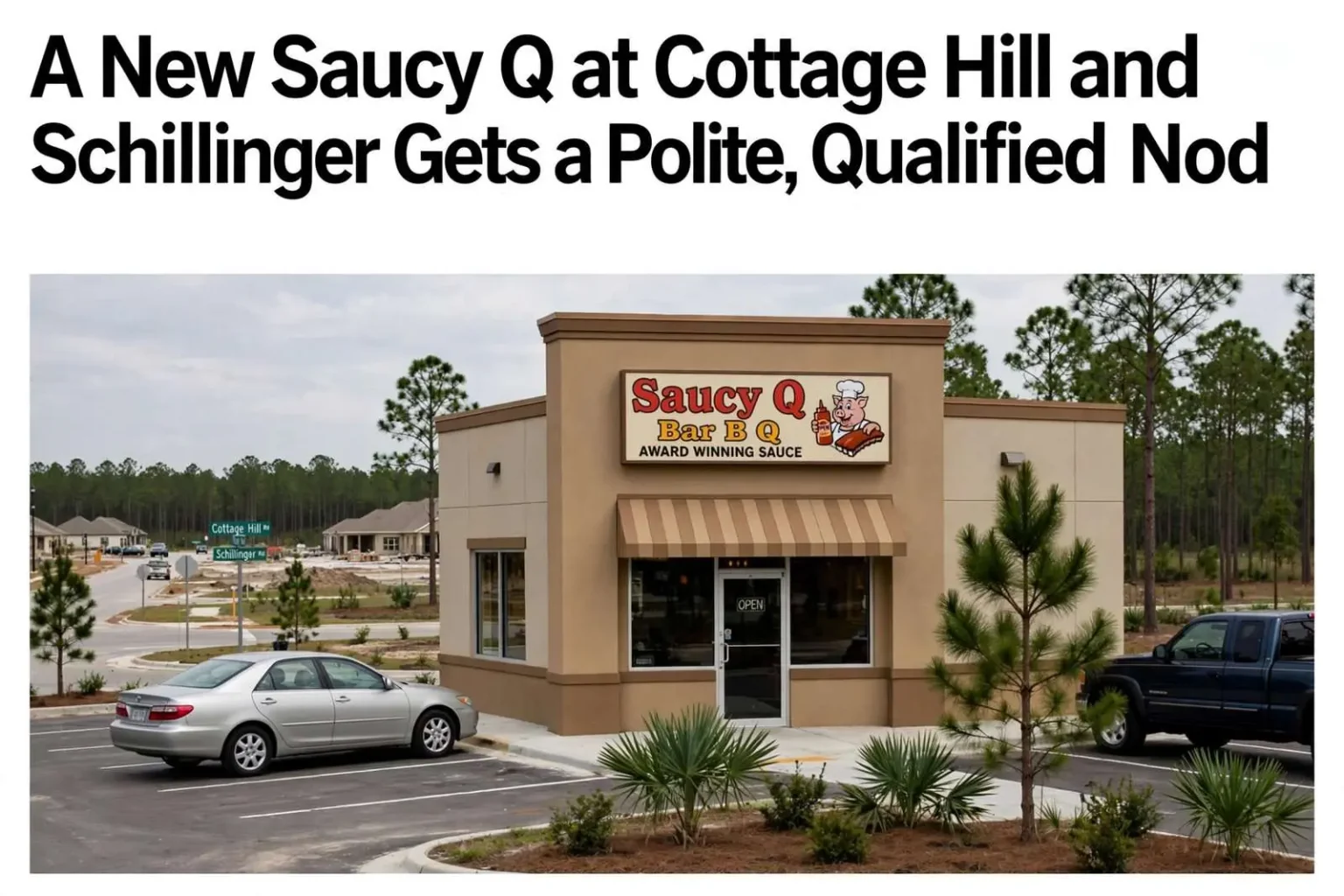
Some restaurant discoveries are the product of research. This one was the product of yard work. On a Saturday afternoon in May 2008, a Mobile dining critic writing under a pen name finished buying plants at a Cottage Hill nursery, found himself hungry, and noticed a new Saucy Q Bar B Q in the northeast quadrant of the Cottage Hill Road and Schillinger Road intersection. His dining companion was willing. In they went.
The visit produced a review that has aged into a small classic of local restaurant criticism — polite, specific and entirely unimpressed where unimpressed was called for. It is worth revisiting both for what it said about the restaurant and for what it captured about west Mobile at the moment the subdivision boom was still pushing the city’s edges farther out.
The room
The first impressions were the best ones. The restaurant was clean and inviting, and everything appeared to be new, though he could not say how long it had been open. It was small, only eight tables and a few counter stools, but he found it a very nice little establishment.
For a neighborhood barbecue joint, that mattered. Barbecue rooms come in every condition, from spotless and modern to deeply worn, and first-time customers read the room as a proxy for the kitchen. A clean, compact dining room with new fixtures gave the branch a fair shot at winning over the families pouring into the surrounding subdivisions — the people who would have to become regulars for a west Mobile restaurant to survive.
Saucy Q was already a familiar name in Mobile, its original location a long-standing fixture of the city’s barbecue landscape. The appearance of a branch out at Schillinger was a sign of the times: west Mobile was where the rooftops were going in the 2000s, and the restaurants followed the subdivisions out Cottage Hill Road.
The geography tells the story. Cottage Hill Road runs west from Schillinger through some of the fastest-growing residential territory in Mobile County, and Schillinger Road itself carries traffic from Airport Boulevard down toward Old Shell Road. By 2008 the intersection had become a commercial node for neighborhoods that had been pine forest a decade earlier, and every new rooftop represented customers who needed somewhere to eat after a Saturday of yard work.
Established names opening branches in that corridor followed a pattern as old as retail: follow the population. A barbecue brand with decades of recognition downtown could transplant some of that goodwill west, and the branch model let a local institution grow without abandoning the original location that regulars still counted on.
The sandwiches
Facing an afternoon of yard work, the pair chose to eat light. He ordered a pork sandwich. His companion ordered beef. They split a large order of French fries.
The pork, he wrote, was okay. He repeated the word, which in a barbecue review functions as a verdict. It was not a pork he would drive across town for. It was dry, with only a small amount of sauce already applied to the sandwich. Edible, not bad, but not really good either.
He placed it in the local hierarchy without hesitation. The pork at The Brick Pit was also dry, he acknowledged, but carried a better smoked taste. The pork at Reggie’s was moist. Both, in his view, beat what he had in front of him.
That instinct to rank — to drop a new sandwich straight into an existing mental standings table — is what separates a working critic from an enthusiast. Mobile barbecue in 2008 had its established names, and any newcomer would be measured against them whether the owners liked it or not. Dryness was the recurring sin in his ledger: sauce can disguise a dry sandwich, but a reviewer who tastes before the sauce does his work catches it.
He sampled his companion’s beef sandwich and found it, too, merely okay. It was not as dry as the pork, but it lacked a distinct smoked flavor. It was large and filling and not a sandwich worthy of plaudits, though he allowed that it was much better than the beef at Reggie’s.
The cross-comparison cuts both ways, which is what makes the review credible. Reggie’s pork beat Saucy Q’s; Saucy Q’s beef beat Reggie’s. A reader who planned to order beef and a reader who planned to order pork would leave the same review with opposite conclusions, and both would be right.
The fries and the sauce
The French fries were over-salted, and he thought they would have been better with no added seasoning at all. The sauce he called rather ordinary. Saucy Q, he noted, boasts that its sauce has won several awards. “Perhaps so,” he wrote, “but I was not impressed.”
The sauce verdict landed softly but firmly. Barbecue sauce is the signature claim of most Alabama joints, and an award-winning label is a marketing asset a restaurant works hard to keep on the menu. A critic who tastes it and files it under ordinary is not accusing the kitchen of anything — he is simply declining to repeat the advertisement. In a review full of measured judgments, that two-sentence dismissal is the sharpest thing in it.
The subject of sauce sent him on a brief detour to name the worst he had ever been served: a mustard-based sauce at Maurice’s Gourmet BBQ in Columbia, South Carolina, which he described as worthy of skipping at every opportunity.
Readers who have argued the merits of South Carolina mustard sauce against Alabama’s tomato and vinegar traditions will recognize a very old fight being resumed in a single sentence. Sauce preference is regional identity rendered in condiment form. South Carolina’s gold-colored mustard sauce is a point of pride in the middle of that state, while Alabama’s barbecue belt runs from the tomato-and-vinegar styles of the eastern part of the state to the famous white sauce of the north — a mayonnaise-based creation found almost nowhere else. A Mobile palate raised on one tradition meeting the other is never a neutral encounter, and critics on both sides have been trading verdicts like his for generations.
What the detour also does is establish the reviewer’s bias openly. A critic who tells you his least favorite sauce lets you calibrate everything else he says. If you love mustard sauce, you know to discount his judgment accordingly — and that transparency, more than any single verdict, is the mark of criticism written in good faith.
The verdict, and the return trip
Would he go back? He thought so. He wanted to try the ribs one day, he said, when he was hungry and not facing yard work.
It is a modest ending, and an honest one. The review does not condemn the restaurant and does not oversell it. What it does, in the manner of the best neighborhood criticism, is give a reader enough specific information to make a decision: the room is clean, the sandwiches are filling, the sauce is unremarkable, and the ribs remain an open question.
Ribs, as any barbecue follower knows, are the true test of a pit. Chopped pork in a sandwich can be rescued by timing, moisture and sauce; ribs cannot hide. A rack that comes off the pit properly — rendered fat, clean bone, smoke that reaches the meat — is the difference between a sandwich shop that serves barbecue and a barbecue restaurant. Deferring that judgment until he could order the ribs properly was the reviewer’s way of keeping the scorecard open.
The “not facing yard work” clause deserves its own appreciation. Reviewers have long argued about whether a restaurant should be judged on its best day or its typical day, and the critic effectively announced which he was describing: a hurried Saturday lunch, eaten lightly, between errands. A hungry customer ordering a full plate on a quiet evening might have a different experience than two yard-work diners splitting sandwiches and fries. By naming his circumstances, he let readers decide how much weight to give them.
Barbecue in south Alabama has always been argued rather than settled. In 2008, the argument in west Mobile had a new address, and at least one critic left the door open.
A snapshot of Mobile barbecue’s landscape
The names in the review sketch the era’s local standings table. The Brick Pit, a long-established Mobile barbecue house, stood for deep smoke and tradition; Reggie’s represented the moist-pork school that many locals considered the standard. Into that company stepped a west Mobile branch with an award-winning sauce and a brand new dining room, hoping to be taken seriously by a readership that had already picked favorites.
Reviews like this one performed a service for the neighborhoods they covered. New subdivisions filled with newcomers who did not know the old-timers’ hierarchy, and a critic’s first visit to the nearest barbecue joint gave those families a starting point. The sandwich verdicts — okay pork, okay beef, good fries if you like salt — were exactly the information a hungry household needed on a Saturday.
The review also caught the economics of barbecue expansion at a particular moment. Barbecue restaurants run on labor-intensive pits and loyal repeat customers, and a branch operation multiplies both the opportunity and the risk: the original location’s pitmen do not move west, the new kitchen has to earn its own reputation, and the brand travels only as well as the smoke. Whether a branch could match the original was, and remains, the central question of barbecue expansion.
Why the review still reads well
Nearly two decades on, the piece holds up as a specimen of what local food criticism does when it is done with discipline. It records what was ordered and what it cost in effort — no flights of fancy, no pretending a Saturday sandwich run was a tasting menu. It ranks the meal honestly against the city’s known standards, names the reviewer’s own biases, and ends with a test left deliberately unfinished.
It is also a document of a Mobile that was changing fast. The Cottage Hill and Schillinger intersection in 2008 sat at the growing edge of the city, where new schools, new churches and new strip centers were arriving with the subdivisions, and where a national recession was just beginning to test which of the new businesses would last. A small barbecue branch with eight tables was one of hundreds of businesses betting on west Mobile’s growth — and the critic’s open-ended verdict captured that uncertainty as well as any market analysis could.
For readers who remember the era, the review is a time capsule. For those discovering it now, it remains what it was on the day it ran: a polite, qualified nod — clean room, filling sandwiches, unremarkable sauce, ribs untested — from a critic who would come back when he was hungry and had the time to do it right.