Six Candidates Vie to Fill Mobile County Circuit Court Vacancy
Six nominees, including two sitting judges, are under consideration to fill a Mobile County Circuit Court vacancy left by a retiring judge this year.
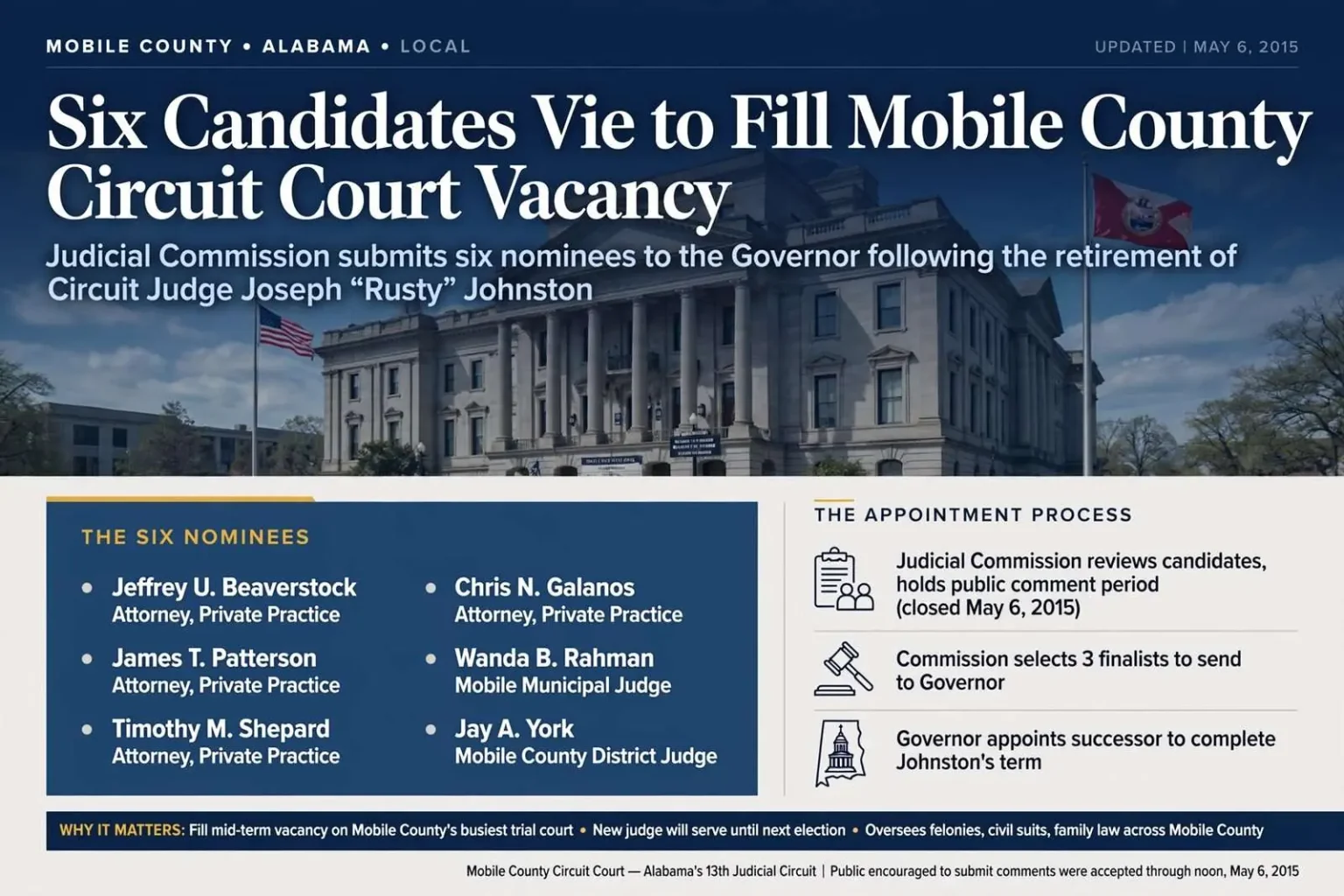
Six candidates are now in contention to fill a vacant seat on the Mobile County Circuit Court bench, following the retirement of longtime Circuit Judge Joseph “Rusty” Johnston earlier this spring. The opening has set in motion Alabama’s standard judicial nomination process, one that unfolds largely away from the ballot box and depends instead on a local commission of lawyers and lay members to screen the field before the governor makes the final call.
Johnston had been on medical leave since early February before formally stepping down from the bench, and his departure left a sitting circuit judgeship open in one of the busiest trial courts in the state. Because Alabama fills mid-term judicial vacancies by appointment rather than special election, the timing of the retirement put the selection machinery in motion almost immediately, with the Mobile County Judicial Commission tasked with identifying qualified successors.
Under that process, the local judicial commission reviews candidates, narrows the field, and forwards a short list to the governor’s office for a final appointment. The person chosen will serve the remainder of Johnston’s term, and any future bid to stay on the bench would come before voters in the next regular election cycle for that seat.
The Mobile County Judicial Commission has put forward six names for consideration: attorneys Jeffrey U. Beaverstock, James T. Patterson, Timothy M. Shepard and Chris N. Galanos, along with two sitting judges already serving Mobile County courts, Mobile Municipal Judge Wanda B. Rahman and Mobile County District Judge Jay A. York. The slate mixes veteran private practitioners with jurists already hearing cases in the county’s lower courts.
Two Paths to a Circuit Judgeship
The mix of nominees reflects the two typical paths to a circuit court appointment in Alabama: promotion from within the local judiciary, or appointment of a practicing attorney with courtroom experience. Both routes are well represented in Mobile County’s history, and governors over the years have drawn on each when filling trial court vacancies along the Gulf Coast.
Rahman and York already hear cases in Mobile’s municipal and district courts, respectively, giving them direct experience with the local docket. Municipal judges in Alabama handle city ordinance violations, traffic cases and misdemeanors within city limits, while district judges preside over misdemeanors, preliminary hearings in felony matters, small claims and civil disputes below the circuit court threshold. Either judge, if elevated, would arrive with familiarity not only with the law but with the prosecutors, defense attorneys and court staff who keep the Mobile County courthouse running.
The four attorneys on the list bring private-practice backgrounds to the table. Lawyers elevated directly from practice to the circuit bench often arrive with deep experience in civil litigation, criminal defense, or corporate matters, and Alabama’s constitution requires only that circuit judges be licensed attorneys, so the pool of eligible candidates is broad. In practice, the judicial commission’s screening is designed to surface the candidates best prepared for the volume and variety of a general jurisdiction docket.
Circuit judgeships in Mobile County carry significant weight within the regional legal community, and openings on the bench traditionally draw interest from accomplished members of the local bar. The six-name list released by the commission represents the result of that vetting, and each nominee now awaits the next stage of the process, which includes both public input and the commission’s own final narrowing.
A Window for Public Comment
As with past circuit court vacancies in Mobile County, the public has been given a window to weigh in before the process moves forward. Residents were able to submit comments on the nominees through noon on May 6, 2015. The comment period gives citizens, attorneys and community organizations a chance to raise information about the candidates that might not appear in resumes or formal applications.
Public input periods have become a customary feature of Alabama’s judicial selection process, and commissions generally treat the submissions as part of their broader review of each nominee’s temperament, experience and fitness for the bench. In a county the size of Mobile, where the bar is close-knit and courthouse watchers follow judicial news closely, the comment window often generates substantial feedback from practicing attorneys who have appeared before or against the nominees.
After the comment period closes, the judicial commission is expected to trim the list to three finalists, who will then go to the governor’s desk for a final decision. From there, the governor’s office may conduct its own interviews and review before naming the next circuit judge, a decision that can take days or weeks once the short list arrives.
What the Circuit Court Does
Alabama’s circuit courts are the primary trial courts of general jurisdiction in the state, hearing felony criminal cases, civil disputes above a certain dollar threshold, family law matters, and appeals from lower courts. Every felony prosecution in Mobile County, from robbery to capital murder, moves through the circuit court system, as do divorces, custody battles, major personal injury lawsuits, contract disputes and probate appeals.
The state is divided into judicial circuits, each covering one or more counties, and Mobile County constitutes its own circuit with multiple circuit judges sharing the docket. Judges are assigned to divisions that may emphasize criminal, civil or family cases, and the presiding circuit judge administers the overall operation of the court, including calendars, grand jury terms and the assignment of new filings.
A circuit judgeship in a county the size of Mobile carries a substantial caseload. Mobile is one of the state’s most populous counties, and its courts sit in downtown Mobile, where the courthouse complex handles thousands of new filings each year across criminal, civil and domestic relations divisions. The volume means a new judge must get up to speed quickly, managing jury trials, motion dockets and settlement conferences from the first weeks on the bench.
Circuit judges in Alabama serve six-year terms and face voters in retention-style elections at the end of each term. Because the appointment fills a mid-term vacancy, whoever the governor selects will serve until the next scheduled election for the seat, giving the appointee the incumbent’s advantage if he or she chooses to run for a full term.
Why the Selection Process Matters Locally
The stakes of the appointment extend beyond the courtroom. Circuit court decisions shape everything from how quickly criminal cases reach trial to how civil verdicts are handled in a county whose courts have historically drawn major litigation. Business groups, plaintiffs’ attorneys, defense lawyers and family law practitioners all keep close watch on who joins the bench, knowing a single judge’s docket can influence the pace of justice for years.
The Mobile County Judicial Commission itself is part of a statewide framework for judicial vacancies. Similar commissions operate in each judicial circuit under Alabama law, combining attorney members and appointments to screen candidates whenever a judgeship opens between elections. The structure is intended to keep nominations in local hands while preserving the governor’s constitutional authority to appoint.
For the six nominees, the coming weeks represent a waiting game that veteran lawyers describe as unlike any other professional milestone. An appointment to the circuit bench elevates a lawyer or lower-court judge into the ranks of general jurisdiction jurists, with lifetime prestige in the local legal community and a docket that touches the most serious matters the courts handle.
Once the commission delivers its three finalists, attention will shift to the governor’s office, where the final selection will be made after whatever review staff deem appropriate. No firm timeline for the announcement has been stated, but past vacancies in Mobile County have typically been resolved within weeks of the short list being submitted.
In the meantime, Johnston’s former docket is being managed by the court’s sitting judges, a routine arrangement when a circuit seat is vacant. Cases are not delayed indefinitely by the vacancy; the presiding judge redistributes matters across the existing bench until the new judge is sworn in and assumes the division.
Residents who followed the comment period will next see the process move out of public view, into the commission’s deliberations and the governor’s review. When the appointment is announced, the new judge will take the oath of office and join one of the busiest trial benches in Alabama, closing out a selection process that began with a retirement earlier this spring.
For court watchers, the vacancy also offers a rare public look at how Alabama fills its trial benches between elections. Unlike partisan elections, where campaigns and party primaries determine who appears on the ballot, the appointment route depends on screening bodies whose work happens largely out of the spotlight. The public comment window is one of the few points where ordinary residents can influence the outcome, and Mobile County’s commission has kept that window open for each of its recent vacancies. When the new judge is finally named, the paper trail left by the process, from the six nominees to the public comments to the three finalist certificates sent to Montgomery, will document exactly how the seat was filled.