Bond Shortfall Delays Construction at Three Mobile County Schools
A $100 million school construction bond ran short of funds, forcing Mobile County to delay work at three campuses until at least fiscal year 2016.
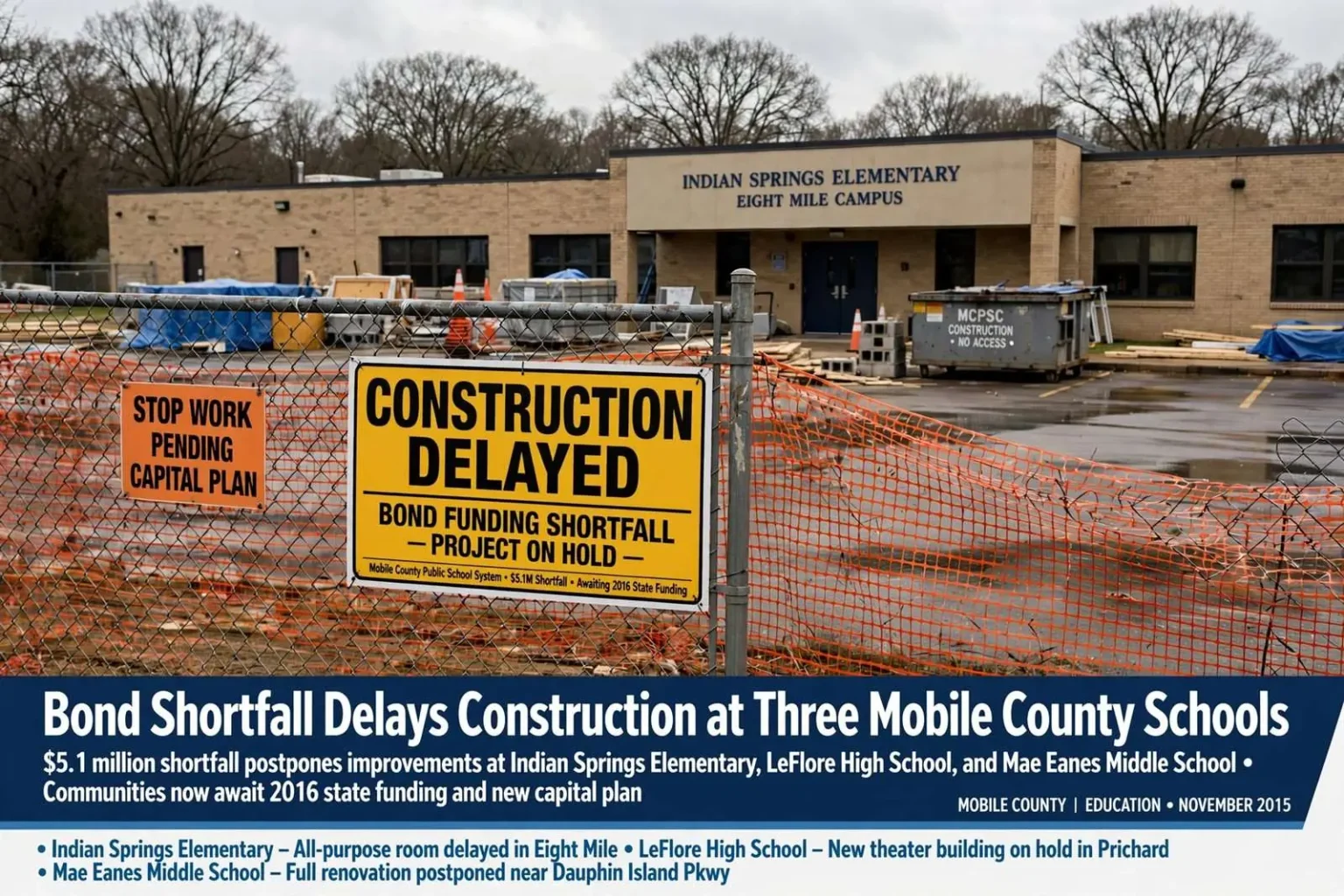
Mobile County school officials say construction plans at three campuses have been pushed back after a $100 million bond issued in 2012 came up short of covering every project on its list. The shortfall means families at three schools — spread across the northern suburbs, the city’s Maysville area, and Prichard — will wait longer for facilities improvements that were promised when the bond program was unveiled.
Superintendent Martha Peek told the school board the shortfall amounts to roughly $5.1 million. The gap emerged as the district tallied the actual costs of the bond program’s projects against the estimates made when the bond was sold, a reconciliation that revealed the program had committed more than its $100 million would ultimately cover.
Rather than scale back the scope of the work, the board voted to wait until the 2016 fiscal year, when additional state construction dollars become available and a new capital plan can be drawn up. The decision reflects a calculation familiar to large school systems: trimming a project’s scope often saves less than it costs in disruption, and state capital funds arrive on a predictable cycle that makes waiting a workable strategy when the gap is measured in millions rather than tens of millions.
The delayed projects include an all-purpose room planned for Indian Springs Elementary’s Eight Mile campus, a new theater building at LeFlore High School, and a full renovation of Mae Eanes Middle School near Dauphin Island Parkway. The three projects differ in scale — an all-purpose room, a stand-alone theater, and a campus-wide renovation — but share a common thread: each addresses facility needs at schools that have waited through earlier rounds of the district’s capital planning.
Peek said all three will be treated as priorities once funding is restored, though she stopped short of promising a specific order. That caution matters to the communities involved, since the sequencing of a new capital plan will depend on how much state money materializes and what other needs compete for it when the plan is drafted.
Where the money went
Peek attributed much of the overrun to unexpected costs elsewhere in the bond program, including relocating the site chosen for the new Citronelle High School, expected to open in the summer of 2016, and additional foundation work required at the Fournier-Chastang K-8 School in Trinity Gardens. The Citronelle relocation — moving the site of a new high school serving the far northern end of Mobile County — carried land, design, and site preparation costs that the original budget had not anticipated. At Fournier-Chastang, soil and foundation conditions in the Trinity Gardens neighborhood added engineering costs before walls could rise.
Both problems illustrate the risk profile of large school construction programs. A $100 million bond spans dozens of projects across a countywide district, and the assumptions made at bond sale — land costs, soil conditions, construction prices — are tested against reality for years afterward. When a single project encounters unexpected site work, the overage draws from the same pool that funds the projects still waiting in line.
Other projects funded through the same 2012 bond included renovations at the historic Barton Academy building, the downtown landmark that was Alabama’s first public school and had sat largely vacant for years. The Barton project, long a civic priority in Mobile, represented the bond program’s investment in the district’s own heritage — and its inclusion in the original program is part of why the list of promised work was so extensive.
A proposal to close the gap
District 4 school board member Robert Battles Sr., who joined the board about six months ago, said he is hopeful that revenue from selling several surplus properties in midtown Mobile could help close the gap for the two projects located in his district. Battles, whose district includes the Mae Eanes and LeFlore communities, has made the delayed projects a focus of his early months on the board, arguing that the property sales offer a path that does not require borrowing or waiting on the state.
Those properties include the former Augusta Evans Special School site on Florida Street, the Russell Building on Broad Street, which once held school system offices, and the original Old Shell Road Magnet School building. Each is a piece of the district’s midtown real estate portfolio that no longer serves its original purpose, and together they represent the kind of underused assets that districts across the country have monetized to fund capital needs.
Battles estimated the sales could bring in close to $3 million, money he hopes will go toward Mae Eanes and LeFlore. The figure would close most of the distance to the $5.1 million shortfall, though it would not cover all of it — and the money is hypothetical until transactions close.
Peek cautioned that none of the properties have sold yet, and the timeline for closing on them remains uncertain. Real estate sales of school properties move at the speed of the market and, often, of municipal zoning processes, and the district cannot bank proceeds it has not received. Her caution sets the practical frame: the property idea is promising, but the 2016 fiscal year funding remains the plan of record.
For now, families in the affected school communities are left to wait — for the state funds expected in the next fiscal year, for the property sales Battles hopes will accelerate the timeline, and for the new capital plan that will determine when the bulldozers finally arrive at Eight Mile, LeFlore, and Mae Eanes.
The Mobile County Public School System is the largest school district in Alabama, serving tens of thousands of students across a network of schools that stretches over a county extending from the Florida state line to Washington County’s borders and from the Gulf to the piney woods of Citronelle. That geography is central to any capital story: a district that size must balance the needs of aging city campuses against new construction at the suburban fringe, and a single bond program carries promises to communities with very different expectations.
The 2012 bond was the district’s answer to a backlog of such promises. Its $100 million funded new construction, renovations, and land purchases across the county, from the new Citronelle High School at the northern end to downtown’s Barton Academy. When voters and taxpayers assess the program, the ledger includes both what got built and what got delayed — and the three projects now pushed back are the visible cost of the overruns elsewhere.
The schools waiting
Indian Springs Elementary serves the Eight Mile community in the county’s northwestern suburbs, a fast-growing area where school facilities have struggled to keep pace with residential development. An all-purpose room — combining cafeteria, assembly, and physical education space — addresses a practical daily constraint for a school without adequate multi-purpose space, and for parents in Eight Mile it is the most concrete benefit the bond promised their community.
LeFlore High School, located in Prichard, is one of the district’s flagship high schools, with a well-known band and athletic program, and the planned theater building would have given its performing arts students a dedicated venue. Prichard, the aging city just north of Mobile, has watched public and private investment drift southward for decades, and a new school facility carries significance beyond its walls. The delay pushes that promise into a later fiscal year, pending the new capital plan.
Mae Eanes Middle School sits in the neighborhood of the same name near Dauphin Island Parkway, south of the city’s core. A full renovation is the most ambitious of the three delayed projects — effectively a rebuilding of the campus’s interior systems and spaces — and the school community has waited longest of all for a comprehensive upgrade. Battles’s district includes both Mae Eanes and LeFlore, which is why two of the three delayed projects fall within his board seat.
How the district gets there
The 2016 fiscal year funding the board is counting on comes from the state’s public school capital outlay allocations, which flow to districts on a cycle set in Montgomery. For Mobile County, the state’s share is a modest piece of an enormous capital program, but it is dependable — and dependable money is what a board needs to write a new capital plan with confidence. When the plan is drawn, the three delayed projects are promised priority treatment, though the final order will reflect conditions at the time.
The surplus property sales Battles champions would operate on a different clock. Selling a former school site involves appraisal, possible environmental review, listing, negotiation, and — for properties in established midtown neighborhoods — often rezoning conversations with the city. The three properties Battles named are each different in character: a former special school site on Florida Street with land that developers may covet, an old administrative building on Broad Street suited to office or institutional reuse, and the original Old Shell Road Magnet School building, a piece of midtown’s architectural history that likely appeals to buyers seeking a historic structure.
If sales proceed as Battles hopes, the roughly $3 million they might yield would be earmarked — in his proposal — for Mae Eanes and LeFlore, the two delayed projects in his district. That would leave the Eight Mile all-purpose room waiting on the state funds and the new capital plan, and it would still leave the full shortfall uncovered unless the remaining distance is closed when the plan is finalized.
What is not in dispute is the commitment. Peek has said all three projects remain priorities, Battles has organized his first months on the board around two of them, and the district’s finance staff continue to track the bond program’s final accounting. The question is not whether the all-purpose room, the theater, and the renovation get built — the question is when, and which funding source closes the gap first.