Suspected Arson Causes $105,000 in Damage at Captain’s Table Restaurant
Fire officials say an early-morning fire deliberately set at a popular Battleship Parkway restaurant caused an estimated $105,000 in damage.
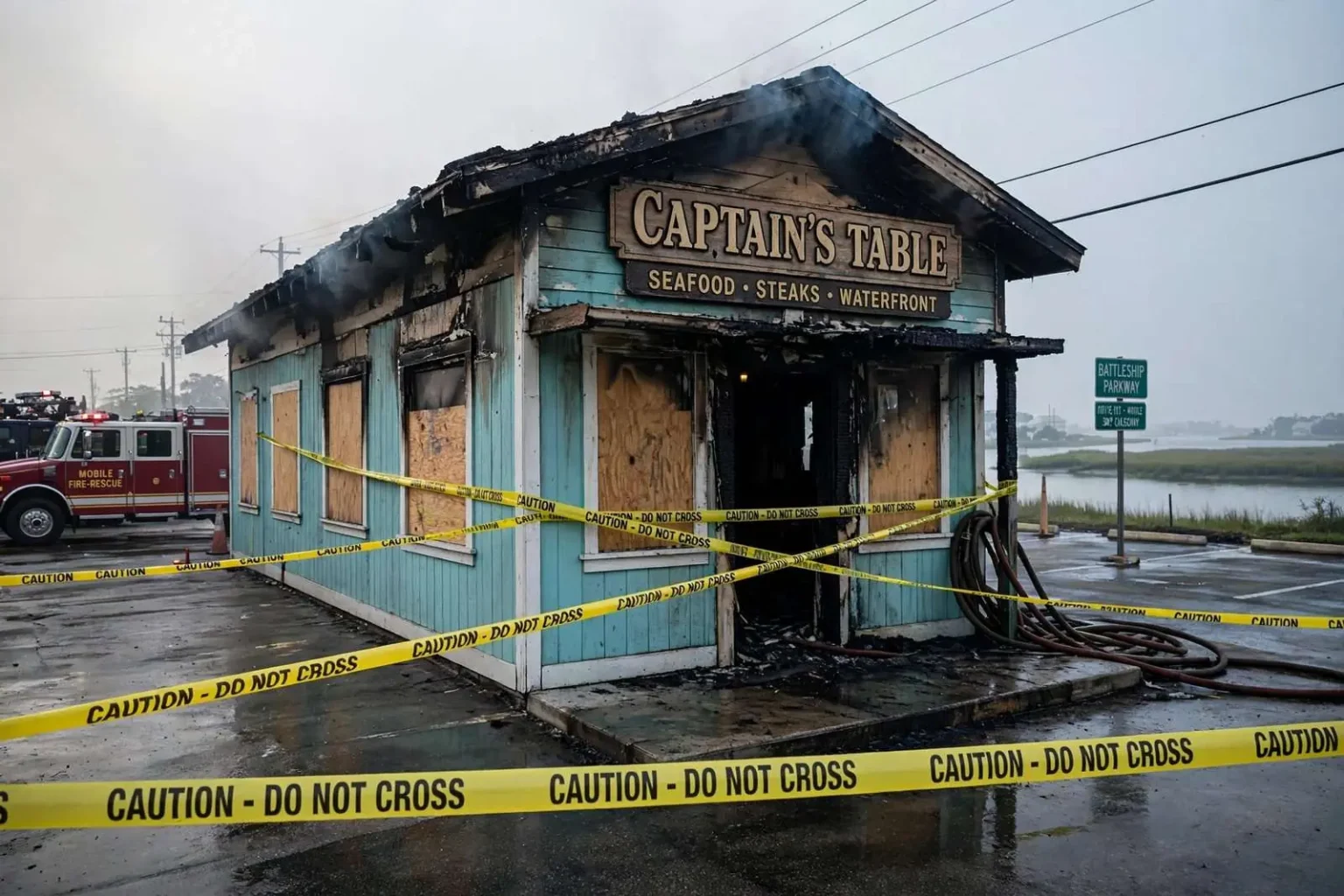
A fire that broke out early Tuesday morning at the Captain’s Table restaurant along Battleship Parkway is being investigated as suspected arson, with Mobile fire officials estimating the damage at roughly $105,000. The blaze struck a waterside landmark that has served travelers and regulars along the Mobile Bay causeway for years, and the estimate does not capture the full cost of lost business during the closure that followed. For the restaurant’s owners and staff, the discovery that the fire may have been deliberately set added a layer of anger to the financial blow.
Firefighters with the Mobile Fire-Rescue Department responded around 3:30 a.m. after a report of smoke coming from the top of the building. Crews arrived to find what department spokesman Steve Huffman described as heavy fire inside the dining area. The pre-dawn hour meant no customers were inside, sparing the restaurant the potential for injuries that a daytime fire would have carried.Firefighters were able to extinguish the flames relatively quickly, but not before smoke spread through much of the restaurant, adding to the damage well beyond the immediate area where the fire originated. Smoke damage of that kind often proves costlier than the flames themselves, penetrating upholstery, kitchen inventory, and the ductwork above a commercial kitchen.
A Restaurant Left Closed Behind Caution Tape
By Thursday morning, two days after the blaze, caution tape still lined the walkway leading up to the restaurant, which has remained closed since firefighters left the scene. Employees who arrived for morning shifts found themselves turned away, and regular customers who pulled into the lot encountered nothing but tape, boarded glass and the smell of smoke drifting off the structure. The building remained in the custody of investigators, who needed the undisturbed scene to document burn patterns and collect samples before any cleanup could begin.
Fire officials confirmed the fire is believed to have been intentionally set, but they declined to share additional details about a possible cause or motive, citing the sensitivity of the ongoing investigation. Investigators rarely release specifics in arson cases — the exact point of origin, the presence of accelerants, or whether entry was forced — because that information is known only to the person responsible and can compromise the case if it becomes public. The department also withheld any assessment of whether the restaurant itself was the target or whether the building was chosen at random.
The restaurant’s future remained unclear in the days following the fire, with no timeline announced for repairs, cleanup or reopening. Commercial fire recoveries of this scale typically involve insurance adjusters, structural assessments and months of reconstruction, and the arson finding complicates the process while the criminal investigation runs in parallel.
A Fixture of the Causeway Corridor
Captain’s Table has long been a fixture along Battleship Parkway, a stretch of road that carries both local traffic and travelers passing through the causeway area between Mobile and Baldwin County, drawing a steady mix of regulars and visitors over the years. The parkway runs along a narrow spine of land in the middle of Mobile Bay, connecting the city to the Eastern Shore by way of the same corridor that carries traffic past the USS Alabama Battleship Memorial Park. Restaurants along that route have always depended on a peculiar blend of customers: commuters crossing the bay daily, fishing parties heading to and from the water, tourists visiting the battleship, and locals who treat the causeway eateries as destinations in their own right.
That geography shapes the risks as well. The blaze adds to a string of concerns for property owners along the causeway corridor, where aging structures sit close together and where exposure to wind, water and long spans of unoccupied overnight hours creates conditions that complicate both fire suppression and security. Fire crews responding to a causeway address face limited access routes — effectively two ways on and off the strip of land — and once on scene, they find few hydrants and long lays of supply hose. A fire that starts in the overnight hours can grow substantially before the first engine arrives, which is precisely the window in which the Captain’s Table fire broke out.
For neighboring businesses, the episode was an unsettling one. Restaurants and marinas along the parkway operate in view of one another, and a heavy fire on the strip is visible from across the water, drawing onlookers and television cameras within hours. Owners reviewed their own overnight security practices in the days that followed, according to routine patterns that follow any suspected arson in a commercial corridor.
The Investigation Continues
Mobile Fire-Rescue investigators continue to examine the circumstances surrounding the fire as they work to determine who may be responsible. Officials have not indicated whether any suspects have been identified, and no arrests had been announced as of Thursday. Investigators are expected to continue processing the scene and reviewing evidence in the days ahead as the case remains open.
Arson investigations of this type follow a well-established sequence. Once suppression crews clear the scene, fire investigators take ownership of the building and begin at the point of lowest burn, working outward to map how the flames moved. They photograph and diagram every room, collect debris samples from suspicious areas for laboratory analysis, and interview anyone who was in or near the building in the hours before the alarm. Security camera footage from the restaurant and from neighboring properties along the parkway becomes critical evidence, since the fire began in the middle of the night when few witnesses were on the causeway.
Determining intent is the pivotal question in any fire that is not immediately accidental. Accidental causes — electrical faults, cooking equipment, lightning — leave characteristic signatures, and investigators rule them out methodically before classifying a fire as incendiary. The department’s public statement that the fire is believed to have been intentionally set indicates that this threshold has been met, even as officials withheld the specific evidence behind that conclusion. The $105,000 damage estimate will also factor into the legal process: in Alabama, arson that damages an occupied or commercial structure is a felony, and the value of the loss influences the severity of any eventual charge.
For the restaurant’s staff, an arson determination brings a different kind of hardship than an accidental fire does. Workers whose jobs disappear overnight face weeks without paychecks, and owners must weigh reconstruction costs against a property whose value has been damaged by someone else’s act. Insurance coverage generally still applies in arson cases, but claims involving suspected criminal acts draw heightened scrutiny, and payouts can wait until investigators certify that the owner had no involvement — a process that can stretch on even when the business itself is clearly a victim.
Waiting for Answers on the Causeway
In the days after the fire, the absence of information became its own burden for the people who knew the restaurant best. Longtime regulars posted memories on social media and asked about reopening dates that no one could yet give. Employees gathered belongings when investigators permitted brief access, retrieving what could be salvaged from an office or a break room that escaped the smoke. The restaurant’s owners thanked the community for its concern but declined to speculate on the investigation or on the building’s future, following the advice that guides most fire victims in open cases.
The pattern of overnight commercial fires along the causeway and the surrounding area has prompted periodic calls for expanded camera coverage and better lighting along the parkway. Businesses on the strip operate with unusual exposure: the same isolated, waterfront setting that makes the corridor attractive to diners also leaves buildings vulnerable in the hours when the causeway empties of traffic. Whether that conversation produces changes in the wake of the Captain’s Table fire remains to be seen, but the episode has given property owners along the route a fresh reason to examine how their buildings are watched overnight.
Mobile Fire-Rescue’s response that morning reflected the department’s routine handling of a commercial structure fire, even under unusual geographic conditions. The alarm brought engines and a ladder company from stations positioned to cover the causeway corridor, along with a battalion chief who assumed command of the scene. The first priority was confirming that no one remained inside, followed by an aggressive interior attack on the dining room fire. Crews rotated through rehabilitation as the early-morning heat and humidity took their toll, and the fire was declared under control before it could extend into the kitchen or the building’s attic spaces, where it might have done far greater damage.
The quick knockdown preserved the parts of the structure that matter most for any rebuilding decision. Had the fire spread into the roofline, the damage estimate would have climbed well beyond $105,000 and the building might have been lost entirely. Instead, investigators found a structure that is smoke-damaged throughout but structurally salvageable — a distinction that gives the owners a genuine choice about reopening once the criminal case and the insurance process move forward.
The Captain’s Table fire also lands in a stretch of years in which restaurants across the Mobile area have shown how vulnerable the industry is to sudden closures, whether from storms, fires or economic shifts. A waterside institution cannot simply relocate its regulars, its dock, or its view, which is why so much community attention has followed a fire that injured no one. The restaurant is part of the daily landscape for thousands of drivers who cross the bay, and its darkened windows and wrapped caution tape have become a small landmark of their own for now — a visible marker of a case that remains open until investigators say otherwise.
Anyone with information about the fire is asked to contact Mobile Fire-Rescue investigators or the department’s arson tip line, as officials continue to build the record they will need to identify who set the blaze that damaged one of the causeway’s best-known dining rooms in the early hours of a Tuesday morning.