Mobile Fire-Rescue Promotes First Two Deputy Chiefs Under New Advancement System
Mobile Fire-Rescue promoted two veteran district chiefs to deputy chief, the department's first promotions under a new system aimed at boosting diversity.
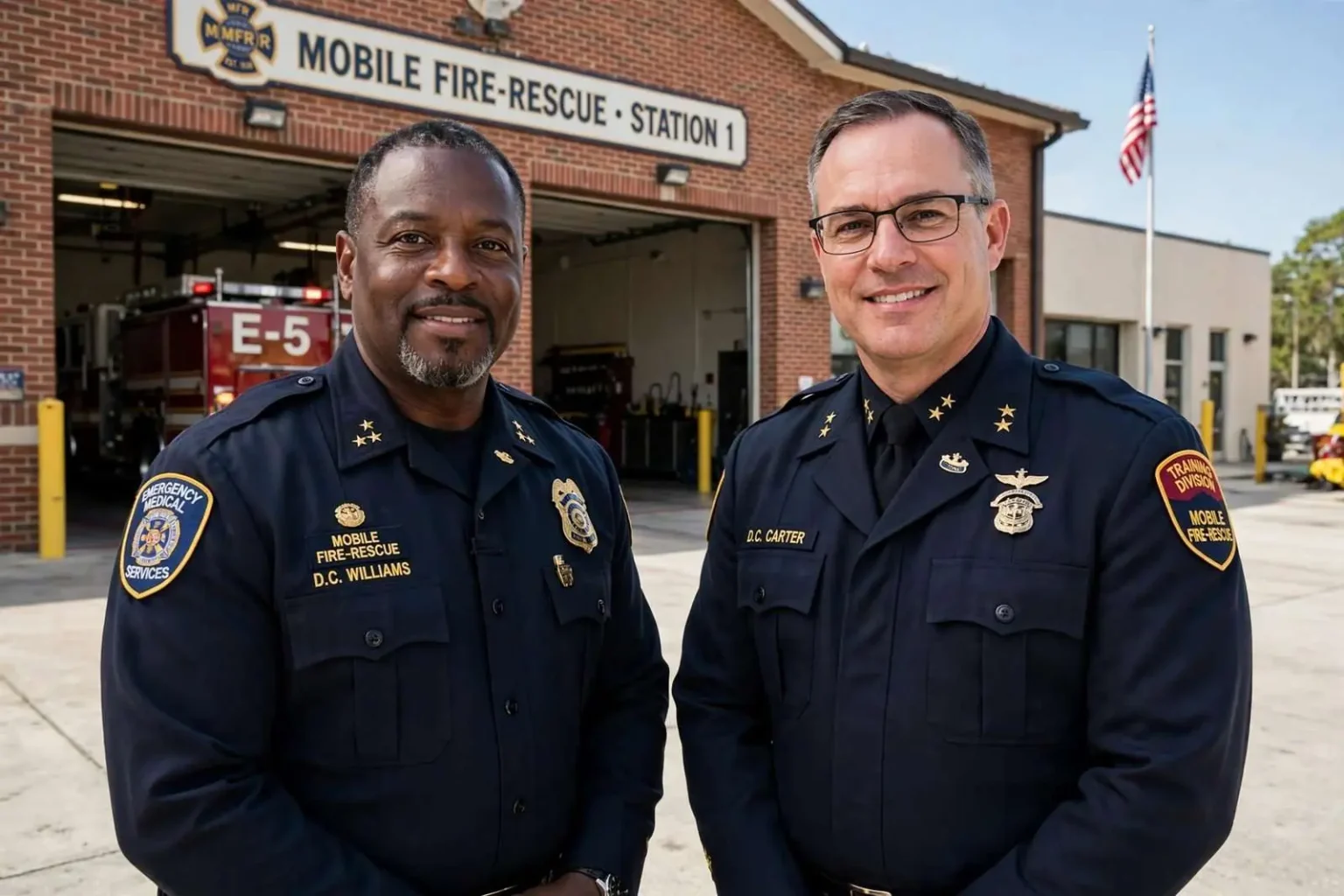
Mobile Fire-Rescue Department announced its first two promotions under a newly implemented advancement system designed to enhance diversity and efficiency throughout the department’s ranks, elevating two veteran district chiefs to the position of deputy chief. The promotions mark the first time the rank has been filled under the revised process, and they place both officers third in command within the department, behind only the fire chief and the assistant fire chief.
The two officers promoted are both district chiefs with more than four decades of combined experience at Mobile Fire-Rescue. Department officials described the selections as the opening result of a process built to reward a broader mix of operational experience, training and demonstrated leadership, rather than leaning on any single credential when deciding who moves up.
For a department responsible for protecting one of Alabama’s largest cities, the arrival of two new deputy chiefs is more than a personnel note. The rank sits just below the department’s top leadership, and the officers who hold it help set day-to-day priorities for everything from fire suppression and emergency medical response to training, recruitment and division-level administration across the city’s fire stations.
A Shift in How Promotions Are Scored
Department officials said the new promotional system marks a shift away from a process that had been criticized for placing too much emphasis on college degrees when scoring candidates for advancement. Under the old system, officers who scored well on promotional exams could still lose out to colleagues who received automatic bonus points for holding a college degree, regardless of the score gap between candidates.
The practical effect of that older structure was that a strong exam performance and a solid service record could be outweighed by a paper credential, narrowing who could realistically compete for senior rank. By reducing the weight of automatic degree bonuses, the revised system lets candidates advance on the strength of their exam results, their years in the field and their records within the department, while still allowing education to count for something in the overall scoring.
Officials have framed the overhaul as both a fairness measure and an efficiency measure. A promotional process that better reflects actual job performance, the argument goes, produces leaders who know the department’s operations from the ground up and gives firefighters across the ranks a clearer picture of what advancement requires.
The changes at Mobile Fire-Rescue follow similar reforms at the Mobile Police Department, where 27 officers were promoted in a comparable round of advancement after that agency also reworked how candidates are evaluated. Taken together, the two efforts signal a broader push across the city’s public safety agencies to modernize the way personnel climb the ranks, with an emphasis on diversity in the candidate pool and on matching promotions to demonstrated ability.
Two Careers Built Inside the Department
One of the newly promoted deputy chiefs is a licensed paramedic with more than 25 years at the department, and he most recently led Mobile Fire-Rescue’s Emergency Medical Services Division. The assignment put him at the center of the largest share of the department’s workload, since medical calls account for the bulk of emergency responses for urban fire departments along the Gulf Coast, where fire-based EMS is often the fastest route to advanced care.
His background blends frontline medical experience with formal leadership training. He is a graduate of Leadership Mobile, the civic development program that introduces emerging local leaders to the workings of the city’s government, economy and institutions, and he has completed coursework in fire science administration at Bishop State Community College. He also finished an executive development program through a New Orleans university, adding management-level study to a career that began on the ambulance and fireground side of the work.
That combination — a quarter-century in the department, leadership of the EMS Division, paramedic licensure and executive training — illustrates the profile the revised system is meant to reward: deep institutional knowledge paired with the administrative preparation needed at the top of the command structure.
A Navy Path Into the Fire Service
The second officer promoted to deputy chief is a registered Emergency Medical Technician-Intermediate with 17 years at the department, and he most recently oversaw the department’s Training Division. In that assignment he was responsible for preparing new hires and keeping veteran firefighters current on everything from pump operations to emergency medical protocols — work that shapes how the entire department performs on calls.
His route into the fire service ran through the military. Before joining Mobile Fire-Rescue, he spent 13 years in the U.S. Navy and Naval Reserve, where he says his introduction to firefighting began. Naval service exposes sailors to shipboard firefighting and damage control from early in their careers, and for many veterans that training becomes the foundation for a second career in municipal fire departments, which have long drawn heavily on the region’s military population.
His academic record is substantial on its own. He holds a bachelor’s degree in fire science and a master’s degree in executive leadership, credentials that cover both the technical and the managerial sides of running a modern fire department. Notably, those degrees helped him under the new system through demonstrated qualification rather than as an automatic tiebreaker over higher-scoring peers — the very distinction at the heart of the promotional overhaul.
Beyond his work in Mobile, he has helped train more than 800 firefighters across the Southeast as a member of the Alabama State Fire College’s technical review committee. The college, which operates under Alabama’s two-year college system, sets and reviews training standards for fire departments across the state, and service on its technical review committee places a department member inside the process that shapes how firefighters statewide are certified and evaluated.
Department officials pointed to that record — military service, division leadership, advanced degrees and statewide training work — as an example of the kind of candidate the revised promotional process is designed to elevate.
What the New System Means for the Ranks
The move to deputy chief is a significant jump in responsibility. District chiefs oversee operations in defined areas of the city on a shift basis; deputy chiefs carry department-wide authority, helping the fire chief and assistant fire chief set policy, manage bureaus and answer for the department’s performance across every station and every shift. With two deputies now in place under the new system, the department has rebuilt a command layer that shapes decisions from budgets and staffing to emergency scene management.
The promotions also carry a message for the firefighters below them. A process that weighs exam performance and service record more heavily — and degree bonuses less mechanically — means paramedics, training officers and line captains across Mobile’s stations can see a path upward that does not hinge on a credential acquired outside the job. Officials hope that, over time, the change broadens the field of candidates for every rank and produces a leadership corps that mirrors the department and the city it serves.
The emphasis on diversity in the announcement was explicit. Department leaders have described the new advancement framework as a way to open the senior ranks to the widest possible pool of qualified candidates, a goal that extends beyond this first round of promotions and will be tested with each subsequent list.
Serving a Demanding, Widely Spread City
The department the two new deputy chiefs join at the top is one of the largest and oldest fire organizations in Alabama. Mobile Fire-Rescue protects a port city with a dense downtown core, sprawling residential neighborhoods, a heavy industrial corridor along the Mobile River, and major transportation routes that carry hazardous materials through the area every day. The department’s responsibilities run from routine house fires and medical emergencies to chemical incidents, water rescues along Mobile Bay and its rivers, and the hurricane response cycles that Gulf Coast departments must plan for every season.
Fire-based emergency medical service sits at the center of that mission. Mobile’s fire apparatus and ambulances respond to far more medical calls than fire calls each year, which is why EMS leadership and training leadership — the two divisions both new deputies recently ran — are considered stepping stones to the department’s highest ranks. A deputy chief who has run the EMS Division understands the licensing, equipment and staffing demands of pre-hospital care; one who has run the Training Division understands how standards are taught, tested and enforced across hundreds of personnel.
The two officers’ combined experience — more than four decades between them — also spans an era of significant change in the fire service: the shift toward fire-based EMS as the dominant workload, the professionalization of training and certification, and the growing administrative complexity of running a major municipal department. Both men came up through that transformation rather than around it, which department officials suggest is precisely the kind of institutional memory the deputy chief role demands.
What Comes Next
With the first two promotions under the new system now made, attention inside the department turns to the promotional lists that follow. Each subsequent round will show whether the revised scoring holds up as fair in practice — whether strong performers across the ranks continue to rise, and whether the candidate pool for senior positions broadens as officials have projected.
For the two new deputies, the immediate work is the same as it has been, only wider in scope. The paramedic who led the EMS Division now carries department-wide responsibility for the systems that answer the city’s most frequent emergencies. the training officer with a Navy past now helps steer the entire command structure. Both retain the division-level expertise that got them here, applied now at the level where budgets, policy and daily operations intersect.
City officials have watched the parallel reforms at the fire and police departments closely, viewing the modernized promotional systems as part of a larger effort to keep Mobile’s public safety agencies competitive in recruiting and retention. If the first round of deputy chief promotions is any indication, the department’s approach going forward will be measured less by credentials on paper and more by performance in the field — a standard the two newest members of its command staff spent a combined four decades meeting.