Bishop State to Showcase Art of Technical Trades in Downtown Mobile
Bishop State Community College is hosting a free downtown Mobile exhibit spotlighting the artistry behind its technical trade programs this spring.
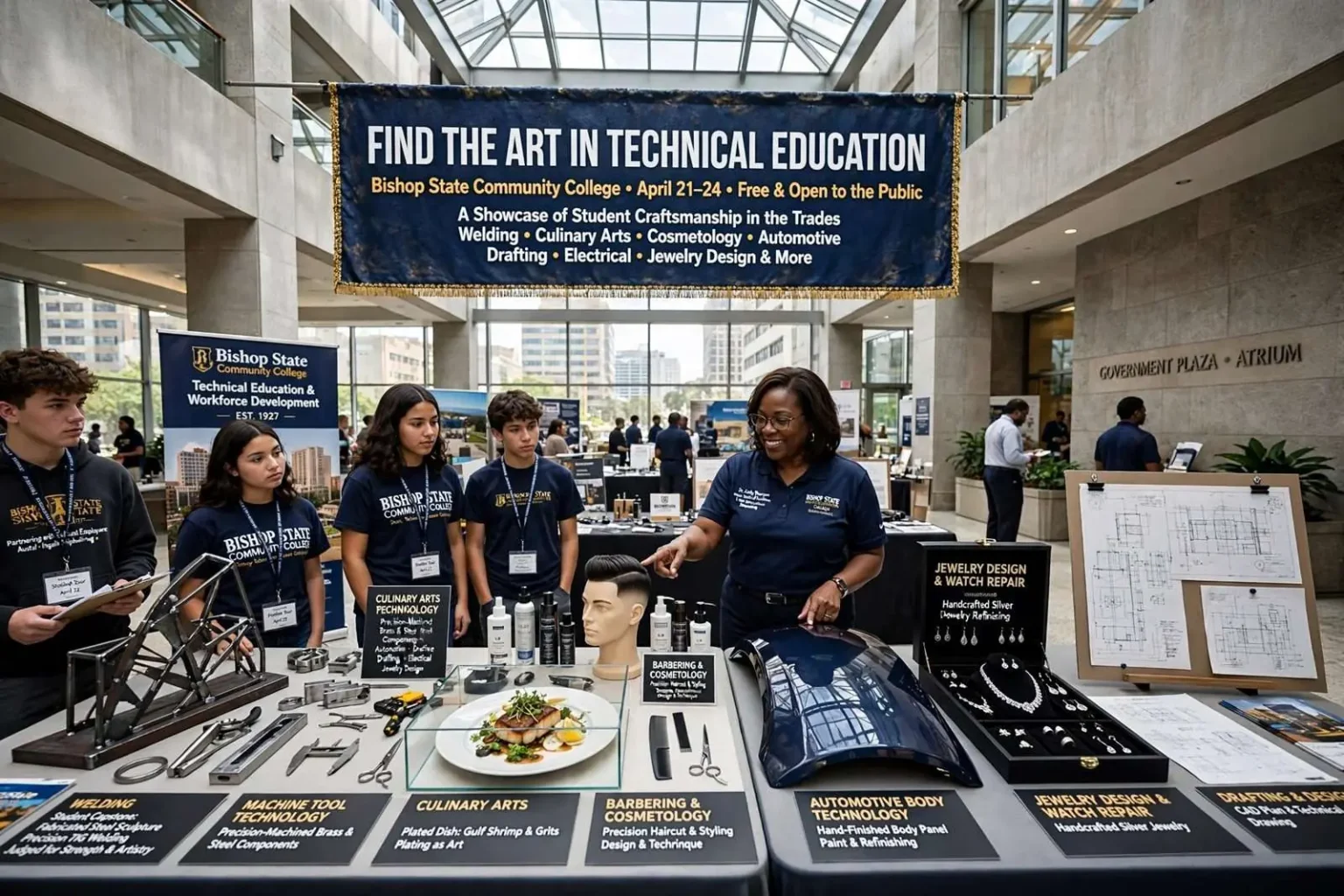
Bishop State Community College is preparing to showcase a side of its technical education programs that rarely gets attention: the artistry behind the trades. The college’s first Find the Art in Technical Education event runs April 21 through 24 beneath the Government Plaza atrium in downtown Mobile, transforming the lobby of the city-county building into a gallery of student craftsmanship drawn from classrooms and workshops across the college’s campuses.
The exhibit is designed to highlight the skills and craftsmanship students develop across Bishop State’s various technical education tracks, framing hands-on trade work not just as practical training but as a creative discipline in its own right. Organizers want visitors to see what instructors see every day: that a precision weld, a seamlessly blended hair color, a hand-built automotive body panel or a plated culinary dish involves judgment, design sense and technique that deserve to be looked at as closely as any painting.
The displays will be free and open to the public from Tuesday, April 21, through Thursday, April 23, with students from Mobile and Washington counties specifically scheduled to tour the exhibit on April 22 and 23. School groups visiting Government Plaza will get a guided look at the work, giving middle and high school students from Mobile’s metro area and the rural county to the north a firsthand view of career paths that begin at a community college.
Dr. Kathy Thompson, Bishop State’s dean of technical education and workforce development, said the timing is meant to draw attention to the progress students are making in fields that don’t always get the spotlight compared to traditional academic programs. Technical education, she has argued, is often described only in terms of employment numbers, while the craftsmanship behind the work goes uncelebrated; the exhibit is intended to correct that by putting the finished products on display in one of the busiest public buildings in downtown Mobile.
The choice of venue also reflects the college’s relationship with local government. Bishop State works closely with the city and county on workforce initiatives, and downtown Mobile’s civic buildings have increasingly hosted public exhibitions and events that draw people into the urban core. Scheduling student tours on consecutive weekdays allows the college to bring large groups through without overwhelming the building’s normal traffic, and it gives school administrators a structured field trip option that doubles as career exploration.
A Pipeline to the Gulf’s Biggest Employers
The college has worked to build partnerships with some of the Gulf Coast’s biggest employers, including Austal, Ingalls and VT Mobile Aerospace Engineering, giving students a pipeline into the workforce with hands-on experience already under their belts. Those companies anchor one of the region’s most important industrial clusters: Austal builds ships at its Mobile riverfront yard, Ingalls Shipbuilding operates across the bay in Pascagoula, Miss., and VT Mobile Aerospace Engineering performs heavy aircraft maintenance at the Mobile Aeroplex at Brookley.
The demand for skilled tradespeople across that cluster is well documented. Shipyards and aviation maintenance firms require welders, pipefitters, electricians, machinists and painters in large numbers, and workforce development officials across the two-state region have made expanding the technical training pipeline a priority. Bishop State’s role in that effort places its graduates directly into careers that support families across Mobile and Washington counties without requiring a four-year degree.
Those partnerships also shape what happens inside the classrooms. Advisory boards drawn from industry help the college keep its curriculum aligned with the certifications employers actually require, and equipment donations and apprenticeship arrangements put students on real production work before they graduate. In fields like welding and machine tool technology, a hiring manager’s confidence in a program’s graduates is the truest measure of its quality, and the college’s employer relationships are built on exactly that track record.
This exhibit is meant to spotlight the artistic side of those programs, something Thompson said often gets overlooked entirely. The connection is more than a framing device: modern manufacturing and industrial work demand exacting standards of fit, finish and appearance, and employers in shipbuilding and aviation judge welding and fabrication work not only on strength but on the quality of the bead, the smoothness of a surface and the care evident in the finished product.
Every Program on Display
Each technical program will contribute its own artistic piece or display representing its craft. The result is a floor-to-atrium survey of the college’s technical offerings, assembled by the students and instructors who work in those shops and salons every week.
Programs included in the showcase span automotive technology, automotive body technology, barbering and hair styling, cosmetology, culinary arts, diesel technology, drafting and design technology, electrical technology, electronics engineering technology, graphic communications technology, jewelry design and watch repair, machine tool technology, plumbing, process and maintenance technology, and welding. The breadth of the list illustrates how wide the college’s technical footprint runs — from the garage to the kitchen to the drafting table — and how many distinct skills fall under the technical education banner.
Each discipline approaches the “art” theme from its own angle. Culinary arts students can present dishes where plating and presentation are inseparable from taste; cosmetology and barbering students work in a field whose entire product is appearance; welding and machine tool students can show sculptural metalwork and precisely finished components; and drafting and design students can display the drawings that turn ideas into buildable plans. Graphic communications and jewelry design bridge art and industry most directly of all.
For the students, the exhibit doubles as a professional exercise. Preparing a piece for public display requires finishing work to a standard that will be judged by strangers, a skill employers value, and the scheduled tours bring potential future classmates and customers through the doors.
A Reception to Open the Week
A public reception is scheduled for the opening evening, Tuesday, April 21, running into the evening hours at the Government Plaza atrium. The reception gives college officials, industry partners, elected leaders and families a chance to view the displays together, and it marks the first time Bishop State has staged an event of this kind in the downtown venue.
Holding the event at Government Plaza is itself significant. The atrium serves as the front door of city and county government, and thousands of residents pass through it each week on routine business. Placing student work there signals that the college and its technical programs are part of the region’s public life, and it puts the craftsmanship in front of an audience — officials, jurors, business people — that might never visit a campus shop.
College leaders have framed the week as a celebration as much as an exhibit. Instructors from each program were enlisted to select the pieces, and the display is intended to trace the story of a student’s progress from first-year fundamentals to capstone work ready for an employer’s floor.
Bishop State’s Technical Roots
Bishop State Community College has deep roots in Mobile’s educational landscape. Founded in 1927, the historically black institution grew from a small branch campus into a comprehensive community college serving the Gulf Coast with academic transfer programs, health professions, workforce training and an extensive catalog of technical offerings across multiple campus locations in the city.
Across Alabama, community and technical colleges have been charged with closing the skills gap that employers describe in manufacturing, construction, health care and transportation. State workforce development initiatives have poured resources into new equipment, dual enrollment for high school students and credential programs, and Bishop State has positioned itself as a key partner for the Gulf Coast’s industrial base.
The technical programs in the exhibit feed directly into that mission. Welding graduates from Bishop State have gone to work at the region’s shipyards, automotive technology students staff repair departments across the county, and cosmetology graduates open salons and barbershops in neighborhoods across the city. Each field on display represents a route to a career that can be started close to home, often with credentials earned in two years or less.
The event also arrives amid growing national attention to career and technical education. Policymakers and employers have pushed to expand apprenticeships, industry certifications and community college partnerships, arguing that the perception of the trades as a lesser path has kept capable students from pursuing fields with strong wages and steady demand. An exhibit that frames trade work as art makes that argument in a way a brochure cannot.
What Organizers Hope Comes Next
As the Find the Art in Technical Education exhibit makes its first run, organizers hope it becomes an annual fixture — a recurring reminder that the trades teach not only a living but a craft. For one week in April, the atrium of Government Plaza will hold the evidence: metal, food, hair, drawings and circuitry, all made by students, all judged by the same standard of care that any artist brings to the work.
Visitors who want to learn more about enrolling in any of the showcased programs can speak with college representatives during the exhibit, or contact Bishop State’s admissions office directly. With tours scheduled for students from Mobile and Washington counties, college officials are betting that some of the young people walking past the displays this month will be back — this time in a shop or salon on campus, learning the same crafts for themselves.