
Mobile Mayor Stimpson Unveils Alternative Civic Center Plan Featuring Arena Renovation
Mayor Sandy Stimpson proposes renovating the Mobile Civic Center arena instead of demolishing it, with phased development including Cordish Live! concept.
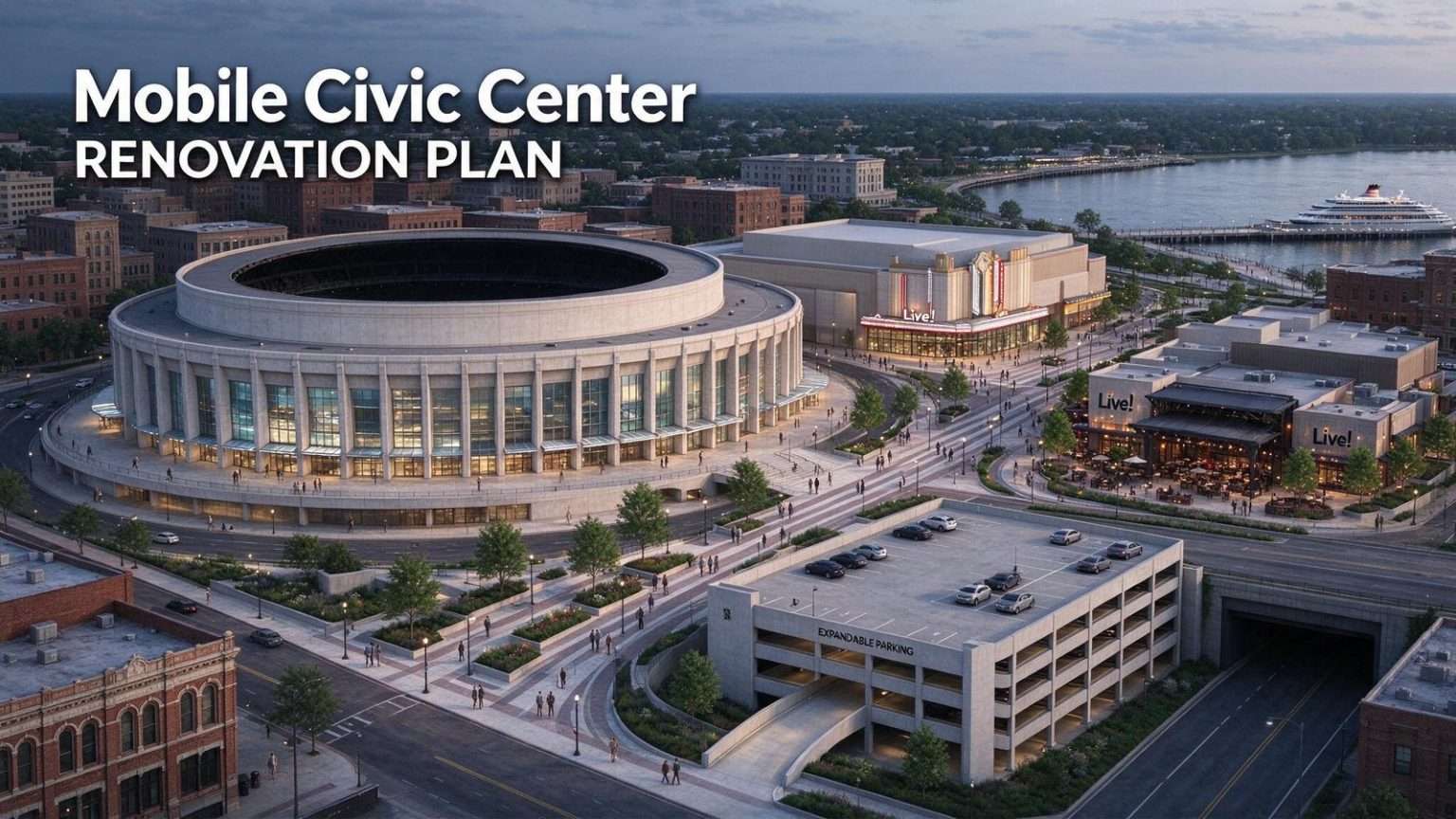
Mayor Sandy Stimpson’s administration has introduced alternative plans for redeveloping the aging Mobile Civic Center site, shifting away from earlier proposals that called for demolishing the decades-old arena in favor of a renovation approach. The mayor’s office presented the new plans Tuesday to members of the Mobile City Council in an executive session, followed by meetings with Church Street East neighborhood residents, Mardi Gras Association leaders and downtown restaurateurs.
The string of private briefings reflected how many constituencies hold a stake in the Civic Center block. The complex hosts Mardi Gras balls each winter, conventions and concerts year-round, and its theater and arena anchor a section of downtown where residential, institutional and commercial interests all converge. Any redevelopment plan touches each of those groups, and the administration spent the days after the council briefing walking stakeholder after stakeholder through the revised concept. The venue has served downtown since the 1960s, and generations of Mobilians have attended graduations, concerts, rodeos and balls under its roof — a history that explains why proposals to demolish the arena drew such a strong public reaction.
Under the revised concept, the arena would be renovated rather than torn down. A smaller section of the property would be made available for Cordish Companies to develop a scaled-down version of its open-air Live! entertainment concept. The plans also include space for possible retail and residential development by a private company.
Parking and connectivity
The proposals call for a parking deck that could be expanded to support passenger parking for a larger or second cruise ship. Stimpson compared the proposed deck to the one currently in use at the Mobile Alabama Cruise Terminal, noting the existing deck should have been built another floor higher. “Let’s not do something that’s going to hamstring us in the future because parking decks can pretty much pay for themselves,” Stimpson said.
The cruise connection is a reminder of how closely downtown’s assets are linked. The Alabama Cruise Terminal sits on the river within sight of the Civic Center site, and city officials have long weighed how downtown parking, hotel capacity and entertainment options affect Mobile’s standing as a cruise homeport. A deck designed with expansion in mind, the mayor argued, protects the city from paying a premium later for capacity it could have built cheaply now.
The plans also envision separating the theatre from the arena and adding a promenade that would connect the Civic Center property to other areas of downtown. The promenade concept aims to knit the block into the surrounding street grid rather than leaving it as an island of parking and venues, an approach urban design advocates have urged for the site through years of public discussion.
Separating the theatre would let the city operate the two venues on independent schedules, so a renovation or closure of the arena would not idle the theater that hosts Broadway tours, symphony performances and community events. Venue operators said the flexibility could keep bookings flowing through a construction period that might otherwise darken the complex for months at a time.
A phased approach
The total cost of the plans has not been determined, Stimpson said, but the work would be completed in phases. The order of the phases would depend heavily on whether Cordish Companies moves forward with its scaled-down Live! concept. If Cordish does not participate, the city would begin with the arena renovation. Cordish has not yet provided the city with information on how much public investment would be needed for its larger Live! concept.
The phasing structure gives the city an exit path from negotiations that have stretched on without a final agreement. Rather than waiting on a single developer to shape the entire site, the administration proposed a plan that can start with public assets — the arena, the deck, the promenade — and fold in private development wherever Cordish or another partner commits. Officials said each phase would be evaluated against the city’s finances as it comes due, so the project does not commit future councils to costs they cannot cover.
City spokesperson George Talbot said the city expected to contribute the 22-acre parcel as the largest portion of its investment in any deal with Cordish. The land, one of the largest single development sites left in downtown Mobile, carries substantial value on its own, and officials have treated it as the city’s principal bargaining chip in negotiations over how much private capital the project attracts.
The plans also account for potential changes if the Alabama Department of Transportation rearranges how drivers enter the Wallace Tunnel, which could open up additional land for hotels or other structures to support tourism. The tunnel, which carries Interstate 10 beneath the Mobile River, sits at the heart of the downtown street network, and any realignment of its approaches would free parcels that are now consumed by highway ramps and surface roads.
Planners have long identified the land around the tunnel approaches as a potential redevelopment zone, and hotel developers in particular have circled downtown sites near the waterfront. If ALDOT’s reconfiguration moves forward, the Civic Center plan’s remaining footprint could expand, adding rooms and attractions that support both the convention trade and the cruise terminal a few blocks away.
Four years of debate
The new plan marks the latest turn in more than four years of talks over the Civic Center site’s future. The city has cycled through studies, developer solicitations and competing visions for the block — some centered on a new arena, others on entertainment districts, others on wholesale demolition and rebuild — without reaching a project that cleared the hurdles of cost, financing and public support.
Louisiana-based Stirling Properties recently backed out of the developer competition, leaving Cordish as the sole remaining candidate. Stimpson’s office has faced backlash since neither an arena nor event center was included in the initial Cordish proposals, a gap that drew criticism from residents who use the venues, from Mardi Gras organizations that depend on them and from council members who questioned whether an entertainment district alone could justify the city’s investment.
The alternative plan answers that criticism directly by putting the arena’s renovation first among the public components. By scaling the Live! concept down to a smaller section of the property, the administration’s revised approach also reduces the public subsidy a larger entertainment development would have required, a point the mayor’s office emphasized in its briefings. Council members who reviewed the plan Tuesday said the renovation-first structure would make it easier to explain to constituents why the city is investing at the site — the money buys a working arena before anything else.
For Mardi Gras associations, the stakes in the Civic Center debate are concrete. The complex hosts some of the Carnival season’s largest balls and events, and its arena floor is among the few spaces in downtown capable of holding a full krewe’s tables, staging and crowd. Leaders who attended the briefings said they wanted assurances that whatever happens to the site keeps those events in place — during construction and after — and the administration’s renovation-first approach was designed in part to answer that concern. Association officials said they would review the plans in detail with their own architects and krewe captains before taking a formal position.
Downtown restaurateurs, who packed the later meetings, framed their interest differently: the Civic Center block feeds customers to the surrounding dining district on event nights, and any plan that leaves the venues dark for long stretches would ripple through their revenues. The promenade connecting the site to the rest of downtown was pitched as a long-term benefit, turning the block from a destination visitors enter and leave into a passage that spreads foot traffic toward Bienville Square and the lower Dauphin Street corridor.
Church Street East residents, whose historic neighborhood sits directly adjacent to the site, raised questions about traffic, event noise and the scale of any new construction. The neighborhood association has participated in the Civic Center conversation for years, and its members have consistently pressed for plans that treat the block as part of downtown rather than a stadium district unto itself.
The administration has not committed to a construction timeline, and officials said further council briefings would follow as cost estimates firm up and Cordish’s intentions become clear. What changed this week is the order of priorities: the arena comes first, the developer comes second, and the city’s largest downtown site gets a plan that can move forward even if the private partnership never materializes. After four years of studies and stalled negotiations, that phasing may prove the plan’s most important feature — giving Mobile a Civic Center future that no longer depends on a single developer’s signature.