Karl Denson on Mobile Aerofest, the Military and a Life of Practice
During Mobile Aerofest, saxophonist Karl Denson sat down to talk about his set, which preceded Dumpstaphunk and Robert Randolph on the main stage.
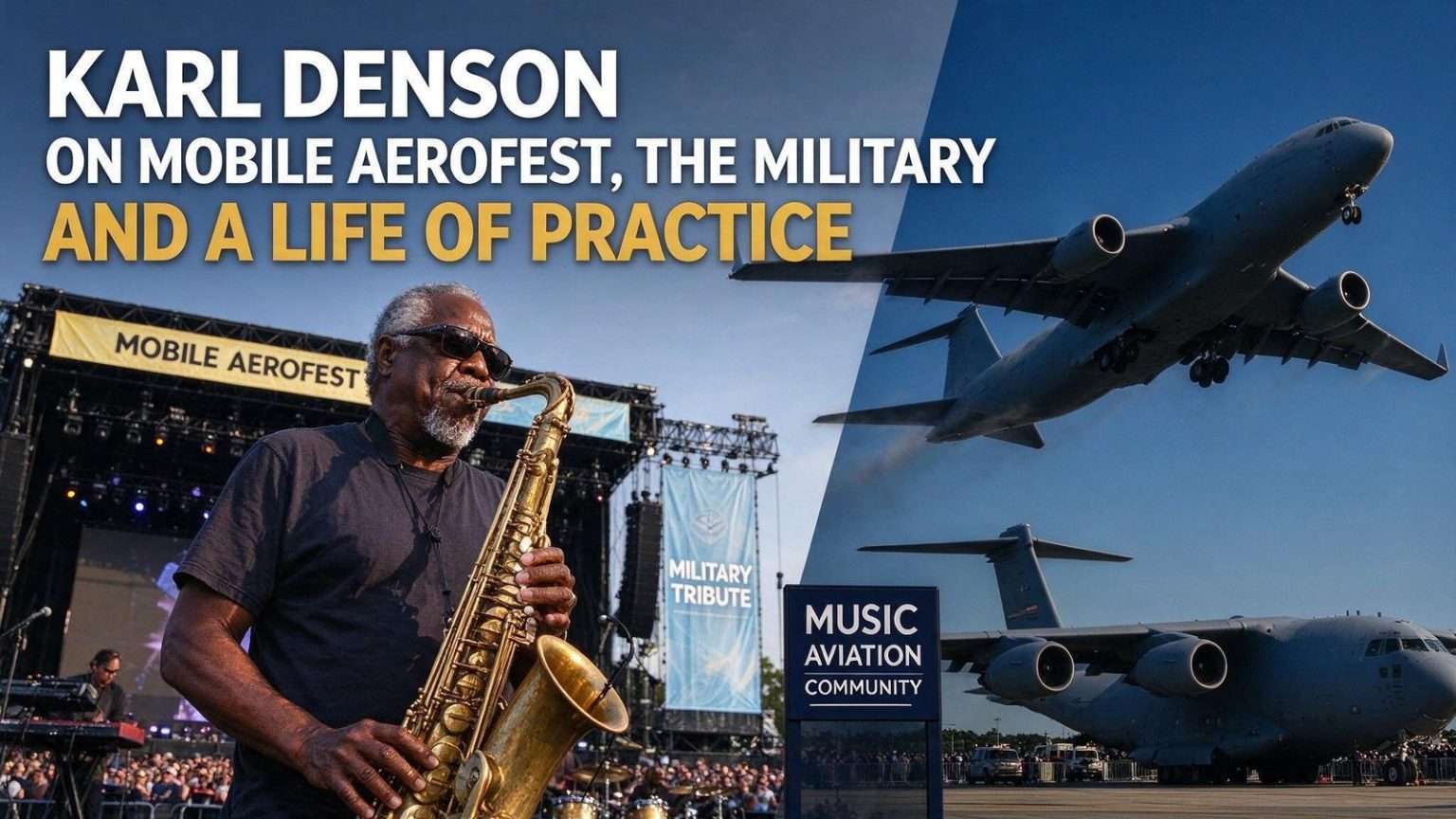
During Mobile Aerofest, saxophonist Karl Denson sat down to talk about his daytime main-stage set, which preceded Dumpstaphunk and Robert Randolph. The slot put Denson’s band in front of an afternoon crowd at a festival that pairs live music with aviation on the Gulf Coast, and the veteran saxophonist treated the conversation the way he treats his set lists — as an exercise in breaking things down to fundamentals. His answers ranged from the hours he puts into his instrument to the reasons the festival’s military mission resonated with him.
A fixture of the festival circuit, Denson’s Tiny Universe has built its reputation on tight musicianship and long, extended sets. The band’s live shows stretch well beyond the brevity of radio-friendly performances, giving arrangements room to breathe and soloists space to work. Audiences who have followed the group across the country know what to expect: grooves that lock in early and songs that unfold across extended solos, with Denson’s saxophone and flute carrying melodies that wander before they return.
Stamina and the Gulf Coast crowd
Asked how he sustains multi-hour performances, Denson pointed to discipline. “When I was in college and beyond I practiced from 8 to 10 hours a day, so doing two hours for a show is not really that much of a challenge,” he said. The remark reframed what audiences experience as ease. What looks like effortless stamina on stage is the residue of thousands of hours in a practice room, a routine that Denson described as having been his ordinary life for years rather than an extraordinary feat reserved for special occasions.
That work ethic has followed him through a career that spans funk, jazz and soul, and through projects well beyond his own band. Denson’s résumé includes work as a founding member of The Greyboy Allstars and years spent playing in Lenny Kravitz’s band, experiences that put him in front of audiences of very different sizes and expectations. The through line, he suggested, is the same regardless of the setting: the music holds up when the practice holds up.
He sees Gulf Coast audiences as no different from crowds anywhere. “People are people everywhere. When the music moves them, they’ll respond in kind,” he said. The observation cuts against the habit musicians sometimes have of tailoring their banter to a region or playing to caricatures of a place. For Denson, an afternoon crowd in Mobile gets the same show that a crowd anywhere else would get, because the connection he is after is universal rather than local.
That universality was on display in the way the festival built its day. Denson’s set occupied the main stage in the afternoon, giving the growing crowd a steady soundtrack while families and aviation fans moved through the grounds. Dumpstaphunk followed with its New Orleans-rooted funk, and Robert Randolph brought his pedal steel guitar later in the lineup, stacking the bill with acts whose live reputations rest on the same kind of extended, high-energy playing that Denson’s band prizes.
An afternoon slot among festival heavyweights
The daytime position on a main stage is its own kind of test. An afternoon audience is a mixture — some listeners arrived specifically for the band, while others wandered in from the aircraft displays and food vendors, deciding on the spot whether the music would hold their attention. Extended jams, the sort that have defined Tiny Universe’s reputation, ask something of that audience. The reward, when it works, is a crowd that stays, and festival slots like this one have historically been where word-of-mouth acts convert casual listeners into ticket buyers for club dates down the road.
The afternoon bill also reflects the way festivals of this size are programmed. Bookers sequence acts so the energy builds toward the evening, and a saxophone-led funk outfit early in the day sets a tone for what follows. For the musicians, meanwhile, the earlier slot means playing in full daylight, in the heat and humidity that the Gulf Coast serves up in every season, to an audience still adjusting to the rhythm of the day. Denson’s answer to the challenge was the one he has repeated for decades: play well, and let the crowd come along.
Honoring the military
Aerofest was created to honor military service members, and Denson was glad to take part. “I am a strong supporter of our military, although I fall squarely on the side of not sending our kids into harms way unnecessarily,” he said. “When we got the offer to play Aerofest, it seemed like a big honor.” The distinction he drew is one that many performers have grappled with over the years: supporting the people who serve, whatever one’s views on the decisions that send them into conflict.
That stance gives the festival’s mission a natural ally. Events that combine air shows and music in Mobile have long drawn veterans, active-duty personnel and their families from across the Gulf Coast, and the music component exists in large part to bring the broader community into the same space. A saxophonist who describes playing the event as an honor, and who is explicit about separating appreciation for service members from questions of policy, offers the kind of straightforward fit that festival organizers look for when they build a bill around a cause.
The setting itself reinforces the theme. With aircraft overhead and military displays around the grounds, the performance becomes part of a larger event rather than a standalone concert, and musicians who play these festivals tend to adjust accordingly — shorter between-song patter, an awareness that families with children are in the audience, and a nod to the occasion that does not require a speech. Denson’s comments suggest he understood the assignment: play the show, honor the purpose, and let the music do the talking.
A life built on practice
For aspiring festival musicians, his advice was simple: “Practice, practice, practice.” Coming from a player who described eight-to-ten-hour practice days in his formative years, the advice carries more weight than the brevity suggests. It is not a slogan but a summary of how he got here — the hours in the woodshed before the festival slots arrived, long before main stages and honorific invitations entered the picture.
The advice also reframes the path for young musicians watching from the crowd. Festival lineups can make a career look like luck or connections, a string of lucky bookings in nice weather. Denson’s account makes the causality run the other way: the stamina to deliver a two-hour set, the repertoire to fill one, and the reputation that gets a band booked for the next one all grow out of daily work that nobody applauds. The audience sees the set; the career was built in the practice room.
It is a message that fits the instrument as much as the musician. The saxophone rewards the patient — tone develops over years, breath control over decades — and players who come up through funk and jazz traditions typically arrive at mastery the long way, through clubs and sideman gigs and hours with records and metronomes. Denson’s generation of players came of age in exactly that environment, long before festival slots offered a shortcut to visibility.
What the festival takes away
For Mobile Aerofest, the interview offered the kind of endorsement that advertising cannot buy: a nationally touring musician describing the invitation as an honor and speaking thoughtfully about the event’s purpose. Festivals on the Gulf Coast compete for attention against larger events in New Orleans and across the Southeast, and the credibility of the artists who show up — and the care with which they talk about the mission afterward — shapes the event’s reputation from year to year.
The pairing of Denson with Dumpstaphunk and Robert Randolph made for a coherent musical argument as well. All three acts trade in groove-forward, improvisation-friendly music rooted in American traditions — funk, soul, gospel and blues — the kind of playing that rewards live performance and translates poorly to recordings. On a festival stage, back to back, the acts give the audience a full day of musicianship built the same way Denson describes his own: on practice, repetition and the accumulated trust of a band that has played together long enough to take risks.
The view from the Gulf Coast
For the local audience, the set was a chance to see a player whose career bridges several worlds at once — the jam-band circuit that Tiny Universe tours, the funk lineage of The Greyboy Allstars, and the mainstream visibility of his years with Lenny Kravitz — without leaving town. Gulf Coast music fans have historically had to travel to New Orleans or Atlanta for lineups of this depth, and events like Aerofest bring a version of that experience to their doorstep, with the added texture of the military tribute that gives the day its framing.
Denson’s afternoon set closed with the same economy he brought to his answers. There was no grand statement about the region or the moment, no attempt to turn the festival into a platform. The summary that emerged from the conversation was simpler: a musician who practiced enormous hours when it was hard, who still treats a two-hour show as the easy part, who respects the audience wherever he finds it, and who saw in a Gulf Coast festival honoring service members an occasion worth showing up for. “Practice, practice, practice,” he told the aspiring musicians in the crowd — four words that double as the story of how he arrived on that stage in the first place.