
Senior Bowl Players Star in First-Ever Mardi Gras-Style Parade in Downtown Mobile
Lamical Perine and Jalen Hurts thrilled downtown Mobile crowds during the first-ever Senior Bowl player Mardi Gras-style kickoff parade.
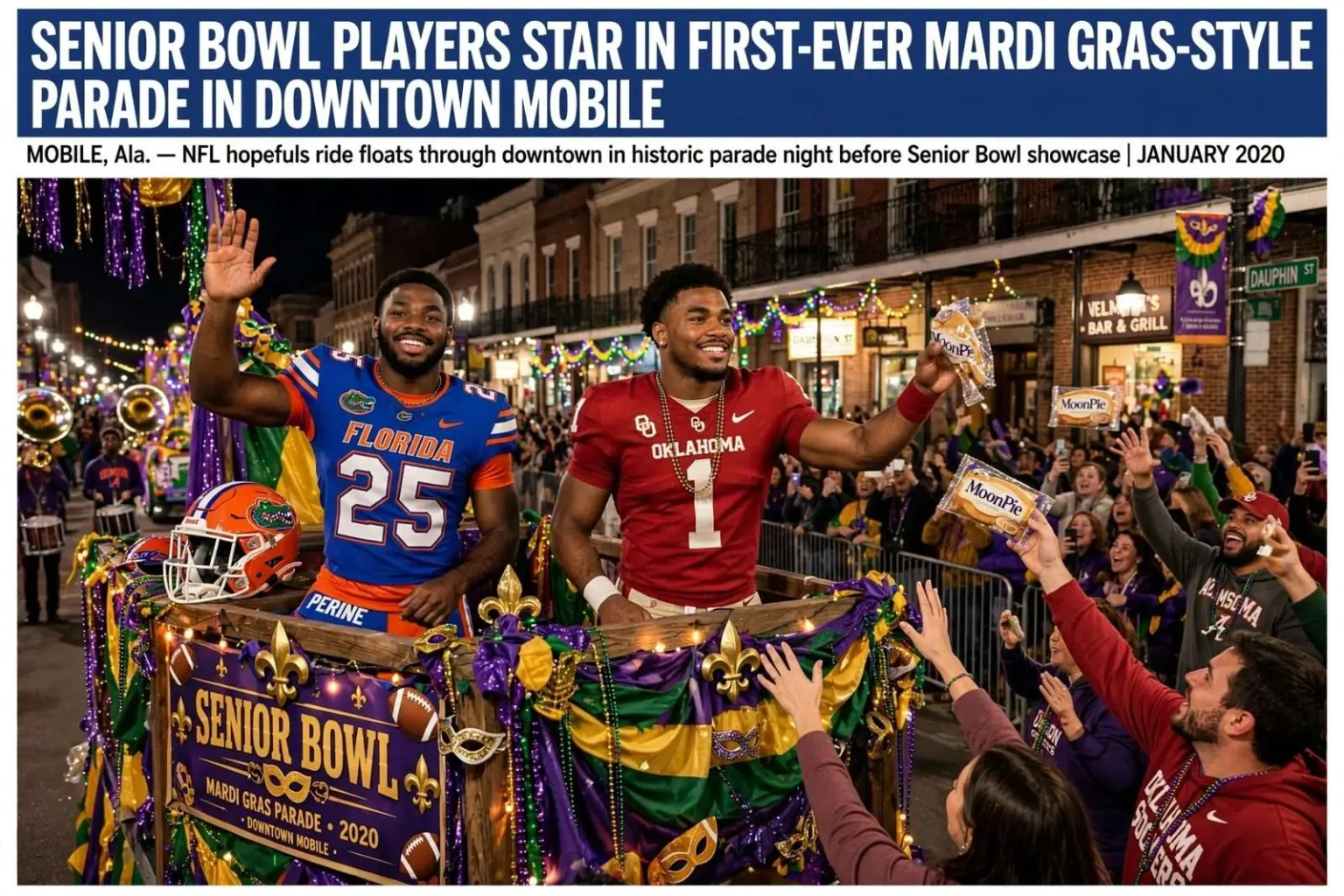
MOBILE, Ala. — Senior Bowl week in Mobile got a new twist in January 2020: for the first time, the game’s star players rolled through downtown in a Mardi Gras-style parade the night before the showcase, drawing an enthusiastic crowd along the route. The event turned a week that usually belongs to scouts and practice reports into a street party, with floats, throws, and some of the best college football players in the country waving from them like born-and-bred Carnival royalty.
The parade route carried the players through the heart of downtown Mobile, where crowds lined the streets for a taste of the season that was just beginning. MoonPies flew, bands played, and NFL hopefuls experienced an initiation that no combine drill offers: learning, in real time, how Mobile does parades. For a city whose Mardi Gras celebration predates New Orleans’s, the pairing felt overdue — the nation’s premier college all-star game, hosted in the Cradle of Mardi Gras, finally borrowing the city’s signature tradition for its own week.
A hometown player in the spotlight
Theodore native and Florida running back Lamical Perine was among the players riding the route, and he said returning home for the week made the moment special. “You know it’s Mardi Gras season, and to be able to do something like this and be back in my community, it’s just so great, honestly,” Perine said. For a player who grew up south of the city, the chance to ride a parade float down the streets he knew — days before beginning his professional career — folded his personal story into the city’s own calendar.
Perine’s presence also gave local fans a player to claim. The Senior Bowl’s roster changes every January, but the connection between the game and the community sharpens whenever a hometown athlete makes the roster, and spectators turned out to cheer a Theodore star on the same streets where he had likely watched Mardi Gras parades as a kid.
Hurts draws the biggest crowds
Oklahoma quarterback Jalen Hurts proved equally popular with fans lining the street. Hurts, the former Alabama star who had finished his college career with a standout season in Norman, carried a dual fan base into Mobile — Oklahoma fans who had watched him lead the Sooners, and the Alabama faithful who had watched him win for the Crimson Tide before transferring. In Mobile, minutes from Tuscaloosa’s orbit, the Tide contingent turned out in force, and no float drew more attention than the one carrying the quarterback.
One parade-goer, Cody Salis, came away with a souvenir tossed from the former Alabama and Oklahoma star himself. “I actually saw Jalen Hurts. I got a MoonPie from him — I caught a MoonPie from his hand,” Salis said. “So basically I caught a pass from Jalen Hurts. It was a good time.” It was the kind of souvenir that only Mobile could produce: a snack tossed from a parade float, delivered by an eventual NFL draft pick, converting a random crowd moment into a story that will be retold for years.
Two traditions, one street
The parade folded Senior Bowl week into Mobile’s Mardi Gras season, blending the city’s two biggest winter traditions as NFL draft prospects mingled with carnival crowds downtown. The timing worked on both ends: by late January, Mardi Gras societies are preparing for the parades that ramp up through February, and the Senior Bowl — the annual all-star game that closes the college football season’s draft runway — was looking for ways to deepen its bond with the city that has hosted it since 1951. The parade answered both needs at once, giving the game a marquee public event and giving the carnival season an early, football-flavored opening act.
The Senior Bowl’s role in Mobile extends well beyond one night. The game draws hundreds of NFL coaches, executives, and scouts to the city each January, filling hotels and restaurants during a season that sits between the holidays and Mardi Gras. Practices at Ladd-Peebles Stadium are open to the public, and the week’s schedule mixes evaluation with community events. Adding a parade gave fans who never attend a practice their own way to see the players — and gave the players a first taste of a football-obsessed Gulf Coast culture that many will return to as professionals, whether with the Saints, the Falcons, the Texans, or any of the NFL teams that scout the region heavily.
Why MoonPies belong to Mobile
The throw that Salis caught was not a random choice of prop. The MoonPie — the marshmallow-and-graham sandwich invented in Chattanooga but adopted by Mobile as its signature Mardi Gras throw — is central to Carnival along the Gulf Coast, where societies order the snacks by the crate for parade season. Mobile’s affection for the MoonPie runs deep enough that the city hosts an annual MoonPie Over Mobile celebration to close the Carnival season, dropping a giant illuminated MoonPie over downtown on Mardi Gras night. A quarterback tossing MoonPies from a float was, in other words, a perfectly native gesture — the rookie move of someone learning the local customs quickly.
The parade’s format borrowed the rest of the Carnival playbook too. Floats, masked and decorated in the style of the mystic societies, carried the players past the same storefronts and balconies that the season’s regular parades pass, and the crowd responded the way Gulf Coast crowds do at any parade: arms up, calls of “throw me something,” and a general willingness of adults to sprint for a packaged snack.
A fitting send-off
For the players, the night before the game is usually quiet — meetings, curfews, and final preparation. The parade gave Senior Bowl week a public celebration at precisely the moment the week’s attention peaked, and it did so in a way that required nothing of the players beyond showing up and waving. The smiles on the floats suggested they took to it naturally; the pageantry of Carnival, after all, is not so different from the pageantry of a college football Saturday, and these were men who had spent their college careers performing for crowds of five figures and more.
When the game kicked off the next afternoon at Ladd-Peebles Stadium, the parade had already done its work: Senior Bowl week in Mobile now had a signature public moment, and the city’s two great winter traditions — football and Mardi Gras — had found the seam between them. Whether the parade became an annual fixture or remained a one-time experiment, its debut in January 2020 gave the city something it had never quite had before: its favorite sport and its favorite season, rolling down the same street on the same night.
The Senior Bowl’s place in the city
The Senior Bowl has been part of Mobile’s identity since the early 1950s, when the game established itself as the premier college all-star showcase in the country. Every January, the nation’s top senior prospects arrive for a week of practices that function as the first major stop of the NFL draft process, staffed by actual NFL coaching staffs rather than college assistants. For prospects from smaller programs, the week is an audition in front of every decision-maker in professional football; for the city, it is an annual economic and social event that has run longer than most professional franchises have existed.
The parade built on that history by making the week more visible to people who are not scouts. A practice session rewards the trained eye; a parade rewards everyone. Families brought children to see the players up close, casual fans got autographs and throws, and downtown’s bars and restaurants — primed for Carnival crowds a few weeks later — got an unexpected January boost. Civic leaders have long sought ways to bind the game more tightly to the community, and a parade did what civic events do best: it turned an occasion into a memory.
The players’ first Mardi Gras lesson
For the draft prospects, most of whom had never experienced Mobile’s Carnival culture, the parade was an education. Mardi Gras in Mobile is a family and community institution, organized by mystic societies whose parades follow rules and rhythms outsiders learn only by participating. Throwing MoonPies, waving to children on shoulders, rolling slowly past packed sidewalks — it is a skill set, and the players took it up with the enthusiasm of men a week away from learning their professional fates. A few likely filed the experience away for future reference: a meaningful share of NFL rosters, especially in the region, is stocked with players who once rode Senior Bowl floats through downtown Mobile.
The night also showcased the city to a national audience of journalists and scouts in town for the week. Mobile leans on events like the Senior Bowl to tell its story — port city, football town, home of the nation’s original Mardi Gras — and a parade that mixed all three threads into one evening did that storytelling effortlessly. Cameras captured MoonPies arcing toward crowds, brass bands playing past historic storefronts, and Heisman finalists playing Carnival rookie.
Perine, Hurts, and the rest of the class of 2020 rolled through downtown on the eve of the biggest audition of their lives, and Mobile sent them off the way it sends off every season — with music, crowds, throws, and the confidence of a city that has been celebrating on its streets longer than anyone else on the Gulf Coast.


