Bluegrass Night at Callaghan’s: Mobile’s Americana Homecoming Under the Oaks
Eldon Bryson, Delta Reign's Murphys and more gather for Bluegrass Night at Callaghan's, Mobile's beloved Americana venue under the oaks.
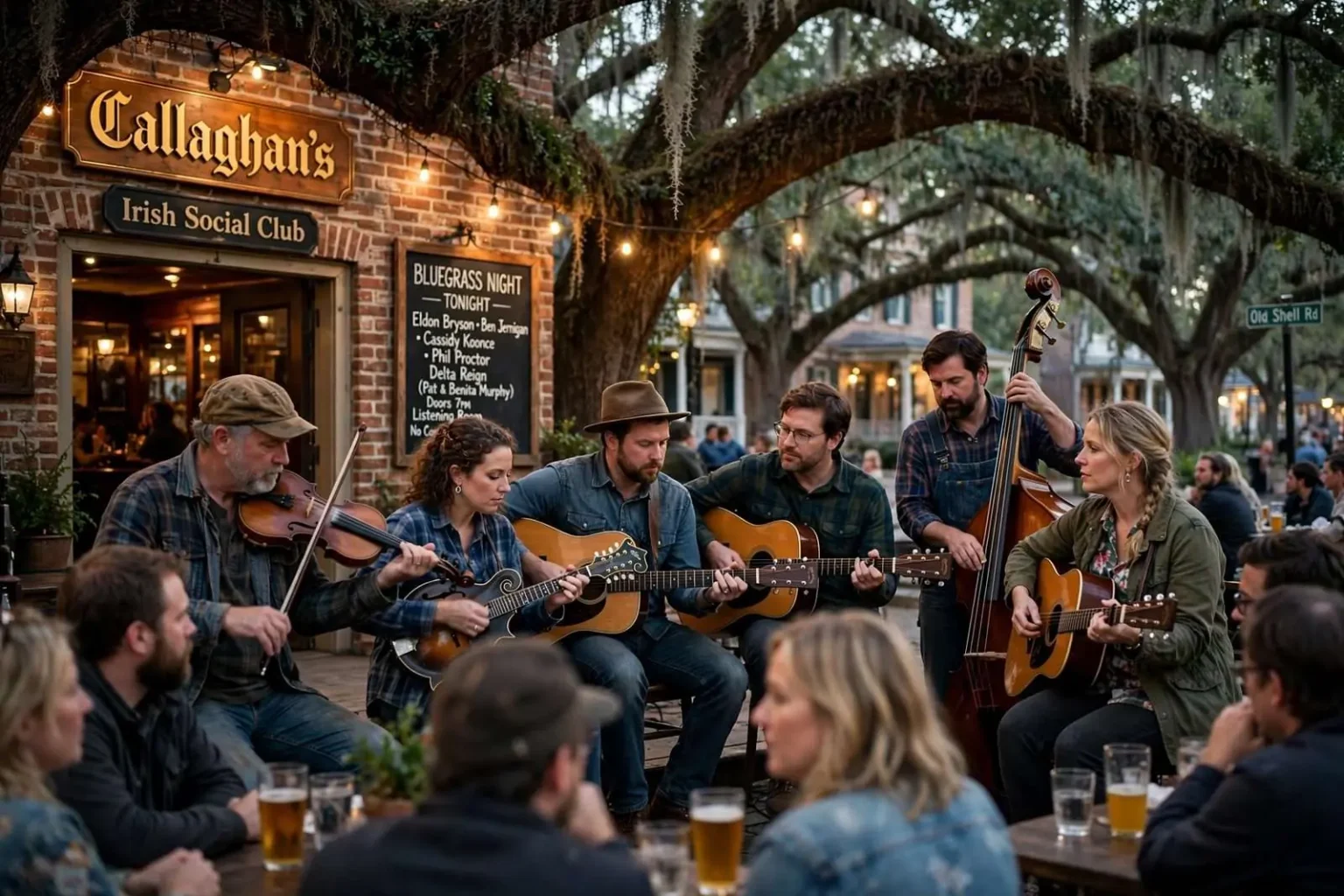
Callaghan’s Irish Social Club has quietly become Mobile’s home for Americana, and on Bluegrass Night the small midtown bar proves why all over again. Tucked beneath the oak canopy of the historic Oakleigh district, the intimate neighborhood bar has grown into a regular stop for nationally touring folk and country acts, and in 2014 its patrons voted it their favorite local venue. On this night, however, the spotlight stays close to home, with a gathering of some of the area’s finest string players sharing one small stage built for close listening.
The setting matters as much as the lineup. The Oakleigh district is one of Mobile’s oldest and most atmospheric neighborhoods, a grid of historic homes shaded by sprawling live oaks that give the area its name and its unmistakable sense of place. Callaghan’s sits along the Old Shell Road corridor, surrounded by the kind of walkable streets that let neighbors arrive on foot and stay for the whole show. Unlike the city’s larger concert rooms, the bar offers no barrier between performers and audience, no reserved seating and no distance from the music.
That intimacy has become Callaghan’s signature. Over the years the venue has built a reputation as a proving ground where touring songwriters and national Americana acts play to crowds of regulars who listen as closely as they cheer. The room has hosted festival warm-up sets, album release celebrations, and weeknight residencies, and its bookers have consistently paired visiting artists with the best of Mobile’s homegrown players. The result is a scene that feels less like a bar calendar and more like a neighborhood institution with national reach.
A master class in strings
Anchoring the night is Eldon Bryson, a genuine master of stringed instruments whose proficiency runs from fiddle to guitar and just about anything else with strings attached. Players of his caliber are rare in rooms this size, and part of the appeal of a night like this is the chance to hear that range up close: the same hands that drive a fiddle tune at breakneck tempo can settle into a guitar ballad with equal authority. For younger musicians in the crowd, watching Bryson work through a set is a free education in arrangement, dynamics and taste.
Joining the circle is award-winning guitarist Ben Jernigan, whose picking has earned recognition well beyond the Gulf Coast. Jernigan brings the kind of technical command that anchors a jam session rather than overwhelming it, and in a round-robin format his ability to follow a vocalist or lift an instrumental break is exactly what the music demands. Alongside him is Cassidy Koonce, another of the area’s accomplished players, adding to the depth of the lineup and the variety of sounds on stage.
Phil Proctor rounds out the core group with a slightly different credential: he is a devoted student of the Americana tradition, ready to lend both his guitar work and his genre knowledge to the mix. That scholar’s ear matters in bluegrass and Americana, where songs carry histories, where a Carter Family number sits beside a contemporary original, and where knowing why a chord progression or a harmony move works is part of the performance. Proctor’s presence signals a night built as much on understanding the music as on playing it.
The pairing of Pat Murphy and Benita Averett Murphy adds yet another dimension. The two are co-creators of what they call the “delta bluegrass” sound and are best known for their work in the band Delta Reign, which has carried that blend of bluegrass instrumentation and Gulf South feeling to audiences across the region. Their involvement ties the evening directly to the broader story of Alabama bluegrass, a tradition that has thrived in the state’s small towns and festival grounds for generations even as it rarely gets the attention commanded by bigger markets.
Why the room still matters
For fans of acoustic music, a lineup like this is a rare concentration of hometown talent, and Callaghan’s is one of the few rooms where it can be heard properly. Bluegrass and old-time music were born in small spaces, kitchens and porches and community halls, where every instrument is audible and every mistake is honest. Amplified arenas flatten those textures; a bar the size of Callaghan’s preserves them. When a fiddle and a mandolin trade breaks three feet from the front row, the audience hears the wood, the strings and the breath behind the notes.
The night also reflects the health of Mobile’s wider Americana ecosystem. The city sits within easy driving distance of New Orleans, Pensacola and the Florida Panhandle, which allows local acts to build regional tours without leaving the Gulf Coast, and events like the SouthSounds festival have given emerging Mobile artists a showcase and an audience. Venues such as Callaghan’s supply the year-round infrastructure those festival moments depend on, providing stage time, paying crowds and a base of loyal listeners who will follow a band from one room to the next.
There is an economic side to that role as well. Small independent venues circulate money through their neighborhoods, hiring local staff, buying from local suppliers and giving touring acts a reason to route through the city. When patrons vote a spot like Callaghan’s their favorite venue, they are affirming a business model that has grown harder to sustain elsewhere: a room that pays attention to booking as carefully as to burgers and beer, and that treats live music as the core of its identity rather than an accessory.
For the musicians, meanwhile, the value of a hometown night is different from a tour stop. Playing to neighbors who have watched a band grow, in a room where the sound carries without a fight, lets players test new arrangements and sharpen their material. Several of the performers on the bill have spent years in regional bands and festival circuits, and a Bluegrass Night appearance lets them convene, trade songs and remind the city what its own scene can produce when the calendar allows it.
Bluegrass itself has deep roots in Alabama, carried through the state by radio, record swaps and family traditions, and sustained today by fiddle contests, bluegrass associations and campground jams from the Tennessee Valley to the Gulf. Mobile’s distance from the style’s Appalachian heartland has never stopped local players from embracing it, and the “delta bluegrass” label that the Murphys use is itself a statement that coastal Alabama puts its own accent on the music. Nights like this one are how that accent gets passed along, from veteran pickers to the students and hobbyists lingering near the stage.
As the evening goes on, the format tends to blur the line between set list and jam session, with players rotating through leads and harmonies in the relaxed way that only familiar musicians can manage. For the price of a night out, listeners get something no recording can deliver: the small adjustments, the eye contact and the spontaneous choices that make live acoustic music feel like a conversation. It is one more reason Callaghan’s remains the beating heart of Mobile’s Americana scene, and a reminder that the city’s most important music often happens in its smallest rooms.
The audience itself is part of the equation. Callaghan’s regulars have spent years learning how to listen, holding their conversations between songs and rewarding solos with the kind of attention musicians remember. That culture did not happen by accident. It grew out of the bar’s long-running commitment to booking acts that reward attention, from singer-songwriters to full bands, and out of a neighborhood that treats the venue as an extension of its living rooms. Younger crowds coming out for the first time tend to absorb the etiquette quickly, which is part of how a listening-room tradition sustains itself across generations of patrons and players alike.
The instrument list alone tells the story of the genre. Fiddle, guitar, mandolin, banjo and upright bass each carry a distinct role in a bluegrass ensemble, and a night built around players who double on multiple instruments gives the audience a running lesson in how the parts fit together. Bryson’s ability to move between instruments mid-set is the kind of skill that crowds do not forget, and it reflects a lifetime of woodshedding in the informal way Gulf Coast musicians have always learned: by ear, by night, and by playing alongside whoever was better than they were.
Regional audiences have also become more adventurous in what they expect from a night of roots music. The lines between bluegrass, folk, country and singer-songwriter Americana have always been porous, and venues that book across those lines, as Callaghan’s does, give listeners a broader picture of the tradition than a single-genre night would. A Delta Reign song may sit beside a standard, an original or a reworked pop tune, and the through-line is the acoustic instrumentation and the emphasis on harmony. That openness has kept the format fresh for longtime fans while remaining approachable for first-timers.
The neighborhood setting completes the draw. A night out in the Oakleigh district carries its own pleasures, from the historic architecture to the short walk between venues, and Callaghan’s has long functioned as the anchor for that scene. Neighbors meet before the show, and the bar fills with the easy hum of a community catching up before the first chord lands. In an era when much of the music business is streamed and scattered, a full room gathered around a handful of acoustic instruments remains one of the simplest and most durable pleasures a city can offer, and Mobile has it year-round.
By the time the last set winds down, the evening has done what nights like this always do: it has restated the case for local music. The players on stage are the same ones who teach lessons, repair instruments and lead jams around the region, and the money spent at the door and the bar goes back into that same ecosystem. For anyone who wonders whether a city of Mobile’s size can sustain a genuine roots-music scene, one evening beneath the oaks answers the question, one song at a time.