Jury Convicts Two in 2013 Fatal Shooting of Coast Guardsman in Mobile
A Mobile County jury found two people guilty of felony murder in the 2013 shooting death of a U.S. Coast Guardsman outside a Mobile-area motel.
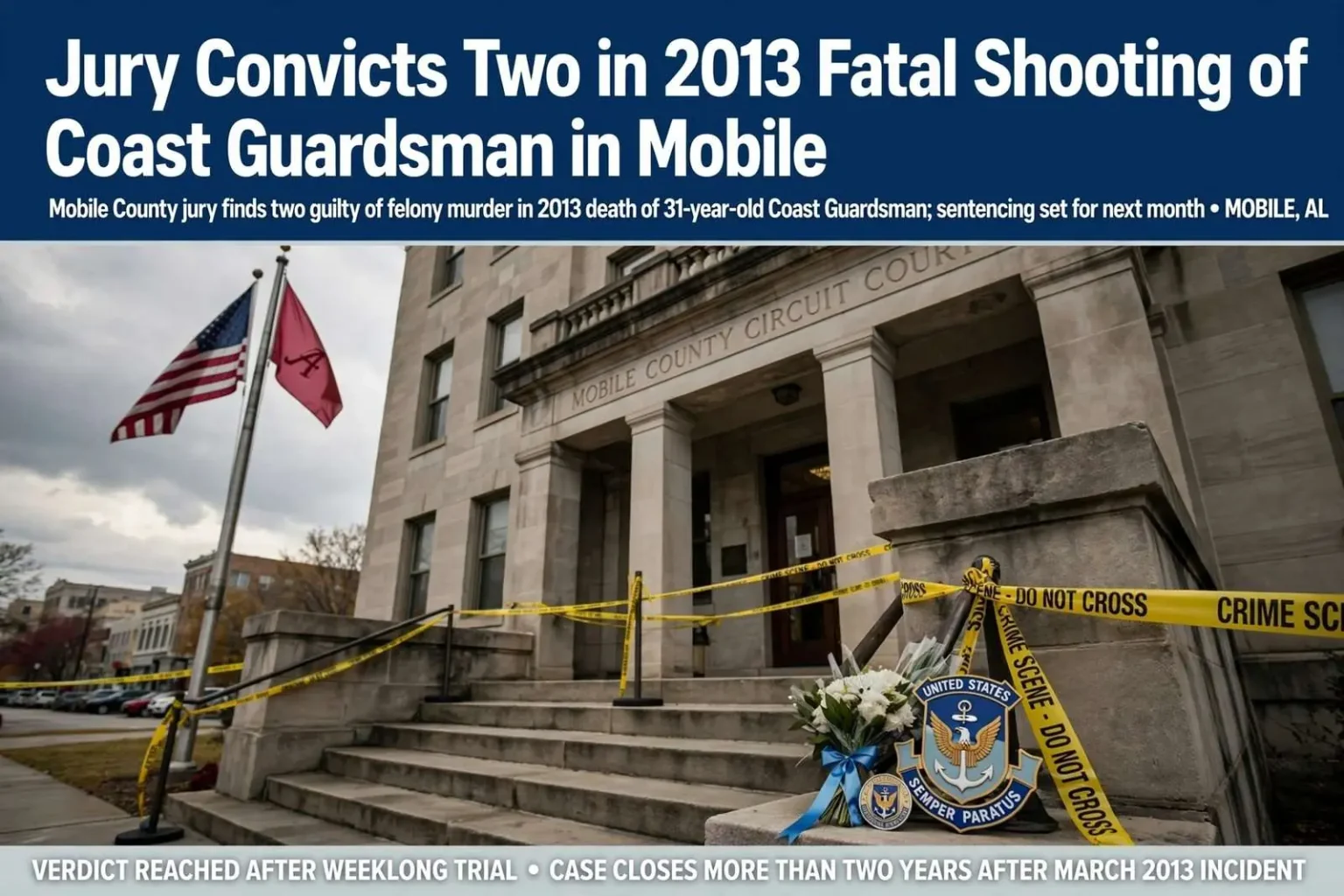
A Mobile County jury has convicted two people of felony murder in connection with the March 2013 shooting death of a 31-year-old U.S. Coast Guardsman outside a Mobile motel, closing out a case that drew close attention from local prosecutors and residents alike. The verdict, returned after a week of testimony in Mobile County Circuit Court, resolved a prosecution that had stretched more than two years from the night of the killing to the moment the jury’s findings were read in open court. Both defendants now face a sentencing hearing scheduled for the following month.
The victim was stationed in the Mobile area, part of the substantial Coast Guard presence that calls the port city home. Mobile hosts Coast Guard units that support maritime safety and security across the north-central Gulf Coast, and the loss of an active-duty member stationed there resonated well beyond the courthouse. According to testimony presented during the trial, the encounter that ended his life began after he met one of the defendants, who had arranged the meeting through an online advertisement. Others joined the encounter, and the group eventually walked out to the Guardsman’s vehicle in the parking lot of a motel off Interstate 65.
Prosecutors told the jury that a dispute over money escalated quickly once the group reached the vehicle. A struggle broke out, and a firearm belonging to one of the defendants fell to the ground. In the moments that followed, the Guardsman was fatally shot. One of the defendants was also wounded during the struggle before both fled the scene, leaving behind the parking lot where the altercation had played out and a colleague whose life could not be saved.
Surveillance video from the motel, shown to jurors during the trial, captured part of the altercation. That footage became a central piece of the state’s evidence, anchoring testimony about how the confrontation unfolded and giving jurors a visual record to weigh against the very different accounts offered by the defense. Prosecutors used the recording as they walked the jury through their theory of how an arranged meeting spiraled into a deadly struggle over money.
Flight and Capture
According to prosecutors, the pair drove first to Pensacola, Florida, where one sought treatment at a hospital under a false name for the wound suffered in the struggle. From there they continued on to Georgia, putting distance between themselves and the Gulf Coast while investigators in Mobile began piecing together what had happened in the motel parking lot. The flight did not last. The two were later apprehended and returned to Mobile County to face charges, a process that required coordination between Alabama investigators and law enforcement authorities in the states where they resurfaced.
Their return set the stage for the prosecution that has now concluded. In the years between the shooting and the trial, Mobile County investigators worked to preserve evidence, interview witnesses and document the events of that night, building a case that could be presented to a jury more than two years after the crime. The week-long trial reflected that preparation, with the state calling witnesses who walked jurors through the arrangement that brought the victim to the motel, the dispute that turned violent and the medical evidence from the scene.
Closing Arguments Frame Two Very Different Stories
During closing arguments, the Mobile County District Attorney’s office urged jurors to reject any suggestion that the victim’s decisions that night justified what happened to him. Prosecutors argued that whatever choices preceded the encounter, they did not excuse a deadly struggle that ended with a Coast Guardsman dead in a motel parking lot. The state’s message to the jury was direct: the man who went to the motel that night did not deserve to die for it, and the law does not require a victim to have lived flawlessly for his killer to be held accountable.
Defense attorneys for both defendants offered a different account of the confrontation, arguing that the Guardsman had been the aggressor inside the motel room before the situation spilled into the parking lot. That theory asked jurors to see the defendants as participants in a fight that escalated rather than as instigators of a fatal attack. It was an argument aimed at softening the picture of the defendants’ conduct and shifting responsibility for the outbreak of violence onto the man who died.
The jury rejected that framing. After deliberating on the evidence, jurors found both defendants guilty of felony murder. Under Alabama law, felony murder does not require proof that a defendant intended to kill; it applies when a death occurs during the commission or attempted commission of certain other felonies. That is why the dispute over money and the surrounding conduct mattered so much to the state’s case, and why the defense worked so hard to characterize what happened as something other than a robbery or felony gone wrong.
Felony murder is charged as a Class A felony in Alabama, the most serious category on the state’s penal code, and a conviction carries the possibility of a lengthy prison term. The verdict means both defendants will return to the same courthouse where they were tried for a sentencing hearing, where a circuit judge will weigh the circumstances of the crime, the defendants’ histories and statements from those affected before imposing sentences that could keep them in prison for decades.
What Comes Next
The sentencing hearing scheduled for the following month will close the final chapter of a case that began on a March night in 2013. Sentencing hearings in Mobile County Circuit Court give prosecutors the opportunity to present evidence of aggravating circumstances and give defense attorneys the chance to present mitigating factors, from the defendants’ backgrounds to their roles in the events. Victims’ family members are also permitted to address the court, and in a case involving an active-duty service member, the Coast Guard community that the victim belonged to will be watching closely.
For the family of the victim, the verdict brings a measure of resolution after more than two years of waiting. The case moved from a mysterious death at a roadside motel, through a two-state manhunt, to a conviction that assigns legal responsibility for the killing. What remains is the sentencing, where the consequences will be fixed and the family will finally hear the court’s judgment on the two people found responsible for the Guardsman’s death.
A Case That Gripped Mobile
The case drew significant attention in Mobile, both for the circumstances surrounding the victim and for the way the killing unfolded. The victim was not a stranger to the community but a stationed service member, and the setting — a motel along the Interstate 65 corridor, a stretch lined with lodging that serves travelers moving between Mobile and Pensacola — struck a familiar chord with local residents. The revelation that the encounter had been arranged through an online advertisement added another layer of public interest, prompting discussion about the risks of meeting strangers arranged through internet listings.
Law enforcement officials across the Gulf Coast have long cautioned about transactions and meetings arranged online, particularly those involving money, which can attract people intent on theft or worse. The facts presented in this trial — a dispute over money, a struggle, a fatal shooting and a flight across state lines — tracked the pattern that investigators warn about when they urge people to meet in public, well-lit places and to avoid carrying large amounts of cash to arranged encounters. Prosecutors acknowledged the victim’s choices that night but insisted those choices were not the crime; the violence was.
The Coast Guard Community in Mobile
Mobile occupies an important place in the Coast Guard’s Gulf Coast operations, supporting the maritime traffic that moves through the Port of Mobile and the waters of Mobile Bay. Service members assigned to the area are part of a tight-knit community of active-duty personnel, reservists and civilians who work together on search and rescue, port security and marine safety missions. The death of one of their own in a motel parking lot, in a case that took more than two years to reach a verdict, was felt throughout that community and among the veterans’ organizations that support Gulf Coast service members and their families.
For now, the courthouse record shows the outcome: two felony murder convictions returned by a Mobile County jury after a week of evidence, and a sentencing hearing ahead. The case stands as a reminder of how quickly an arranged meeting can turn deadly, how far investigators will pursue suspects who flee across state lines, and how the Alabama court system ultimately brought accountability for the death of a Coast Guardsman who served in the city where the case was tried.