University of South Alabama Mobile
Second Gulf Coast Commercial Real Estate Summit Convenes in Downtown Mobile
The second annual Gulf Coast Commercial Real Estate Summit and Market Review was held at the Arthur R. Outlaw Convention Center, organized by University of South Alabama professor Don Epley.
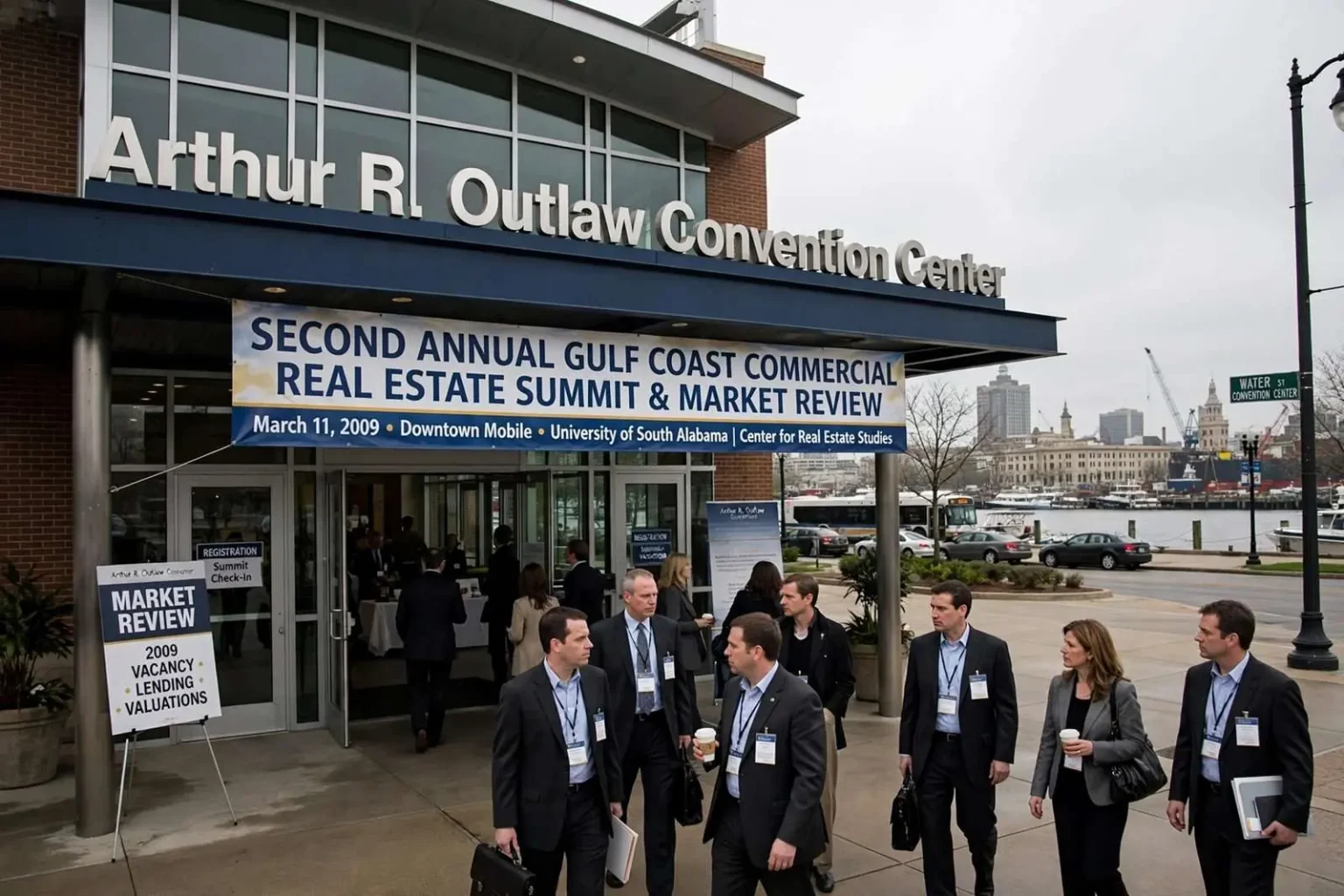
The second annual Gulf Coast Commercial Real Estate Summit and Market Review convened on Wednesday, March 11, 2009, at the Arthur R. Outlaw Convention Center in downtown Mobile — and few gatherings that year could have been better timed or more uncomfortable.
The summit was organized by Dr. Don Epley, a real estate professor at the University of South Alabama and a member of the Sunrise Rotary Club of Mobile. Registration materials and the summit brochure were distributed through the university’s Center for Real Estate Studies.
Epley had built the event into the region’s standing appointment for taking the market’s temperature — a format that paired academic analysis of data with the practical judgments of the people whose money and livelihoods were actually in the buildings. The second year of anything is a test of whether the first was a novelty; arriving in the worst commercial real estate climate in a generation, the summit had become something closer to a necessity.
Meeting at the Bottom
To hold a commercial real estate market review in March 2009 was to convene a room full of people looking at the same set of very bad numbers.
The credit markets had seized the previous autumn. Commercial lending had contracted sharply. Nationally, values were falling, transaction volume had collapsed, and developers who had projects in the ground were discovering how quickly a construction loan can become the central problem of a business.
The sequence had been brutal to watch from inside the industry. Through the middle of the decade, capital for commercial projects had been cheap and abundant, and Gulf Coast markets had absorbed it eagerly. Then the financial crisis cut off the securitized lending channels that had fed much of the boom, banks began hoarding capital, and projects that penciled out in 2006 could not find financing at any price by early 2009. A developer holding land, permits and drawings could be entirely sound on paper and entirely unable to move, because the market for the debt itself had disappeared.
The Gulf Coast had its own version of the story. The condominium boom along the Alabama beaches had already turned, and the region’s commercial market — office, retail, industrial — was absorbing the consequences of a housing correction that had begun well before the broader financial crisis arrived.
Coastal Alabama had, in a sense, experienced the crash early. The high-rise condominium market along the Gulf beaches had peaked years before Lehman Brothers failed, leaving a residue of finished units, stalled projects and distressed inventory that the broader region had already been digesting when the national crisis arrived to finish the job. By March 2009, the question was no longer whether the market would correct but how deep it had gone and how much further the bottom sat.
A market review, in that setting, is not an academic exercise. It is the moment when a region’s brokers, lenders, appraisers and developers sit in one room and agree on what things are actually worth.
Why the University’s Role Mattered
The summit’s home at the University of South Alabama’s Center for Real Estate Studies gave it a particular usefulness.
Commercial real estate data is notoriously fragmented, especially in mid-sized markets. Brokers hold their own numbers. Lenders hold theirs.
In the absence of a neutral party willing to assemble the picture, a region can operate for years on impressions rather than measurements — which is precisely how markets talk themselves into booms and then fail to notice when the boom has ended.
A university-based center, publishing a market review that everyone can argue with, supplies a common set of facts. In a year when nobody wanted to be the first to mark down a valuation, that function had unusual value.
The impartiality was the point. A broker publishing a market survey has an incentive to shade the numbers toward a story that generates business — optimism in good times, reassurance in bad. A lender’s view of values is shaped by its own loan book. A university center with no transactions to close is one of the few parties in the room whose published numbers carry no commission, and in a downturn the discipline of being publicly wrong — of putting a vacancy rate or a price index in print that colleagues can check against their own experience — forces a rigor the industry rarely applies to itself. Epley’s academic positioning made him a rare figure who could stand in front of the region’s most invested players and tell them what the data said.
A Downtown Venue With Its Own History
The choice of the Arthur R. Outlaw Convention Center was fitting.
The center sits on the Mobile River at the edge of downtown, and it stands as one of the more visible products of the city’s long effort to reinvest in its urban core.
Holding a commercial real estate summit there placed the discussion squarely within the thing being discussed. The participants could look out at a waterfront that the previous decade’s optimism had reshaped, and assess how much of that optimism the new decade would sustain.
That was not a subtle metaphor. Mobile’s downtown renaissance — the convention center itself, the restored historic blocks, the entertainment district ambitions, the waterfront investments — had been the city’s flagship commercial real estate story for two decades, built on exactly the kind of public-private confidence that a credit freeze puts to the test. Every developer in the room had a project or a client tied to that trajectory. Reviewing the market in the building that anchored the strategy meant confronting, in one view, both what the investment had achieved and how vulnerable it remained to a national economy in free fall.
The Questions in the Room
Nobody attending a market review in the spring of 2009 expected good news.
What they came for was calibration — how far values had fallen, how long lending would remain tight, which sectors would recover first, and whether the Gulf Coast’s particular mix of port activity, tourism, shipbuilding and the still-unresolved Air Force tanker prospect would cushion the region or expose it.
Each of those sectors carried its own implications for real estate. Port activity — container volume, bulk cargo, the terminal expansions then underway on the river — drove demand for warehouse and industrial space. Tourism supported the coastal hospitality and retail inventory, already bruised by the condo correction. Shipbuilding anchored a steady industrial workforce along the bay. And the Air Force tanker contract — the prize Mobile had pursued for years, whose award and re-award had whipsawed the region’s expectations — represented the single largest potential economic infusion in the region’s modern history, with the housing, retail and industrial demand to follow it. A region with those engines could reasonably believe its floor was higher than the national floor; a region still waiting on the tanker’s final answer had to plan for both outcomes at once.
Those were the questions Epley’s summit existed to put on the table.
Calibration as a Discipline
The answers, in March 2009, were not yet available to anyone. But the discipline of gathering the region’s real estate professionals to look honestly at the numbers, rather than at their hopes, was itself a form of progress.
Markets recover unevenly, and the first out of a downturn are usually those who priced reality earliest. A lender who marked a collateral portfolio down in 2009 could lend again in 2011; one who waited for values to return spent those years frozen. The same logic applied regionally: a market that agreed on how bad things were could plan — repositioning properties, renegotiating leases, assembling land quietly at the bottom — while a market that clung to peak valuations simply stopped transacting. That was the practical case for a summit held at the bottom: it compressed the period of denial that traditionally stretches the pain of a real estate collapse across a decade.
For the University of South Alabama, the event also marked a long-term investment in the region’s professional infrastructure. A real estate program with a research center and a flagship annual review gave the Gulf Coast something mid-sized markets rarely have: a homegrown analytical base, trained graduates for the industry, and a standing forum where the region’s data got compiled regardless of the cycle. Epley’s role — professor, Rotary member, summit organizer — tied the academic and business communities together in a way that persisted well beyond any single market year.
What the Second Summit Signaled
That the summit returned for a second year, in that particular March, said something durable about the region. Conferences are easy to hold in boom years; attendance is a marketing expense. Holding one when every attendee has lost value — when the honest answer to “how is the market” is a number nobody wants to hear — requires a professional community that has decided it needs the truth more than the comfort.
The format itself reflected that seriousness. A market review is backward-looking by design — what happened to vacancy, to rents, to prices — but its purpose is forward-looking: giving brokers a defensible basis for a listing price, lenders a rationale for a workout, appraisers a comparable set that reflects the market as it is. In a frozen market, the absence of sales makes valuation harder precisely when it matters most, which is why the assembled expertise in that convention center ballroom was doing work that would echo through the region’s transactions for years afterward.
History has largely vindicated the instinct. The Gulf Coast’s commercial market did find its floor, the tanker question did resolve — eventually — in Mobile’s favor, the port kept expanding, and downtown Mobile’s reinvestment continued in fits and starts across the following decade. The professionals who calibrated to the bottom in March 2009 were the ones positioned to participate in the recovery. The summit, uncomfortable as its timing was, had put them in a room together to start that process — which is exactly what a university-based market review exists to do.