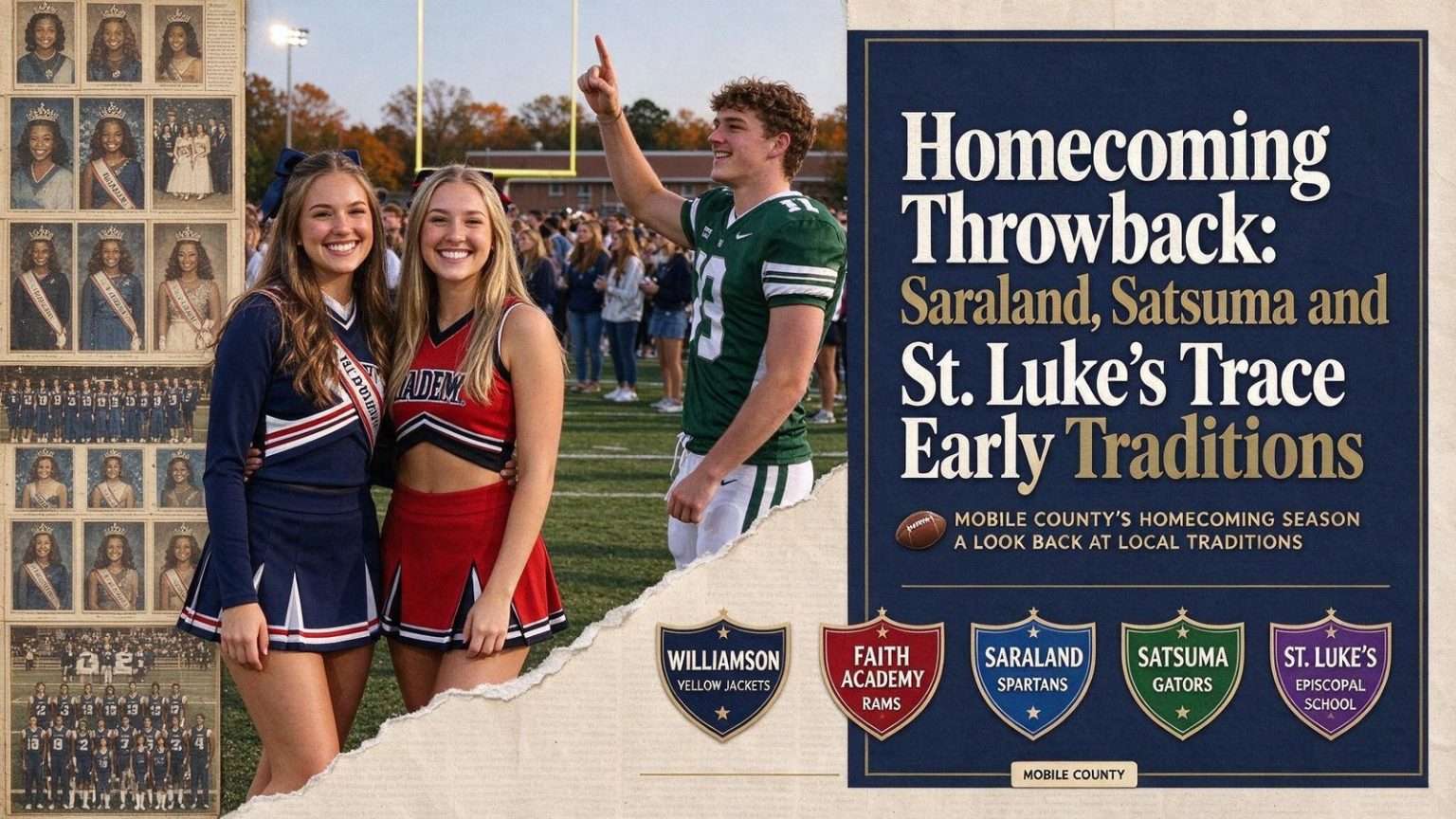
Mobile County’s homecoming season kicked into gear this week as five area schools, Williamson High School, Faith Academy, Saraland High School, Satsuma High School and St. Luke’s Episcopal School, each marked the tradition in their own way, drawing on decades of yearbooks and alumni memories along the way.
Homecoming itself has murky origins nationally, with Baylor, Illinois and Missouri all laying claim to holding the first celebration, but in Mobile County the tradition has taken on distinct local flavor at each campus. This year marks Saraland High School’s sixth year celebrating homecoming as a standalone school, a relatively young tradition compared to some of its neighbors.
St. Luke’s Episcopal School’s homecoming history is similarly recent but well documented. The school began celebrating homecoming in 2010, when it was still growing and fielded homecoming maids but had not yet crowned a queen. That changed the following year, when Monique Hawkins became the school’s first homecoming queen; she has remained part of the court every year since 2009. This year, all 12 of the school’s senior girls will take part in the 2014 homecoming court, and the school plans to bus its lower-school students to the upper-school campus so younger children can take part in the pep rally alongside older students.
Faith Academy’s homecoming roots stretch back further, to 1972, though the school was known as Lott Road Christian School before adopting its current name. A gap in the school’s yearbook records between 1981 and 1988 was significant enough that the school eventually published a compendium in 1988 covering those “lost years” of history.
Satsuma High School’s homecoming milestones include a Silver Homecoming celebration in 1981, when the Gators played B.C. Rain and crowned Jill Wiggins as that year’s queen. The school is now trying to track down yearbooks from the 1970s to fill gaps in its own archive, and has asked anyone with old copies to contact the school directly to arrange a donation.
Williamson High School was also invited to take part in this year’s homecoming retrospective, but organizers were unable to collect photographs from the school in time for this feature.
Together, the five schools’ homecoming histories offer a window into how a single autumn tradition has taken root differently across Mobile County, from century-old rivalries to newer campuses still building their own archives one yearbook at a time. Residents with old homecoming photos or memories from any of the five schools are encouraged to reach out to their school’s alumni association to help fill in the gaps still missing from local yearbook history.
Mobile is the county seat of Mobile County in southwest Alabama and the state’s only saltwater port. Situated where the Mobile River meets Mobile Bay near the northern Gulf of Mexico, the city has long served as a commercial and cultural gateway between Alabama and the wider Gulf Coast. Founded in 1702 as Fort Louis de la Louisiane and ruled in turn by France, Britain, and Spain before joining the United States in 1813, Mobile carries a layered heritage distinct from the rest of the state.
Today Mobile anchors a metropolitan area spanning Mobile County and neighboring Baldwin County, and it remains a center for shipping, aerospace, healthcare, and higher education in the region. Its downtown and waterfront have seen sustained revitalization, while historic neighborhoods preserve architecture from its colonial and antebellum past. The city’s identity is shaped as much by its working port and industrial base as by its festivals and food culture, making it a frequent focal point for news about growth and change in southern Alabama.
Education in South Alabama spans public school systems in Mobile and Baldwin counties, a network of private and parochial schools, and institutions of higher learning including the University of South Alabama, Spring Hill College, and community colleges. Public-school governance rests with locally elected boards.
Boards oversee budgets, curricula, and facilities, often amid debates over funding equity and student achievement. The region’s colleges contribute not only to the workforce pipeline but also to healthcare, research, and cultural life, and education policy set in Montgomery frequently shapes what local districts can do.
Schools are also central to community stability. Enrollment trends, facility conditions, and graduation outcomes are watched closely by families and employers alike, making education a persistent focus of public attention and news coverage across the Gulf Coast.
The history of South Alabama is shaped by its position at the crossroads of cultures and waters. Indigenous peoples, including the Muscogee (Creek) and Choctaw, lived in the region for centuries before European colonization by French, British, and Spanish powers.
The cotton economy and the Civil War left deep imprints, as did the Civil Rights Movement, in which Alabama played a defining role. Understanding present-day debates in the region often requires appreciating this layered past, in which port commerce, racial history, and coastal geography have long intertwined.
That inheritance is visible in the architecture, street names, and institutions of the area. Public memory of the past informs contemporary conversations about growth, equity, and identity, and it frequently surfaces in coverage of local events and policy.
Local government in the Mobile area operates through a combination of mayor-council or commission structures at the municipal level and a county commission in Mobile County, with elected officials handling budgets, public safety, infrastructure, and zoning. Baldwin County has its own commission and a collection of incorporated municipalities.
Decisions made in council chambers and commission meetings affect roads, school funding, economic development, and quality of life, which is why coverage of local government is a staple of regional journalism. The interplay between city, county, and state authorities often determines how effectively the area can address shared challenges.
Because many services residents rely on are delivered at the local level, the choices of elected officials have direct, everyday consequences. Budget priorities, in particular, reveal a community’s values and shape the trajectory of growth and public welfare for years to come.
Probate courts in Alabama handle matters distinct from the trial courts that hear criminal and civil cases, including wills, estates, guardianships, and involuntary commitments for mental-health treatment. In Mobile County the probate judge is an elected official with broad administrative and judicial duties.
Cases involving involuntary psychiatric commitment require the court to balance an individual’s liberty interests against concerns for their safety and the safety of others, a sensitive legal threshold that has drawn scrutiny in many jurisdictions. The procedures governing such hearings, including who must appear and testify, are set by state law and local rule.
Disputes over those procedures often surface tensions between healthcare providers, the court, and advocates for patients. Because the stakes involve both liberty and wellbeing, courts and clinicians alike face pressure to honor the law while ensuring that people in crisis receive timely and appropriate care.
Charitable and nonprofit organizations form a vital safety net across South Alabama, addressing needs from hunger and homelessness to disaster relief and holiday assistance. Groups such as The Salvation Army operate local corps that provide shelter, food, and seasonal programs funded largely by community donations.
The generosity of Gulf Coast residents, often mobilized after hurricanes and economic hardship, underscores how tightly knit many of these communities are. Local philanthropy also relies on volunteers and corporate partners, and the progress of fundraising efforts is a recurring subject of regional news because it reflects the community’s capacity to care for its most vulnerable members.
Holiday campaigns in particular reveal the scale of need and the reach of volunteer networks. The rhythm of annual giving, from food drives to toy distributions, is woven into the regional calendar and into the coverage that keeps residents informed about how to help and where support is most needed.
The natural environment is central to life on the Gulf Coast, where barrier islands, bays, rivers, and wetlands support fisheries, recreation, and storm protection. Coastal Alabama faces challenges common to low-lying regions, including hurricane exposure, erosion, and the management of fragile ecosystems.
The Mobile-Tensaw Delta, one of the largest river deltas in the country, is a particularly significant natural asset. Conservation efforts, fisheries regulation, and shoreline restoration are frequent points of collaboration among state agencies, federal bodies like the Army Corps of Engineers, and environmental groups.
How the region plans for growth while protecting its natural assets is a recurring theme in local reporting. The tension between development pressure and ecological stewardship plays out in zoning fights, infrastructure projects, and disaster-recovery decisions that shape the coast for generations.
Baldwin County sits directly east of Mobile County across Mobile Bay and is the largest county in Alabama by land area. It encompasses the Eastern Shore communities of Daphne, Fairhope, Spanish Fort, and Foley and stretches south to the beaches of Gulf Shores and Orange Beach along the Gulf of Mexico.
Long among the fastest-growing counties in the state, Baldwin blends suburban development near the bay with tourism-driven coastal economies. Its proximity to Mobile and its position on the Eastern Shore make it a recurring subject of regional news covering growth, infrastructure, schools, and the balance between development and coastal preservation.